




The Presidency of the Financial Crimes Investigation Board (MASAK) plays a critical role in detecting and preventing financial crimes in Turkey. The agency’s activities are of great importance, particularly in preventing informal economic activities and uncovering serious crimes such as money laundering. However, the impartiality of this oversight mechanism and its adherence to ethical principles are vital to maintaining public trust.
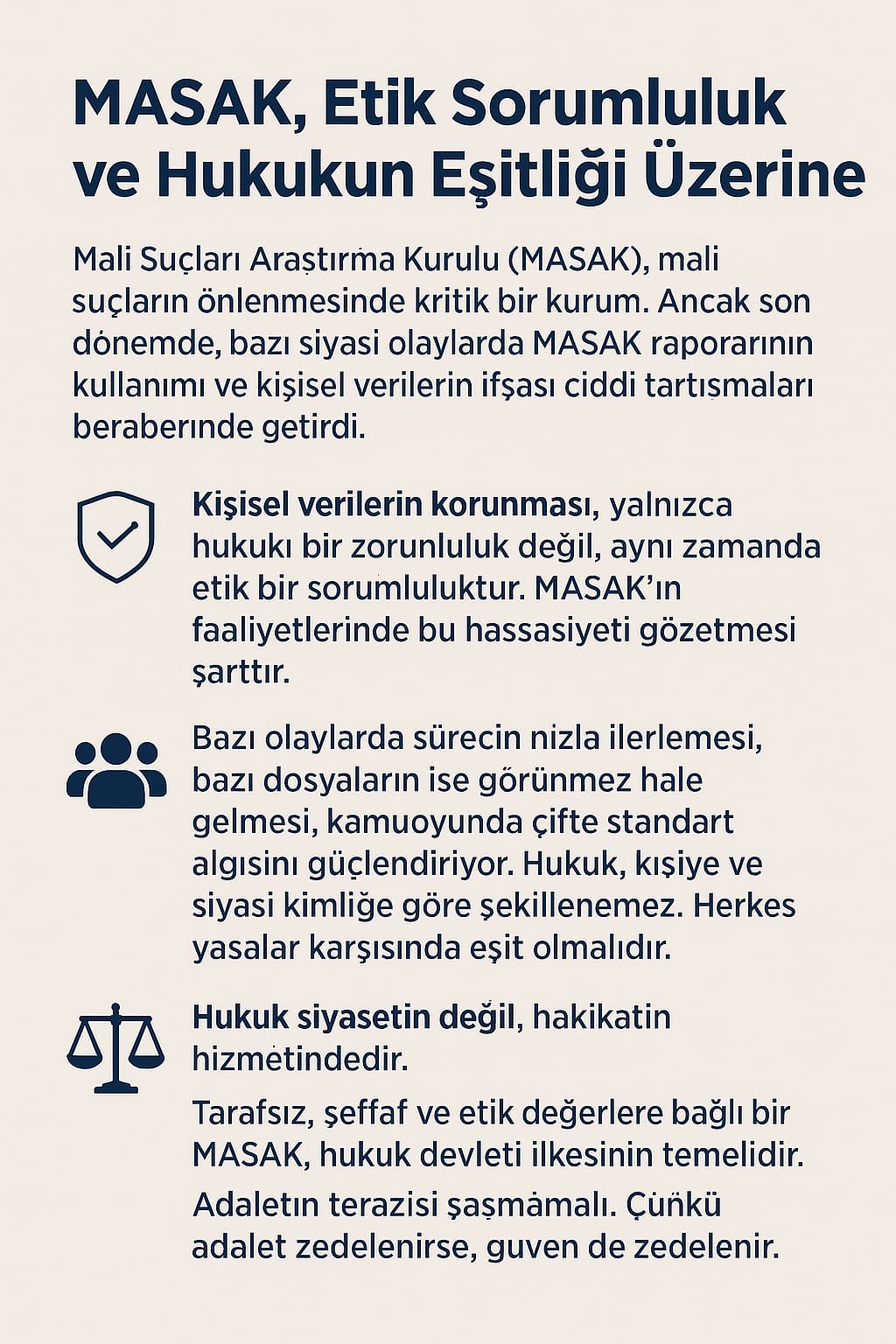
Recently, the public disclosure of MASAK reports—or the findings of these reports—in a manner that reveals personal data in the context of certain political processes has sparked serious controversy. In particular, the widespread circulation of personal information belonging to certain political groups may constitute a clear violation of the Personal Data Protection Law (KVKK). The protection of personal data is not only a requirement of the rule of law but also an ethical imperative. In this context, institutions such as MASAK must also exercise this sensitivity in the operations they conduct.
On the other hand, questions are being raised about the extent to which MASAK reports have been factored into proceedings involving individuals mentioned in certain high-profile cases—such as the couple Dilan and Engin Polat or Rıza Sarraf. The fact that these individuals’ case files remain confidential or that the process is proceeding slowly is raising further questions about the agency’s impartiality.
Furthermore, it is also a matter of curiosity whether MASAK conducted an investigation into Zehra Taşkesenlioğlu—who has long been a topic of public discussion—and, if so, why the results were not shared with the public. Such examples cast a shadow on the principle of “equality,” one of the most fundamental principles of the rule of law. In a state governed by the rule of law, there can be no double standards; everyone must be equal before the law.

There is a growing public perception that a similar double standard is being applied in the political arena as well. For example, while allegations of corruption raised at the 38th Congress were widely publicized, while similar developments within circles close to the ruling party were covered up, reinforcing the perception that MASAK has become a tool serving politics rather than remaining above it. Yet the law should serve the truth, not politics.
In conclusion, transparency, impartiality, and a commitment to ethical values must be fundamental principles in the activities of institutions such as MASAK. The rule of law can only be ensured by upholding these values. The equal application of the law to everyone is the guarantee of true justice. Otherwise, the sense of justice is undermined, and trust in state institutions is seriously eroded.