



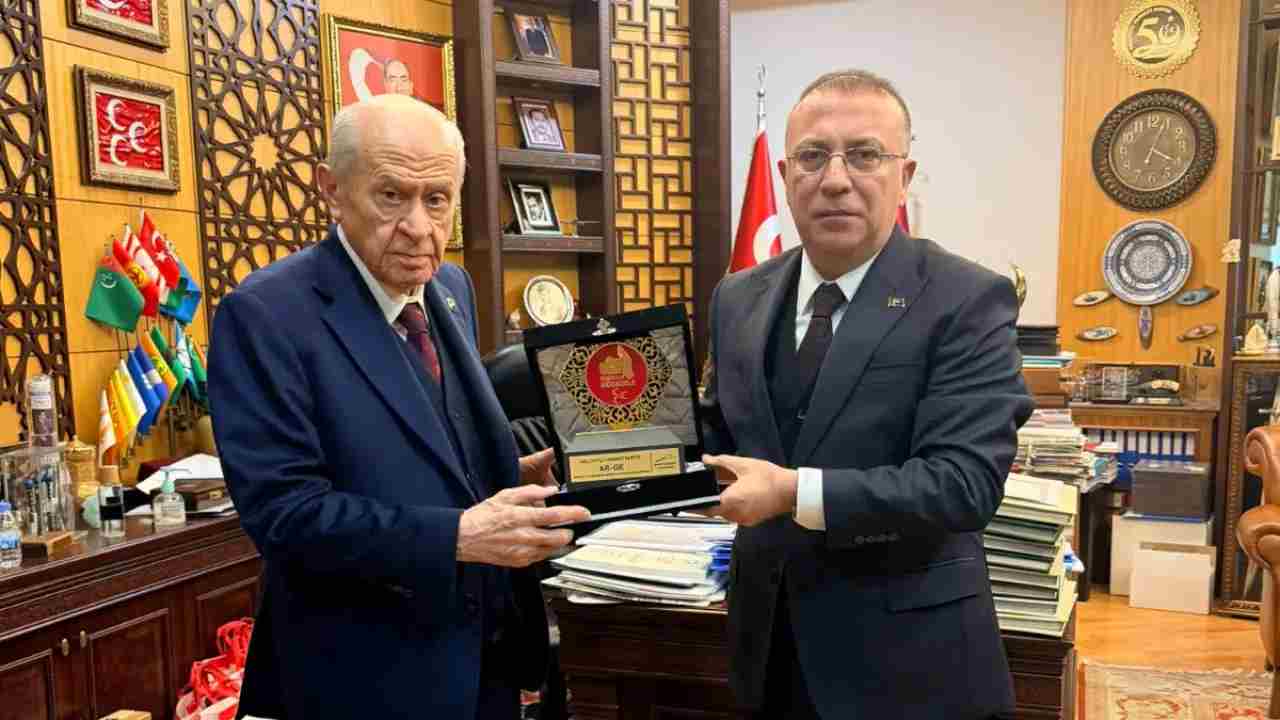
HALKWEB/KULIS For many years, the Nationalist Movement Party (MHP) has displayed a disciplined and centralized structure under the leadership of Devlet Bahçeli. However, the talk in the political circles points to the existence of a struggle for the balance of power within the party, especially in the “post-leadership period”. These discussions lead to talk of a structure shaped around two different axes.
One of the names on the first axis is İzzet Ulvi Yönter, popularly known as “hodja”. Yönter is said to have established strong relations with intellectual and bureaucratic circles within the party and to have a high level of contact with academia and the judiciary. He is also considered to have played an active role in the preparation of Bahçeli's political texts. In this line, he is interpreted as representing the “institutional and elite” wing of the party, which is more integrated with the state mechanism.
Among the names rumored to be close to this group is Semih Yalçın. There are also various allegations that some public figures - Sedat Peker, for example - are close to this axis. However, such connections are often not officially confirmed and remain more like backstage information.
On the other side, there is a structure that gains power through its organizational structure, field organization and economic networks. One of the prominent names of this axis is Eyüp Yıldız. It is stated that Yıldız has been influential in party organizations and financial processes for many years and has strong ties with the organizations.
It is stated that this structure works more closely with the Ülkü Ocakları and consolidates the power of the organization, especially through its President Ahmet Yiğit Yıldırım. Figures such as Alaattin Çakıcı and Vahit Kayırcı are also mentioned in this axis with various allegations. It is claimed that these figures are particularly influential in the business world, tender processes and economic power.
Another unconfirmed allegation that has been making the rounds recently is that this power struggle is sometimes reflected on the ground. Accordingly, a few months ago, Eyüp Yıldız's car was attacked with a gun while being driven by his son on Mevlânâ Bulvarı in Ankara; the attack was allegedly carried out by people close to Ayhan Bora Kaplan's circle, who is associated with the underworld. According to the same allegations, there was a beating in the argument that took place after the incident, and although police teams were deployed to the area, the process was reflected in the official records in a limited way and did not receive widespread media coverage. However, it should be underlined that these accounts are largely backstage information and have not been confirmed by official authorities.
There are also allegations that figures such as Selahattin Yılmaz, who has been on the public agenda from time to time, are linked to this second axis. However, most of these connections have not been clarified by judicial decisions; they are mostly evaluated within the framework of political analysis and backstage comments.
In conclusion, the “two-axis structure” debate within the MHP is based on the issue of tomorrow's leadership and power-sharing rather than today's governance. On the one hand, there is a structure that is more integrated with the state and has a strong bureaucratic and intellectual network; on the other hand, there is a structure that gains power through organizational, field and economic relations.
However, the critical point to remember is that the MHP is a party with a tradition of strong leadership. With Devlet Bahçeli alive and active in politics, such internal conflicts remain mostly controlled and invisible. The real possibility of a breakthrough may occur when scenarios for the post-leadership period start to be discussed more openly.
Today, these discussions are more on the level of backstage information and political analysis. However, given that the balance of power in Turkish politics is often shaped along invisible lines, it is impossible to completely ignore such analyses.