



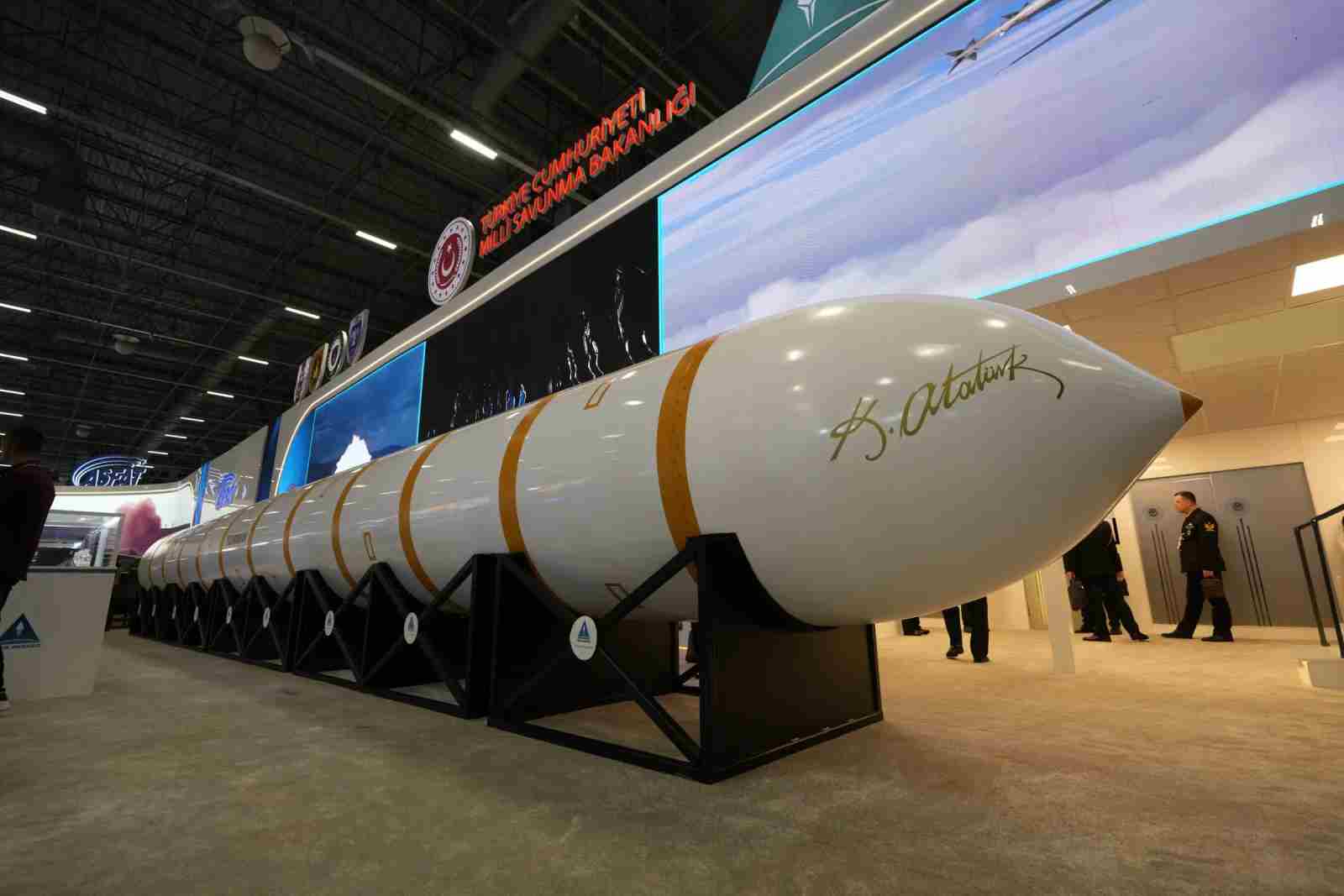
At this year's arms fair, Turkey unveiled the ‘Yildirimhan’, an intercontinental ballistic missile with a range of more than 6000 km. Moreover, its model was presented to the public. As a result, many comments and analyses have been made and analyzed that Turkey has entered the category of countries producing long-range ballistic missiles and has become one of the powers that determine global balances.
Although the characteristics of the missile, named ’Yildirimhan', were listed, the language was both very cautious and did not seriously claim that a long-range ballistic missile had been produced, given the statement made by the Minister of Defense.
Although there has been no announcement to date that Turkey is producing medium-range ballistic missiles in order to become a regional power, the fact that a mock-up of an intercontinental long-range ballistic missile was shown at one moment naturally raised suspicions. This is because the production of intercontinental ballistic missiles implies the use of high military technology. Because one of the important features of these intercontinental missiles is the ability to mount nuclear warheads.
Characteristics of Ballistic Missiles
There are 31 countries in the world with short, medium and long-range ballistic missiles. The number of countries with medium and long-range ballistic missiles is very limited. Only nine of the 31 states (China, France, India, Israel, North Korea, Pakistan, Russia, the United Kingdom and the United States) possess nuclear weapons.
A ballistic missile defense is a missile that can be deployed to counter nuclear or non-nuclear intercontinental ballistic missiles. However, the ballistic missile is often used not only for defense but also as an offensive missile. Short- and medium-range ballistic missiles have been used as defensive and offensive weapons in the Ukraine-Russia and US/Israeli-Iranian wars.
Ballistic missiles are initially powered by rockets, but then follow an unpowered, free-fall trajectory towards their target. Missiles are classified according to the maximum distance they can travel. This distance depends on how powerful the missile's engines (rockets) are and the weight of the missile's payload. To add more distance to a missile's range, the rockets are stacked on top of each other in a configuration called phasing. There are four general classifications of ballistic missiles:
- Short-range ballistic missiles: travel less than 1,000 kilometers.
- Medium-range ballistic missiles : Travel between 1,000-3,000 kilometers.
- Intermediate range ballistic missiles, : Travel between 3,000-5,500 kilometers.
- Long-range ballistic missiles: Intercontinental ballistic missiles (ICBMs) that travel more than 5,500 kilometers.
Short and medium-range ballistic missiles are referred to as short range ballistic missiles, while ICBMs or long-range ballistic missiles are defined as strategic ballistic missiles. Missiles are usually classified by fuel type: liquid or solid propellants. Solid propellant missiles require less maintenance and preparation time than liquid propellant missiles because solid propellants have fuel and oxidizer together, whereas with liquid propellants the two must be kept separate until just before deployment.
Fuel plays a crucial role in launching ballistic missiles. The production of this fuel requires high military technology. Countries such as Iran source ballistic missile fuel from Russia, China and North Korea.
Countries with active Medium and Long Range Ballistic Missiles
There are a limited number of countries in the world that possess medium and long-range ballistic missiles. For example, countries such as Iran, Egypt, Saudi Arabia and South Korea possess medium-range ballistic missiles. Especially countries with nuclear weapons are also understood to possess intercontinental ballistic missiles.
Table-1 : Countries with Medium and Long Range Ballistic Missiles
| Country | Missile Type | Current Status | Range2 | Fuel |
| China | DF-26 | Active | 4,000 km | Solid |
| DF-31(CSS-10 Mod1) | Active | 7,000+ km | Solid | |
| DF-31A(CSS-10 Mod2) | Active | 11,000+ km | Solid | |
| DF-41(CSS-X 20) | Aktif | 12,000-15,000 km | Solid | |
| Julang (JL) 2 (CSS/N/14) (SLBM) | Active | 7,000+ km | Solid | |
| Julang Julang (JL) 3 (SLBM) | Aktif | 9,000+ km | Solid | |
| France | M45 (SLBM | Retired/Discontinued | 4,000-6000 km | Solid |
| M51.1 (SLBM) | Retired/Disabled | 6,000+ km | Solid | |
| M51.2 (SLBM) | Active | 8,000+ km | Solid | |
| M51.3 (SLBM) | Developing | 9,000+ km | Solid | |
| India | Agni/VI | Developing | 8,000-10,000 km | Solid |
| K-4 (SLBM) | In development/testing phase | 3,500 km | Solid | |
| K-5 (SLBM) | Developing | 5,000+ km | Solid | |
| Iran | Ghadr 1/Modified-Shahab 3 | Developing | 2,000 km | Liquid |
| Sejjil-2 | Active | 1,500-2,500 km | Solid | |
| Khoramshahr | Developing | 2,000 km | Plaster | |
| Emad-1 | Developing | 2,000 km | Liquid | |
| Israel | Jericho-2 | Active | 1,500-3,500 km | Solid |
| Jericho-3 | Active | 4,800-6,500 km | Solid | |
| North Korea | Taepo Dong-2(2-stage) | In Development-Tested | 4,000-10,000 km | Liquid |
| Taepo Dong-2(3-stage) Unha-2 SLV | In Development/Tested | 10,000-15,000 km | Liquid | |
| KN/08/Hwasong-13 | Developing | 5,500-11,500 km | Liquid | |
| KN/14/Hwasong-13KN/08 Mod 2 | Developing | 8,000-10,000 km | Liquid | |
| KN/20/Hwasong-14 | In Development/Tested | 10,000+ km | Liquid | |
| KN/22/Hwasong-15 | In Development/Tested | 13,000 km | Liquid | |
| Pakistan | Shaheen-2( Haft6) | Active | 1,500-2,500 km | Solid |
| Ghauri-3 | Developing | 3,000 km | Liquid | |
| Ababeel | Developing | 2,200 km | Solid | |
| Russia | RS-20V(SS/18 Satan) | Active | 10,200-16,000 km | Liquid |
| RS-18V(SS/19 Stiletto) | Active | 10,000 km | Liquid | |
| RS-28V Sarmat (SS-X -30 Satan II) | Test was/Developing | 10,000-18,000 km | Liquid | |
| SS-24 | Active | 10,000 km | Solid | |
| RS-12M Topol(SS-25 Sickle) | Active | 10,500-11,000 km | Solid | |
| RS-12M1 Topol M(SS-27) | Active | 11,000 km | Solid | |
| RS-12M2 Topol M(SS-27 Mod-X-2) (silo) | Active | 11,000 km | Solid | |
| RS-24 Yars(Mobil and silo versions)(SS-27 Mod 2) | Active | 10,500 km | Solid | |
| RS-26 Rubetzh Yars M (SS-27) | Tested | 5,800 km | Solid | |
| RSM-54 Sineva M SS-N-23 or R-29RM) (SLBM | Active | 8,300 km | Liquid | |
| RSM-56 Bulava (SS-N-32) (SLBM | Active | 8,300 km | Solid | |
| Saudi Arabia | DF-3 (CSS-2) | Active | 2,600 km | Plaster |
| DF-21 East Wind (CSS-5) | Active | 2,100+ km | Solid | |
| England | D-5 Trident II (SLBM) | Active | 7,400-12,000 km | Solid |
| USA | Minuteman III (LGM/30G) | Active | 9,650-13,000 km | Solid |
| D-5 Trident II (SLBM) | Active | 7,400-12,000 km | Solid | |
| Source : https://www.armscontrol.org/factsheets/worldwide-ballistic-missile-inventorie, https://www.armscontrol.org/factsheets/worldwide-ballistic-missile-inventorie | ||||
Ballistic missiles are generally launched from land to land. SLBM stands for submarine-launched ballistic missile and ASBM for anti-ship ballistic missile. 31 countries in the world have short-range missiles in their armies. Relatively few countries have medium-range missiles. Very few countries have long-range missiles. As mentioned, ballistic missiles with nuclear warheads are found in 9 nuclear-armed countries.
The Russian Strategic Missile Forces have 286 intercontinental ballistic missiles capable of carrying 958 nuclear warheads. Russia's active long-range missiles : RS-20V (SS-18 Satan) 10,200-16,000 km, RS-18 (SS-19 Stiletto), 10,000 km, SS-24 10,000 km, RS-12M Topol (SS-25 Sickle) 10,500-11,000 km, RS-12M1 Topol-M (SS-27), 11,000 kilometers, RS-12M2 Topol-M (SS-27 Mod-X-2) (silo), 11,000 kilometers, RS-24 Yars (mobile and silo versions) (SS-27 Mod 2) 10,500 km, RSM-54 Sineva (SS-N-23 or R-29RM) (SLBM) 8,300 km, RSM-56 Bulava (SS-N-32) (SLBM), 8,300 kilometers. Testing and development two missiles in the pipeline; RS-28 Sarmat (SS-X-30 Satan II) 10,000-18,000 km, RS-26 Rubezh/Yars M (SS-27) is 5,800 km. The Soviet R-36M (SS-18 Satan), the largest intercontinental ballistic missile in history, has a launch weight of 8,800 kg.
China has the world's third largest intercontinental ballistic missile arsenal, with more than 300 missiles, and has developed several long-range intercontinental ballistic missiles. The Dong Feng 31 (aka CSS-10) is a medium-range, three-stage, solid-fueled intercontinental ballistic missile and a land-based variant of the submarine-launched JL-2. The DF-41 or CSS-X-10 can carry up to 10 MIRVs and has a range of about 12,000-14,000 km. The DF-41 is allegedly deployed underground in Xinjiang, Qinghai, Gansu and Inner Mongolia. The mysterious underground metro intercontinental ballistic missile delivery systems are called the ’Underground Great Wall Project’. In addition, China's other active long-range ballistic missiles are : DF-5 (CSS-4, Mode 1), 12,000 kilometers, DF-5A (CSS-4, Mode 2), 13,000km, DF-5B (CSS-4 Mod 3) 12,000 km, DF-26 4,000 km, DF-31 (CSS-10 Mod 1) 7,000+ km, DF-31A (CSS-10 Mod 2) 11,000+ km, DF-41 (CSS-X-20) 12,000-15,000 km, Julang (JL) 2 (CSS-N-14) (SLBM) 7,000+ km, Currently Testing and development two missiles in the pipeline; DF-5C 13,000 km DF-15C (CSS-6) range distance unknown.
The United States currently has 405 intercontinental ballistic missiles at three US Air Force bases. All previous US Air Force Minuteman II missiles were destroyed under START II and their launch silos sealed or sold. The powerful MIRV-capable Peacekeeper missiles were phased out of service in 2005. US active long-range missiles : Minuteman III (LGM-30G) 9,650-13,000 km, D-5 Trident II (SLBM) 7,400-12,000 km.
Pakistan's most effective medium-sized ballistic missiles active Ghauri-1 (Hatf-5) 1,250-1,500 km and Shaheen-2 (Hatf-6) 1,500-2,500 km. Pakistan is one of the countries most engaged in ballistic missile development. In recent years Ghauri-2 (Hatf-5a) 1,800 km, Ghauri-3 3,000 km, Ababeel It began testing missiles with a range of 2,200 km.
Britain's active strategic ballistic missile: D-5 Trident II (SLBM)’has a range of 7,400-12,000 km
Israel is believed to have deployed the Jericho III road-mobile nuclear intercontinental ballistic missile, which entered service in 2008. The missile can be equipped with a single 750 kg (1,650 lb) nuclear warhead or up to three MIRV warheads. It is believed to be based on the Shavit space launch vehicle and is estimated to have a range of 4,800 to 11,500 km. In November 2011, Israel tested an intercontinental ballistic missile believed to be an improved version of the Jericho III. Israel's active ballistic missile Jericho-3 4,800-6,500 km, Jericho-2 1,500-3,500 km. However, since Israel does not provide direct information to international organizations, including the United Nations, it is not possible to make a concrete assessment of the missiles under development.
Iran's active ballistic missile Shahab-3 (Zelzal-3) 800-1,200 km under development Ghadr 1/Modified Shahab-3 The missile will have a range of 2,000 km. Iran has used some of these ballistic missiles against US/Israeli attacks. As this war demonstrated, long- and medium-range ballistic missiles alone cannot achieve decisive military results without more advanced air and naval systems.
India has a series of ballistic missiles called Agni. On April 19, 2012, India successfully tested the first of its three-stage solid-fuel missile Agni-V with a range of more than 7,500 km. The missile was tested for the second time on September 15, 2013. On January 31, 2015, India conducted the third successful test flight of Agni-V from the Abdul Kalam Island facility. On December 15, 2022, the first night test of Agni-V was successfully conducted by the Indian Strategic Forces Command from Odisha. India's active missiles : Agni-V (ICBM) are. Agni-V with a range of about 5,000-8,000 km, Surya missile 12,000-16,000 km (estimated)[2], Agni-VI: Road and rail mobile ICBM, silo-based, 8,000-12,000 km.
It is clear that the ballistic missiles in the hands of the global powers today are capable of destroying the world, even without nuclear warheads. A ballistic missile can carry explosives from 500 kilos to 9000 thousand kilos. It is also considered relatively easy to develop chemical warheads for short-range ballistic missiles. It is also emphasized that the development of biological warheads would be catastrophic for the environment during the missile flight and when dispersed.
As missiles and missile production technology become more widespread, the demand for biological and chemical warheads for longer-range missiles is increasing. The production of biological weapons, which can be produced at a lower cost than nuclear weapons, is coming to the fore.
The risk of some states and non-state groups acquiring short-range missiles and attaching chemical and biological weapons to their warheads has increased significantly. Since 2000, the number of countries possessing ballistic missiles has more than doubled, increasing the likelihood of proliferation, especially of short- and medium-range missiles. The states that possess the technology to develop nuclear weapons and ballistic missiles are primarily responsible for all these risks. Those who possess thousands of nuclear, chemical and biological weapons have the potential to destroy the world in any way they choose.
Ankara has a program to develop military technology, but it is not yet concrete
It is known that Turkey is intensifying its military efforts to produce ballistic missiles and is making serious efforts to do so. Even in terms of regional power relations, this is extremely important. Pakistan and Israel are the only two countries in the region with nuclear weapons. Iran, Egypt and Saudi Arabia, in particular, have medium-range ballistic missiles, and it is clear that they want to gain an advantage in regional competition. It is also known that Ankara wants to have medium-range ballistic missiles in regional power relations and is working towards this end.
There may be a desire to produce intercontinental ballistic missiles like the ‘Yildirimhan’ on display at the exhibition, but Ankara's military technology does not have the potential to produce intercontinental ballistic missiles in the current conditions and stage. It is important to see the difference between publishing such images for propaganda purposes and the real situation.
This situation is similar to the production of the ‘Kaan fighter jet’, which is marketed as the sixth generation. After Foreign Minister Hakan Fidan said, ’We cannot start mass production of the Kaan fighter jet because the U.S. does not provide the aircraft engine,‘ the ’Kaan‘, which was propagated as ’the most advanced fighter jet in the world', was suddenly forgotten. In addition, no state would randomly talk about or simply advertise the war technology it has developed. Only Turkey has such a situation. Because there is no such powerful technology yet. It is thought that there is no harm in talking about technology that does not exist and turning it into propaganda.
Dr. Mustafa Peköz