
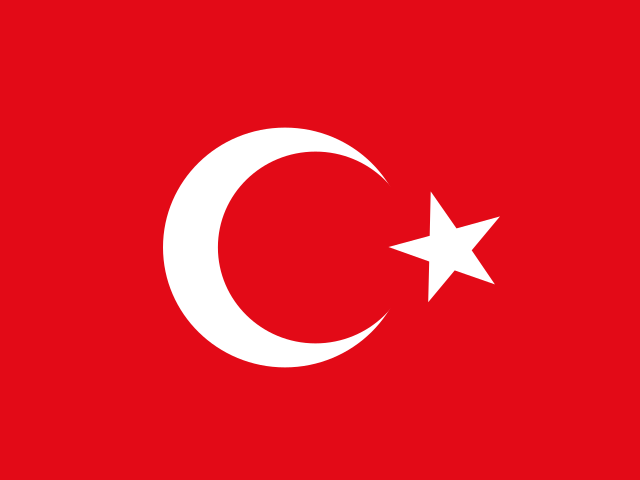



Confronting the realities of the present, rather than clinging to historical fantasies beyond our borders, is a prerequisite for lasting peace for Turks, Armenians, and all of the Caucasus.
The Shared Memory of Anatolia
Anatolia is the homeland where the nearly thousand-year history of shared life, common culture, architecture, music, and intertwined social memory between Turks and Armenians truly took root and blended together. On this land, the two peoples lived in peace for nearly 900 years—in the same neighborhoods, on the same streets, in the same harmony, and under the same state—as children of a shared homeland.
The Caucasus, however, has been the setting only for the final chapter of this centuries-old story—and, unfortunately, for the past century of conflict shaped by the interventions of great powers. The new situation arising from the collapse of the empires and the subsequent dissolution of the Soviet Union turned the Caucasus into a region marked by suffering, displacement, and tragedies trapped along border lines.
Karabakh and the Price of Maximalist Nationalism
Armenia’s post-independence era has turned into a laboratory-like process in which the country has become detached from its own geographical and regional realities, trapped instead within the historical revenge narratives of the diaspora beyond its borders and the maximalist fantasies of Dashnak nationalism.
This approach, which is founded on anti-Turkish sentiment as one of its core tenets, has unfortunately evolved into a policy that has led to bloody consequences for the Azerbaijani Turks. Unattainable territorial ambitions and cartographic fantasies in Anatolia have transformed into concrete aggression in Karabakh. The occupations, the so-called structures established in violation of international law, and the status quo that persisted for thirty years have caused suffering, displacement, and deep trauma for both peoples.
Disconnected from geographical realities, this vision has condemned Armenia to a regional dead end, a spiral of economic isolation, and ultimately, Russian military tutelage.
From Dream to Reality: The June 7 Elections
However, today we are witnessing a significant turning point in the Caucasus and in the region’s history.
The Armenian elections held on June 7, 2026, confirmed a political reality rarely seen in the region’s history: Nikol Pashinyan, a leader who had lost a war, offered his people not ’fantasy goals“ but ”Real Armenia“ (Real Armenia) He emerged victorious from the election by making promises.
Perhaps the need to emerge from the dark corridors of a fictional Armenia and take refuge in this realistic doctrine arose from the immense suffering and heavy toll experienced in Karabakh and the region.
This approach, which formed the core of Pashinyan’s campaign platform, reminded the Armenian people of a reality that was difficult to face but vital: to stop chasing after historical maps and ideological dogmas, and instead focus on the internationally recognized current borders of 29,743 square kilometers and peace with neighboring countries.
Indeed, through his outspoken remarks during this process, Pashinyan has adopted a stance that questions how past sufferings and the “genocide” narrative can be used as a geopolitical tool in the rivalry among major powers, and how the Armenian people have been turned into pawns in international power struggles.
The people of Armenia are now beginning to see more clearly that it is not the military bases they have long relied on, but rather the trade and transportation networks passing through the Alican-Margara and Ahuryan-Akyaka border crossings on the Turkish border—along with the promised “Peace Crossroads” projects—that will bring them prosperity. The outcome of the election can also be largely interpreted as an endorsement of this realistic vision.
A Call for Peace Born of Pain
Preserving this fragile yet promising foundation for peace that has emerged today is a historic responsibility not only for politicians but also for the societies on both sides of the border.
This sense of responsibility should not stem from raw romanticism; it must be rooted in real-life suffering.
I say this as a member of a generation whose family suffered at the hands of Armenian gangs in the past and was forced to leave behind a homeland, a past, and countless memories on the other side of the border in Anatolia to build a new life on this side.
As the descendants of a generation that has suffered, our appeal to our entire nation today is this:
Our first task is to learn to use the word “Armenian” not as an insult or a derogatory term, but as a term of identity for a people with whom we lived side by side in Anatolia for a thousand years and who are now our neighbors.
Undoubtedly, the same hope and the same linguistic purification apply to the other side of the border as well.
Realizing that what lies across the border is not an enemy camp but a sovereign neighboring state is the first prerequisite for shaping the future.
We all need peace, and the path to peace lies in empathy that does not overlook justice. Mutual empathy leads us not to blind denial, but to constructive tolerance.
The Historic Duty Falling to Hrant’s Friends
One of the most critical tasks here falls to our citizens of Armenian descent living in Turkey, our intellectuals, and especially the friends of Hrant Dink, who dedicated his life to reconciliation between these two peoples.
Hrant Dink did not speak by shouting and screaming, but with “the timidity of a dove”—yet with that dove’s courage.
His most important legacy is the idea that Turks and Armenians are not enemies, but two neighboring peoples who can heal each other’s wounds. It is the truth that these two peoples are each other’s healers.
The task facing Hrant’s friends and Armenian intellectuals today is not merely to mourn the past. The task is to ensure that this courageous “True Armenia” march, initiated by Pashinyan, is not sabotaged by pro-Russian oligarchs, the remnants of Dashnak radicalism, and diaspora circles resistant to reconciliation; but to translate the new language of peace in the Caucasus and Anatolia into the heart of society.
We have a historic opportunity to close the dark chapter of the past century in our thousand-year shared history in Anatolia.
Just as the people of Armenia have awakened from their illusions and chosen reality, we too must choose the future—without denying the pains of the past, yet without becoming their prisoners. For peace is not about forgetting; it is the courage to live together while remembering.
Lasting peace can only be built by those who are brave enough to heal the wounds of the past.