
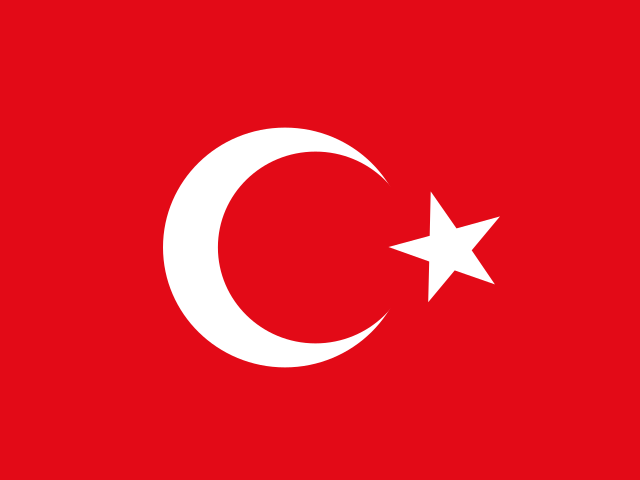



Once upon a time, there was an indispensable tradition in April: Eurovision Song Contest.
We would gather as a family in front of the television and watch the hours of voting with great excitement. “I wonder how many points Turkey will get?” was the common phrase of almost the whole country. In those years, Eurovision was not just a music contest; it was also a cultural gathering, a common excitement and a stage for diplomacy.
The songs were really memorable. The melodies were strong, the lyrics were meaningful and the orchestras played live. At that time, important names of Turkish music touched the Eurovision stage directly or indirectly.
Names like Timur Selçuk and Garo Mafyan who represent depth in music,
Great composers like Onno Tunç were part of that musical atmosphere.
There have been many memorable songs in Turkey's Eurovision adventure.
“Seninle Bir Dakika”, sung by Semiha Yankı, was one of Turkey's first memorable songs in the contest.
In 1980, Ajda Pekkan took the stage with ’Pet'r Oil“; the gasoline pumps in the song's music video became one of the symbols of the popular culture of those years.
In 1985 Mazhar Fuat Özkan created a great energy on stage with ’Diday Diday Day“.
In 1997, Şebnem Paker came third with ’Dinle“, bringing Turkey its biggest success to date.
And finally the historical moment arrived.
In 2003 Sertab Erener won Eurovision with “Everyway That I Can”. Turkey won first place for the first time. A year later, the contest was held in Istanbul. This was not only a musical success; it was also an important moment for Turkey's cultural visibility.
Another aspect of Eurovision was that it showed political and cultural balances. Which country gave points to whom and who did not... The points given by Greece to Cyprus and the Scandinavian countries to each other were always talked about. The voting relations between Turkey and some countries were also a matter of discussion.
But beyond all these debates, the most important aspect of Eurovision was this: it created musical memory. The songs were remembered for years, people hummed the melodies.
Today, one inevitably asks the question:
Which song have we all remembered together in the last 20-25 years?
Television screens are full of music competitions. But most of them do nothing more than generate short-lived popularity. Melodies are quickly consumed and artists are quickly forgotten.
Maybe it is not only about Eurovision.
Perhaps the issue is the gradual shrinking of the musical commons that once constituted the collective cultural memory of society.
Once upon a time, millions of people listened to the same melody and shared the same excitement on the same night.
Today, that shared excitement has been replaced by a fragmented, short-lived popularity.
And one inevitably remembers the past:
Those long nights of voting, the excitement that rose with every point and the melodies that stayed in the memory for years...
Maybe it's not just about losing a competition, but about losing a cultural tradition.