



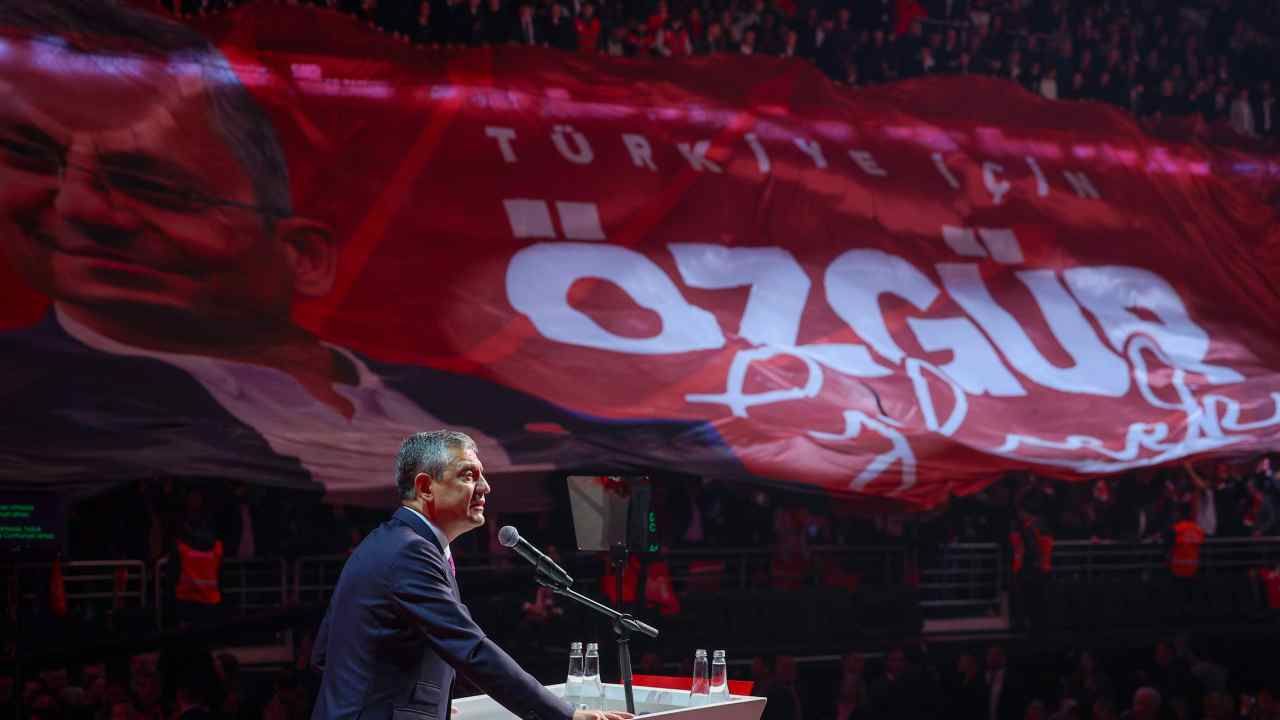
The CHP held its 39th Ordinary Congress. Following provincial congresses dominated by impositions and featuring a single candidate, the national congress naturally also had a single candidate. The disappearance of leadership competition within political parties signals not only a weakening of pluralism but also a decline in organizational dynamism. This situation established a framework that defined the spirit of the current convention from the very beginning.
While previous conventions saw around 400–450 applications for a 52-member PM list, it is striking that only 145 people applied for the 70-member PM this time. This sharp decline in interest is not merely a numerical drop; it is a significant indicator of a loss of motivation within the party, a silent withdrawal, and a erosion of loyalty. This quiet withdrawal is thought-provoking and can be interpreted as one of the most obvious signs of a breakdown in organizational psychology.
Apart from a repetition of past messages, there were a few key points that stood out at the convention. First, the statement that the CHP would rid itself of its veterans—though framed as part of a discourse on political renewal—reveals an approach that, in practice, amounts to a purge of experience. Indeed, the “eclectic” PM list formed after the convention served as a concrete reflection of this policy. The list points to a hybrid structure that randomly brings together different factions but fails to present a clear ideological backbone. This situation indicates that renewal is taking shape not as a strategic orientation but as a fragmented and reactionary process.
Second, the party leader’s description of some CHP members as “hedgehogs” drew attention. Considering that hedgehogs are not aggressive creatures and use their spines solely for defense against attacks by predators and reptiles, this analogy serves as a striking indicator of how internal party pluralism is perceived.
In political science literature, the criminalization or symbolic exclusion of critical voices is regarded as one of the early stages of organizational closure. At this convention, however, a discourse prevailed that went beyond merely accusing dissenting voices, effectively pushing them out of the political arena. Furthermore, the convention’s discourse does not appear to present either a coherent vision for the future or a clear ideological perspective.
In this context, describing the resulting PM list as “a hodgepodge” is not merely a figure of speech; it reflects the fact that the party leadership has been driven into a structure lacking a backbone. In other words, the organizational leadership—the backbone of the CHP—has also been weakened. This situation implies that institutional continuity in decision-making processes has weakened, while the definition of identity and objectives has become increasingly blurred.
As I have mentioned before, the claim that the CHP is Atatürk’s party has turned into mere nostalgia. By limiting the CHP’s leadership and objectives to the struggles in Silivri and Istanbul, the party has increasingly widened the gap between its historical mission and its political practice. This is a choice that narrows the party’s capacity for both ideological and sociological representation.
Ultimately, although this congress set out with the aim of seizing power, the resulting picture points to a trend that weakens organizational motivation, deepens ideological ambiguity, and limits internal party pluralism. The picture emerging from the convention seems to have heightened the visibility of structural problems rather than generating hope for the future.
Guest Author: Ahmet Kılıç