


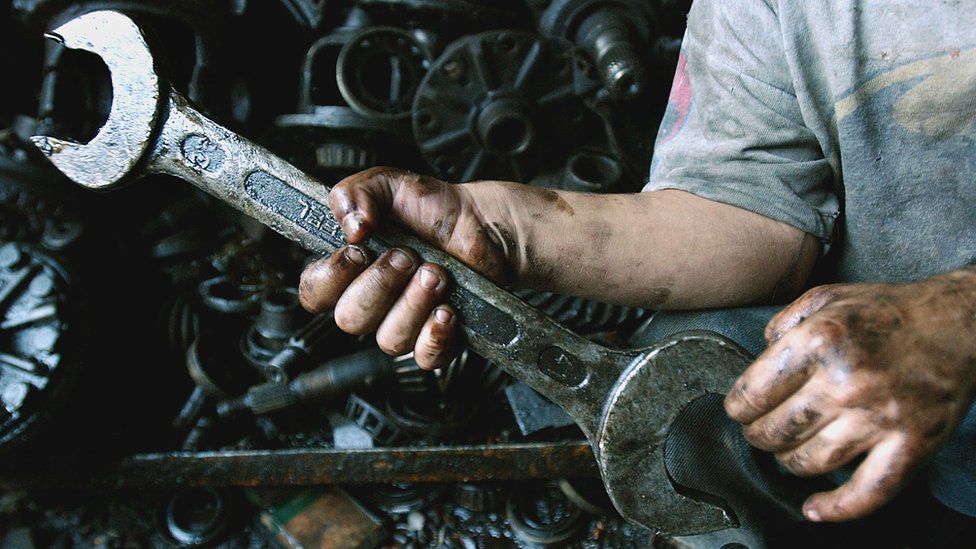
Child labor is not a choice. In Turkey, children are massively employed in line with economic policies that impoverish society (OVP), the liquidation of public education and capital's need for cheap labor. This process is legitimized under the name of “education” through different mechanisms, including MESEM, which we have also mentioned in this article, and children's lives, health and future are shaped according to the needs of capital.
Dozens of child laborers die every year
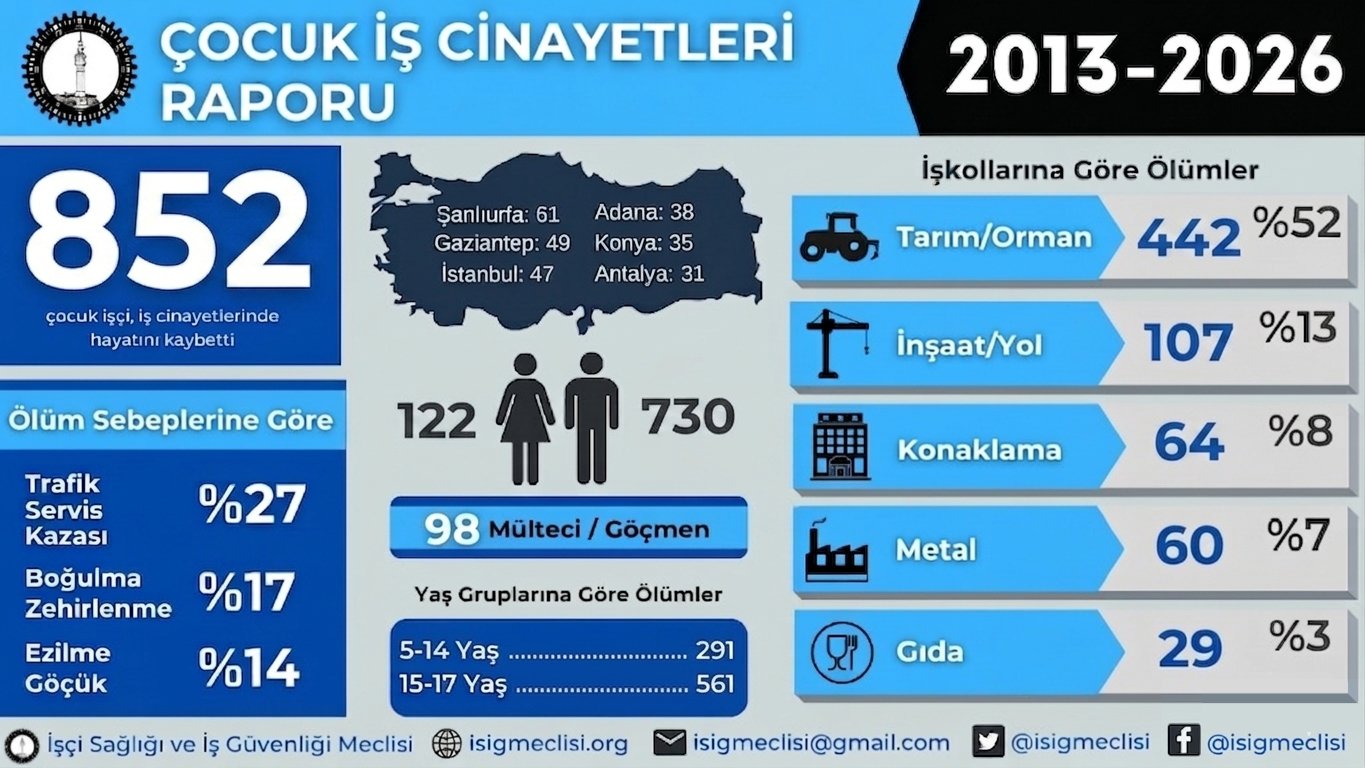
When we examine the statistics on the website of the Ministry of Labor in our country, 13-14 child worker deaths were officially recorded every year and these deaths were not announced. However, as we have stated in the reports on occupational homicides that we have been recording as the ISIG Assembly since 2013, 63-64 children have lost their lives every year and this picture has deepened even more in the last two years. While 71 child workers died in 2024, 94 child workers died in 2025, which summarizes the situation of child labor. Since last year, when the deaths of child laborers were exposed through collective efforts, there has been a great reaction. The main application where this reaction has materialized has been Vocational Education Centers (MESEM) and partly Vocational and Technical Anatolian High Schools (MTAL)...
Around three million children are working in Turkey
In the agricultural sector, there are many different forms of work for children, including seasonal workers, mobile seasonal workers (the worst form of work in agriculture), field workers, shepherds, livestock farm workers, forestry workers, fishermen and farmers. It is enough to give only Şanlıurfa as an example: As the research conducted by the Bar Association in the wake of the pandemic shows, around 300 to 500 thousand children from the city go to other cities with their families in May, leaving their education and working in the fields.
In the construction industry, there are children who work as apprentices and journeymen, such as plasterers, bricklayers and middlemen, but who work in the same way as adults in terms of workload, usually with other family members or relatives. This means tens of thousands of child laborers from Ordu, Samsun, Çorum, Van, Ağrı and migrant children.
In the service sector, there are tens of thousands of child laborers who have recently been working as moto couriers, in every shop in shopping malls, in sales or in the kitchen wherever food is sold, as well as on the streets, shining shoes, peddling, wiping car windows, collecting waste, and working on every main street in every city.
In the industrial sector, there are tens of thousands of registered and unregistered child laborers working in workplaces and workshops under the stairs, in organized industrial zones (OIZs) that used to be located in big cities but are now spread all over Anatolian cities, in metals, leather, chemistry and wood.
How many students/child workers are there in MESEM and MTAL practices?
Among the three million child laborers mentioned in the title above, students working as interns/apprentices, which have increased massively in recent years, occupy an important place. These children are made workers in the industrial-construction-service sectors under the name of integration into the education system. The number of students in MESEMs and MTALs is very variable, the number given in each statement is different, but at this point, we take the statements of the Minister of National Education Yusuf Tekin as a basis. Here are the statements of the Minister in his speech at the ’Turkey Century Vocational and Technical Education Summit‘ on December 1, 2025:
“As of the 2024-2025 academic year, we have 1 million 536 thousand 242 students in 3 thousand 954 vocational schools and 420 thousand students in 408 MESEMs.” In other words, this means approximately 2 million students who are in the process of being made workers.
“In the 2025-2026 academic year, 509,85 vocational education center students are receiving vocational education in 224,346 enterprises and 254,60 MTAL students are receiving vocational education in 111,578 enterprises.” In other words, 765 thousand of the approximately two million students (MESEM+MTAL) are ‘personally working as workers’ in workplaces.
In a nutshell, what needs to be understood is that around 3 million children in Turkey are employed in various forms in industry, agriculture, construction and service sectors. The most obvious consequence of this, the occupational homicides (852 deaths of child laborers in the last 13 years), have helped to reveal the reality.
How was child labor massified?
The neoliberal policies implemented with the January 24 decisions and the September 12 coup d'état are at the root of this process, but the ‘massification of child labor’ has been accompanied by the impoverishment and education policies implemented especially in the last 20 years.
First of all, the education system was collapsed starting from universities to primary schools. With the discourse of a university in every province, universities and departments with unknown names were opened and mass graduations were given. This process led to falling wages, unemployment and the creation of unassigned professions.
Policies of commodification of education and industry-education cooperation were implemented. In 2006, the number of vocational schools was increased and the ratio of vocational schools in high schools exceeded one-third with the aim of starting to train students as intermediate staff for industry with the slogan “Vocational High School is a Crucial Matter for the Nation” with the cooperation of MoNE and Koç Holding.
In 2012, with 4+4+4, the first eight years of education were dismantled, children started school at the age of 60 months, were drowned in a theoretical curriculum disconnected from life, and no resources were allocated to schools except for building construction and teacher salaries. Private schools were given incentives and their number increased. Today, there are thousands of children who have completed primary education but lack basic math, language, science and life skills.
In short, a major blow was dealt to the education system. It was imposed by saying that reading is both ‘not providing a future’ and ‘an unnecessary activity’, ‘there is no such thing as everyone reading’, and education policies were shaped accordingly.
MESEM as the worst form of work for urban children
After the 2008 crisis, impoverishment policies came into effect rapidly. The purchasing power fell and every member of the family had to work. When urban poverty became widespread, ‘child labor became urbanized’ rapidly with the guidance of education policies on this issue. With the pandemic process, children enrolled en masse from formal education to open high schools. As we have seen especially in MESEM, child labor, which has been massified by state policies and the reality of OIZs concentrated in all Anatolian cities, has now carried child worker deaths to city centers and peripheries.
MESEM, which was shaped in line with the opinions in the 2014 Vocational High School Workshop report organized by MÜSİAD, was included in the scope of formal education in 2016. In 2020, MESEM program students were entitled to receive a vocational high school diploma by taking difference courses and MESEM classes were opened in vocational high schools and became widespread. In 2021, after the wages of interns and apprentices were taken from the responsibility of the bosses and linked to the Unemployment Insurance Fund, there was a massive increase in the number of MESEM students.
The objective basis of child labor, which is concentrated in MESEMs, is the policies of impoverishment and exclusion from the education system. Hundreds of thousands of children go to school one day and work four days under the name of education. In practice, work in the workplaces lasts 5-6 days and up to 10-12 hours and, as the Minister permits, is carried out until 23.00 at night, ’learning the job by working as a worker‘. The wage paid to the children, which is one-third to half of the minimum wage (9-14 thousand TL), is covered by the unemployment fund, and the most that comes out of the boss's pocket is the food or pocket money (if he/she wants it). In other words, MESEM is a ’free source of labor‘ for the bosses.
Therefore, MESEM cannot be understood only as a bad education model. MESEM is a mechanism financed with public resources that provides low-cost / free child labor to capital. The discourse of “vocational education” is used to legitimize the exploitation of children at an early age.
For the last two years, steps have been taken to reduce this practice to the middle school level. With the regulation published in the Official Gazette on January 17, 2025, children in the 5th and 6th grades can be transferred to vocational middle schools during the school year and in the 7th grade until the last working day of September. In other words, the age of labor in the name of vocational education is being lowered to 10-11.
As a result, children from families with poor financial situation go to MESEM. Thus, on the one hand, they will receive a high school diploma, and on the other hand, they will have dreams of opening a workplace by studying and obtaining a diploma, journeyman's and master's certificate (having a profession and wearing a gold bracelet on their arm). In reality, however, the future offered to these children is to become intermediate staff in sectors such as food, metal, chemistry or service sector workers in OIZs. On the other hand, they will leave their health, childhood and youth at their workplaces.
Labor murders are the most painful reality, but medium- and long-term health problems are the other side of the problem. Long working hours, heavy and hazardous work, exposure to chemical and physical risks, physical wear and tear during the developmental age, psychological abuse and disengagement from education are the invisible consequences of child labor that cause permanent damage to the human body. Child labor is a public health problem in this sense.
Fight against child labor
At the moment, we are experiencing the consequences of a process in which children are being massively employed. At this point;
1- Child labor must be banned. All practices that push children into the labor force at an early age must be ended.
2- Education must be restructured on a free and scientific basis, private schools must be nationalized. The conditions that force families to force their children to work must be eliminated, and measures such as free nutrition, transportation and housing must be provided by the state. At this point, the share allocated to education from the budget must be increased.
3- We are not against vocational education, but against the determination of children's futures according to the financial situation of their families and against child labor. Our children's lives should be shaped according to their talents and inclinations.
(What kind of vocational education should be discussed? For example, the starting age for vocational education should be 16, the time spent in school and in the enterprise should not exceed 40 hours, Saturdays and Sundays should be holidays, working between 20.00 and 06.00 should be prohibited, not only occupational accidents and occupational diseases insurance but also pension insurance should be provided, wages and insurance premiums should be paid by the employer, wages should be increased to the minimum level, worker health and occupational safety inspections should be carried out, etc... In summary, not ‘learning by doing work personally’ but ‘education and learning that complement each other in school and workplace’ should be taken as a basis).
Of course, these problems cannot be solved only by demanding. Under the leadership of labor and youth organizations, a ‘coordinative relationship network’ should be developed on the axis of ‘struggle against child labor’ that can cover all segments of society, where common approaches to current problems will be highlighted.
The struggle against child labor cannot be separated from other social problems. Actual ties are being established and steps are being taken on current issues such as child labor deaths, MESEMs, children in the budget, free education, drugs/gambling/violence/virtual addiction and the fight against gangs. It is up to us to give these steps an institutional character...