



 The most important lesson to be learned from what is happening in Iran is not military, as one might think, but economic. Real security is not provided by tanks, missiles or border lines, but by the security of production. States that define security only as a military issue will be defenseless in the first big shake-up. Because wars are lost not at the front, but in the economy. If a state abandons its economy as its sovereign domain and leaves it at the disposal of a certain parasitic class, it will have nothing to defend in the event of an uprising or a war. Internal security collapses, social ties dissolve, money and values are wasted.
The case of Iran has shown this reality in all its clarity. In order to sell its oil, an order was established that looked for ways out through figures like Reza Zarrab, and groups in cooperation with the West took the oil revenues and moved them out of the system. When the state lost its production income, there was only one option left: printing money. As money was printed, money became worthless, and as money became worthless, social anger grew. The price Iran is paying today is the result of an economic sovereignty that has been emptied from within rather than foreign intervention.
Why didn't the same Iran experience a much more destructive conflict like the Iraq-Iran War in this way? Because at that time, the state's production mechanism had not yet been handed over to the parasitic classes. The fate of the war was not decided on the front line, but on economic resilience.
The example of Russia teaches us the same lesson. As soon as the war began, the first move was not military, but economic. The assets of oligarchs were confiscated and strategic sectors were nationalized. The de facto control of a huge energy company such as Gazprom by a single person is a complete statelessness. What Putin is doing is not ideological; it is an extremely naked state reflex: To guarantee the security of the people by ensuring the security of production. Two wars, two countries, one result: A state that cannot control production cannot control security.
This historical and economic framework brings us directly to the Syrian issue.
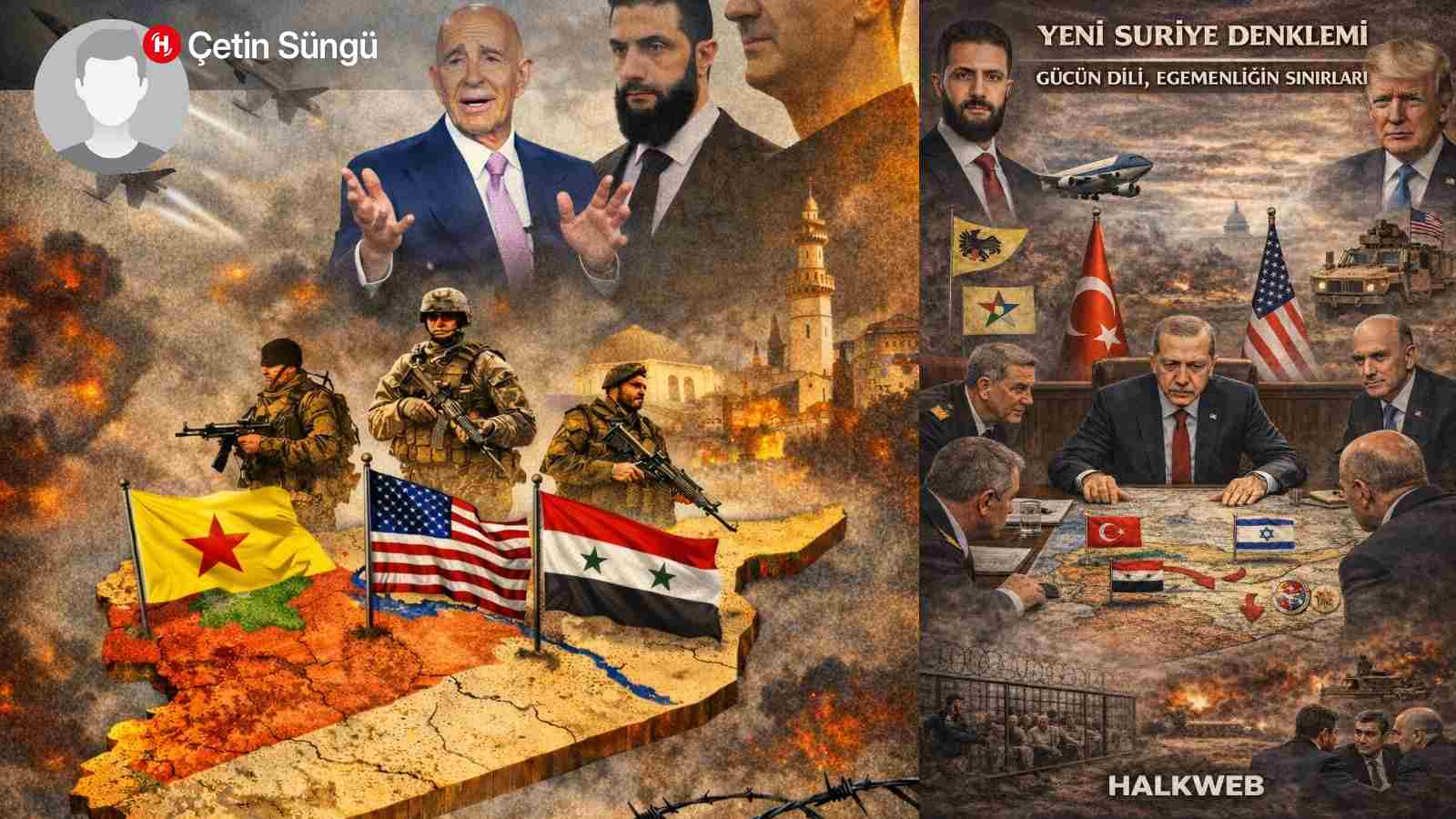
The Syrian issue is no longer a civil war, a temporary security threat or a crisis that can be explained by the influx of refugees. Today, Syria has turned into a political laboratory where the 21st century's understanding of sovereignty is tested and the conditions under which nation-states are rendered dysfunctional are observed. The meetings held in Ankara at the Ministry of National Defense building and the simultaneous harsh but indirect messages coming from Washington clearly show that the experiment being conducted in this laboratory is no longer hidden.
At the center of this experiment is a single question: Is military capacity decisive, or is it who decides the limits within which this capacity is used? Today, the possession of military power is not enough to produce sovereignty; on the contrary, any exercise of power that is not recognized by the global system becomes a direct cost-generating factor. This is precisely the fundamental problem Ankara faces.
Classical diplomacy was based on written agreements, protocols and clear commitments. Today, diplomacy has been replaced by strategic ambiguity. Messages are no longer delivered in texts, but in contexts. What is not said has become more decisive than what is said. “We don't tell you what to do, but you know what you can't do” is the epitome of modern hegemonic diplomacy.
In this context, the SDF “The main ally defeating Daesh” This shows that this structure is no longer positioned as a temporary field element, but as a permanent strategic apparatus. The issue of the nine thousand ISIS prisoners is not a security problem, but a tool to legitimize the US presence in the field. The unresolved problem is not a problem for the US; it is a justification.
“We would not be satisfied with Turkish or Syrian army control” means a deliberate discrediting of the security capacity of sovereign states. What is actually being said is this: Syria is not sovereign and Turkey is not reliable enough. It is no coincidence that these messages were delivered from a US Presidential airplane. Air Force One is not just an airplane, but the mobile headquarters of American sovereignty. The reminder of the Venezuelan example is not a direct threat. “disciplining by example” method. The message is clear: The global order may change, but the control mechanism will not.
The United States “Integrating the SDF into the new Syrian administration” proposal is presented as a technical governance issue. Yet this is a critical break in the theory of the state. Integration is not the dismantling of the armed structure, it is not the linking of the chain of command to Damascus, it is not the transfer of control over territory and resources. The central state becomes visible, but the capacity to use force remains with local actors. This is the classic method of modern imperial rule from Iraq to Afghanistan.
The advance of US armored vehicles west of the Euphrates carries a much clearer message than international legal texts. This military mobilization has three consequences: Turkey's operational space is narrowed, the SDF is given de facto assurance, and the risk of a possible hot confrontation between the US and Turkey is deliberately raised. This is not an option offered to Ankara; it is a reminder of the military cost.
In this equation, the Syrian government's decrees on Kurdish-language education, the recognition of Kurdish identity and the granting of citizenship to formerly stateless Kurds are no ordinary reform steps. On the surface, these decisions appear to be a restoration of rights, but in essence they are a new move on the political front of the SDF-Damascus struggle.
With these steps, Damascus aims to disassociate the entire Kurdish society from the SDF and to make the state umbrella attractive again through individual and cultural rights. The aim is to narrow the SDF's grounds of legitimacy and pave the way politically for military struggle. Here, the recognition of rights is a means, not an end.
But these decrees alone are not a game changer. For the SDF, lasting security is not limited to cultural recognition or citizenship. The real issue is local security, command structure, resource sharing and constitutional guarantees. Without concrete progress in these areas, the SDF cannot be expected to abandon its military capacity and bargaining power. Therefore, the decree will not immediately change the military balance on the ground, but will be decisive in the long-term struggle for legitimacy.
For the US, these steps are not a solution, but a new balancing act. Washington neither wants the SDF to be completely dismantled nor accepts the absolute sovereignty of Damascus. The decrees are a political instrument for the US to recalibrate its position on the ground. If the implementation fails, new justifications will be created for the US to continue its relationship with the SDF.
Therefore, the Syria-SDF relationship will continue to be a process of attrition based on time, legitimacy and implementation capacity rather than a war of results. The SDF cannot become a state; this will not be allowed. Syria cannot establish its full sovereignty in the short term; this will also be prevented. The US will not leave the field, because if it does, the game is over.
For Turkey, the issue is not only the existence of the SDF, but also the permanence of this structure. Every proxy structure that becomes permanent produces a quasi-state across the border. This is a long-term erosion of sovereignty rather than a military threat. Turkey's biggest mistake would be to read this picture only with military reflexes.
Therefore, normalization with Damascus is not a temporary tactic, but a sovereignty-based strategic necessity. A diplomacy that directs, not excludes, the search for a solution to the Kurdish issue inside Syria is in Ankara's favor. The issue of ISIS prisoners should be brought to multilateral international mechanisms; the US's most powerful justification should be narrowed.
In conclusion, the framework drawn for Ankara over Syria today is clear. This framework will not be torn in a hurry; it will be overcome by narrowing it, making it meaningless and neutralizing it over time. Because in this new era, it is not the toughest who win, but the most patient, strategic and consistent ones.
The line stretching from Iran to Russia, from Syria to Turkey reminds us again and again of a single truth:
Security starts with production; sovereignty is built with patience.