




 The age we live in is not only an age of speed, technology or information. We are facing a deeper and more dangerous phenomenon: With a political regime in which morality is systematically suspended. Today “polluted world” is not the sum total of individual corruption or cultural decay; this contamination is institutionalized, rationalized and legitimized.
Morality is no longer seen as a public principle but as a decorative ornament of the private sphere. Governments, corporations, parties and even opposition movements “not the time” and postpones justice by saying “when the conditions are ripe” to an issue to be talked about. Thus, politics has lost its capacity to produce morality; it has turned into an activity of crisis management and power consolidation.
This transformation is not accidental. Neoliberalism is not only an economic policy; it is also a moral regime. In this regime, the human being is not a citizen, but a performing subject, a measured data, a managed risk element. Contemporary politics does not understand the human being as either “security threat” either “economic cost” or “election math” as "utilitarianism". From the refugee issue to unemployment, from women's bodies to the futility of youth, every issue is addressed within this naked utilitarianism.
The governments have to “hard times” legitimizes it through discourse. A state of emergency is constantly produced: Terrorist threat, economic crisis, external enemy, internal enemy, the discourse of survival... As the phenomenon becomes permanent, morality is suspended, law is stretched, rights are postponed, conscience is silenced. The biopolitical reason described by Michel Foucault is at work today in its naked form: Who will live, who will be impoverished, who will be ignored?
However, what is more disturbing at this point is the opposition's inability to produce an ethical break with this regime. Today's opposition is largely trapped in the language constructed by the government. Instead of questioning the securitarian discourse “rational” promises of security; instead of criticizing the market “fair” market; instead of rejecting authoritarianism, it proposes a more “soft” a dream of governance.
This is not a desire to produce an alternative; it is a desire to be a better ruler within the limits of the existing order. However, ethical politics does not begin by accepting the existing limits, but by questioning the legitimacy of those limits.
Today, politics has been reduced to a matter of technical expertise rather than a field of morality. Who communicates better, who manages crises better, who campaigns better? These questions, “what is right?”, “what is just?”, “whose life must be protected?” and other fundamental ethical questions. Thus, politics ceases to be a struggle of values; it becomes the art of governance.
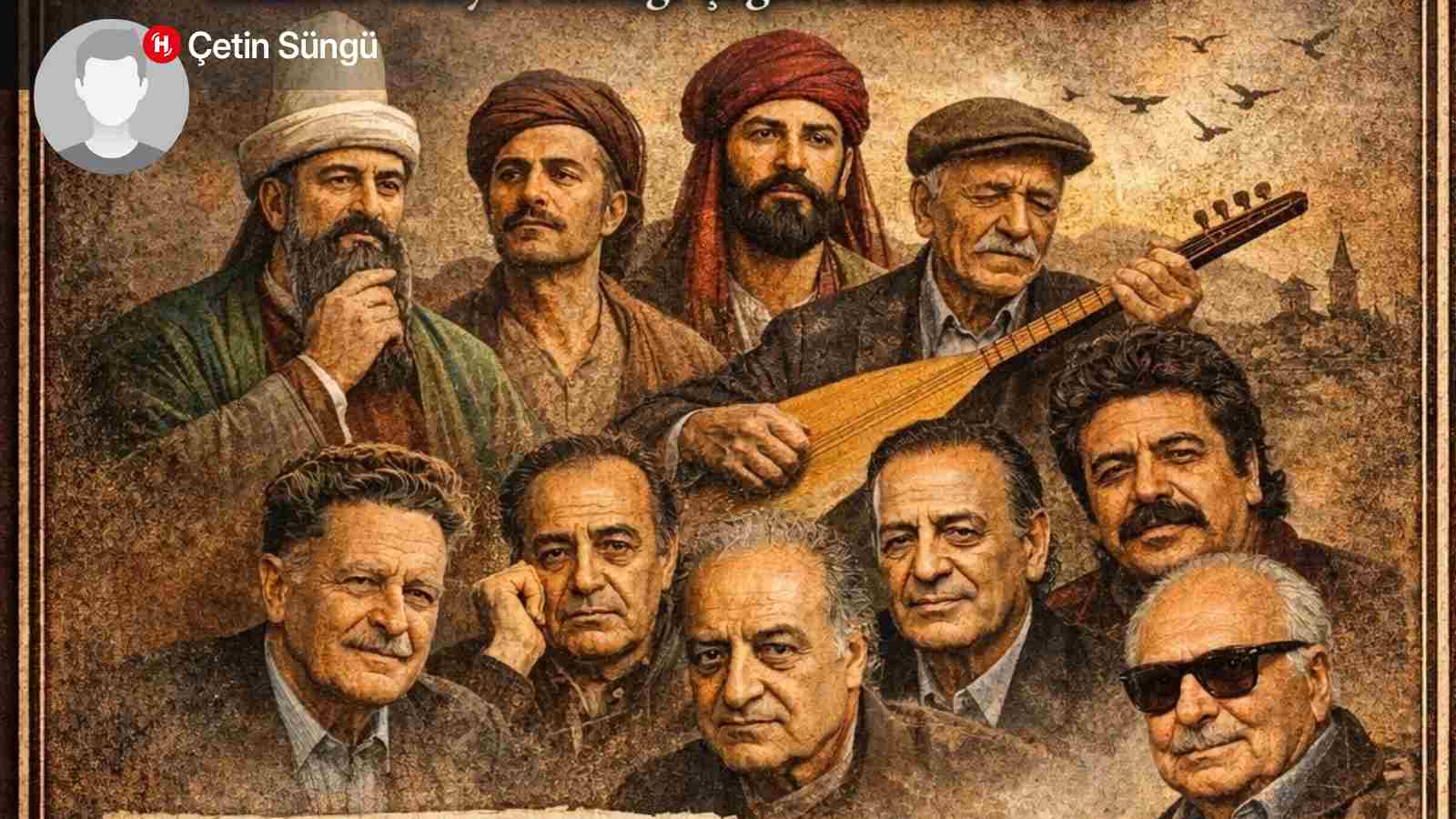
It is precisely at this point that Anatolian wisdom should be reconsidered not as a romantic nostalgia but as a radical political possibility. Because this tradition is one of the rare intellectual veins that does not detach politics from morality.
Haji Bektash Veli's “Don't hurt even if you're hurt” This principle is extremely disturbing for today's politics. Because in our age, power has turned hurting into a conscious strategy. Denigration, stigmatization, criminalization, lynch culture; these are not coincidences, but management techniques. Media language, social media algorithms and judicial practices constantly reproduce this regime of hurt.
The opposition, on the other hand, often does not radically reject this language of violence, but instead uses the same language. “righteous indignation” in the guise of a peacefulness. However, not hurting is not a passive pacifism; it is an active political stance that rejects the logic of domination. To reject the language of violence is to strip power of its most basic means of legitimacy.
Yunus Emre's understanding of the human being is also very instructive for contemporary political theories. In Yunus, the human being is neither the raw material of the state nor the input of the market. The human being is a value in itself. This approach is a radical counterpoint to humanity, which today is besieged by data politics, surveillance technologies and algorithmic forms of governance.
Looking at current debates, it is clear that in every field, from artificial intelligence to social assistance, the human “optimization problem”to what is the best way to live a life. When human life is compressed into cost-benefit calculations, ethical decisions become technical choices. Yunus' approach radically rejects this reductionism.
Hacı Bektaş Veli's understanding of morality over identities is a direct criticism of the world today, which is governed by identity politics. Modern governments rule by fragmenting society, and the opposition often tries to make its own part more visible instead of overcoming this fragmentation. However, morality is not about belonging; it is about the quality of actions.
Pir Sultan Abdal “standing in the right place at the wrong time” His call is still valid for today's intellectuals. To stand in the right place today is not only to oppose power, but also not to reproduce the language of power. In an age when silence is considered reasonable and conformity a virtue, ethical behavior is inevitably uncomfortable.
Âşık Veysel's voice against the contempt for human beings speaks directly to today's class inequalities. Poverty is no longer a fate; it is the result of conscious policies. Despite this, the poor are morally blamed and failure is presented as an individual fault. This is the dirtiest face of neoliberal morality.
Neşet Ertaş's emphasis on culture “culture industry” should be read together with the debates on culture. Governments want to manage culture but cannot produce it. Because culture is born not by order but by experience. This is why repressive regimes imitate art, display folklore in a showcase but lose its soul.
Mahzuni Şerif's love for humanity is one of the most depoliticized “love” re-politicizes the concept of love. Love cannot remain neutral in the face of inequality. Love demands justice. That is why true love disturbs power.
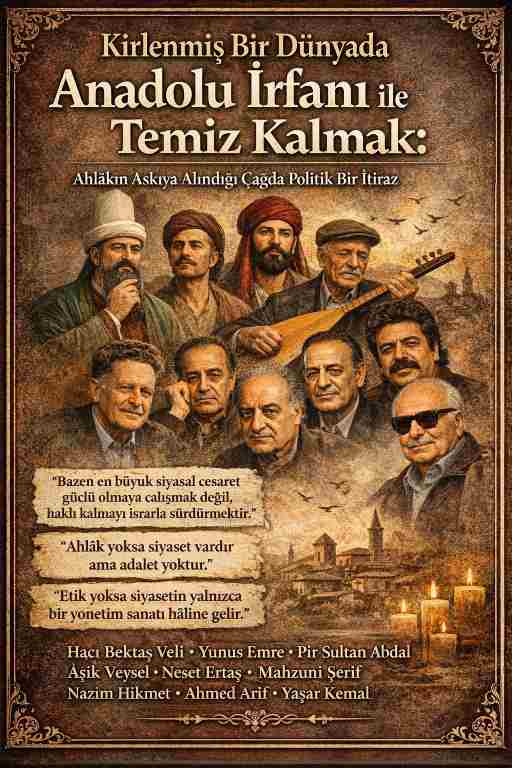
Nazım Hikmet's understanding of the homeland is a powerful antidote to today's oppressive policies based on nationalism. The homeland is not a space where criticism is silenced; it is a common life where thought flourishes. Ahmed Arif's wounded verses are the collective memory of societies whose honor has been damaged. Yaşar Kemal's call for peace is the last breath of humanity against the endless discourse of war.
All this intellectual heritage tells us this:
Morality is not outside politics. If there is no morality, there is politics, but there is no justice.
Staying clean in a polluted world is not an escape today; it is a clear political choice. This choice requires not becoming like the government, not taking refuge in the comforts of opposition and not postponing morality.
Because sometimes the greatest political courage,
not trying to be strong,
is to insist on remaining right.
Brotherly
In this age, to all those who do not surrender their conscience to power, comfort or fear.