




Worker Health and Worker Safety (ISIG) Assembly released its November report on occupational homicides. Worker Health and Worker Safety (ISIG) Assembly published its report on workplace murders in November.
The report has once again revealed how the wheels of exploitation on labor in Turkey have become deadly. At least 216 workers lost their lives in November due to bosses' greed for profit and lack of supervision.
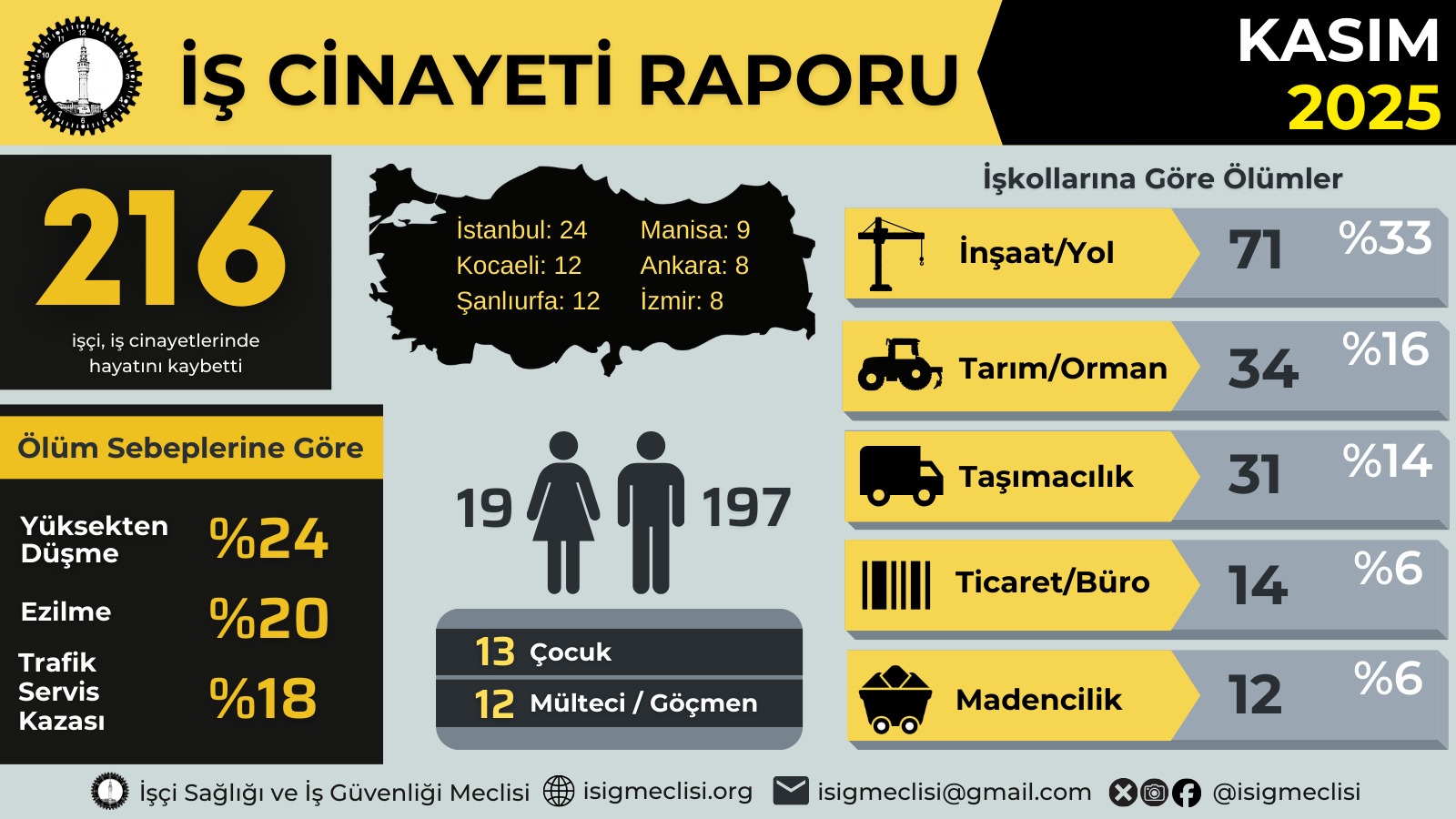
This is the highest number of deaths in November since 2011, when the OHS Assembly started keeping reports, excluding extraordinary periods such as the Soma massacre and earthquakes. In the first 11 months of 2025, the total loss of life reached 1956.
13 children died while working in one month
The most striking title in the report was child labor murders.
In November, 13 children lost their lives in labor murders and 85 children lost their lives in 2024. This number went down in history as the highest number of child labor deaths recorded.
The OHS Assembly reminded the names of those children one by one in the report: “İsa, Metehan, Nursefa, Tuğba, Nisanur, Cansu, Muhammed, Hikmet, Onur, Sedat, Yakup, Alperen and Mustafa... They lived 14 to 17 years. This order did not give them their childhood. They died by burning in the workshop, being tortured, falling from construction sites, being thrown on the road and crushed under a tractor.”
With the government's education policies and deepening poverty, children are torn away from school desks and put into the service of capital, and the price of this is paid with loss of life.
The axis of child labor in Turkey has shifted from rural to urban areas, factories, workshops, industrial sites and construction sites with the MESEM-like policies implemented in recent years. Children are exploited as cheap labor under the guise of “apprentices” or “interns”.
71 workers killed in construction
The construction sector continues to be the area where precarious labor and the subcontractor system are the most brutal. In November, 71 construction workers lost their lives. This is one of the highest number of deaths recorded in the construction sector in a single month.
Especially in industrial basins such as Dilovası, the system of slavery in which women and children work without insurance, for up to 12 hours a day, for periods up to 12 hours a day, for less than the minimum wage, prepares the ground for occupational homicides. The fact that 85 percent of “falling from height” cases, the leading cause of death, occur in construction sites proves that occupational safety measures are seen as a cost item and ignored.
Death in agriculture and on the roads
Construction was followed by agriculture with 34 deaths and transportation with 31 deaths. It was noteworthy that the deaths continued even though the summer months, when agricultural labor is intense, are behind us. 12 of those who lost their lives were migrant workers.
Occupational homicides were mostly concentrated in provinces with high industrial and agricultural production such as Istanbul, Kocaeli, Şanlıurfa, Manisa and Ankara.
When poverty, the burden of the economic crisis and the informal labor market are added together, a bitter picture emerges: Children forced to work. Innocuous phrases such as “contribution to the family budget”, “let them learn a trade”, “let them cook with the master” are in reality just a thin veil covering the atrocities.
What we see behind that veil is this:
Children are seen as low-paid and obedient labor. Uncontrolled, cheap, unquestionable. A boon for workplaces. For the state, a detail that is often ignored.
But the reality is this: If children die while working in a country, there is no system in the interest of workers and laborers. There is only a struggle for survival, and that struggle crushes children the most. The struggle against occupational homicides cannot be fulfilled only by demanding inspections. The success of the struggle is possible with a new system that will eradicate poverty.