



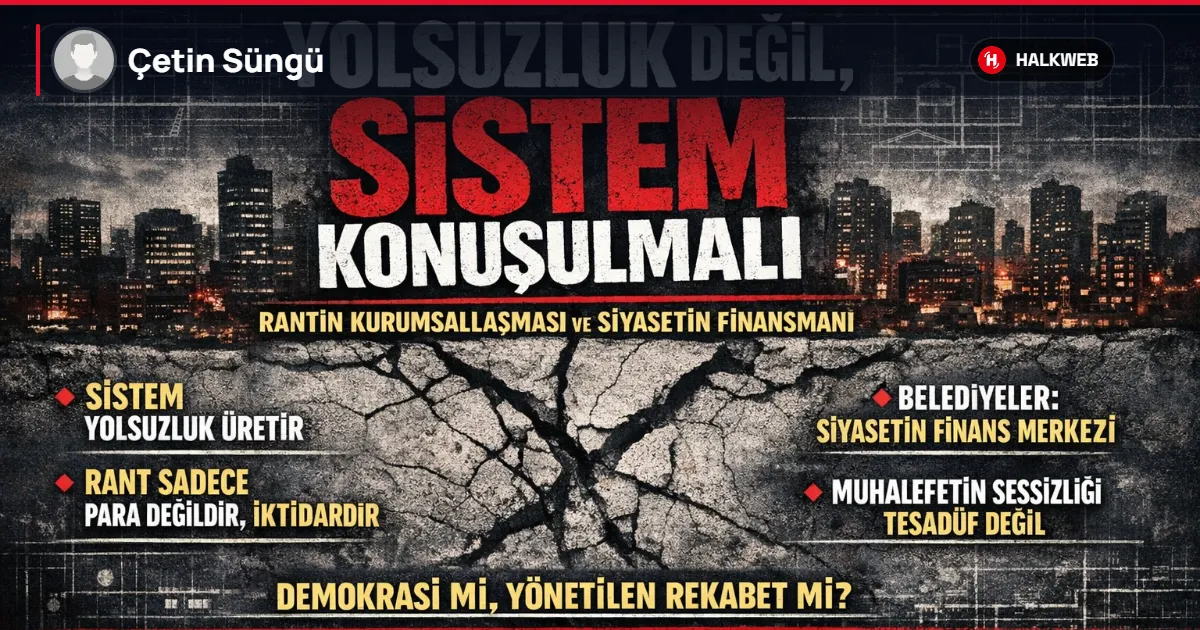
Politics in Turkey has long revolved around a false question.
Question:
“Who is corrupt?”
But this question does not help to understand the issue, but to conceal it.
Because that has never been the right question.
The right question is this:
“Why does this system systematically produce corruption?”
Unless you ask this question, every operation is an illusion.
Every claim of “cleanliness” is just a wiping of the surface.
Because there is no deviation.
There is a System There is.
But this system is not just about legal loopholes, as many believe.
It is a system that works together with economic incentives, political needs and institutional design.
In other words:
Corruption in Turkey is not an individual aberration;
is an institutionally produced outcome.
THE POLITICIZATION OF RENT, THE RENTIFICATION OF POLITICS
In modern Turkey, local governments have ceased to be “administrative units producing public services” in the classical sense.
They are now:
- Resource allocator
- Creating value through zoning
- Distributing wealth through tenders
quasi-economic, quasi-political power centers.
This transformation is not unique to Turkey, but the difference in Turkey is that this structure over-concentrated and uncontrolled is that.
There are three critical elements underlying the transformation of local governments into such powerful economic actors:
- Unlimited zoning authority
- Political influenceability of procurement processes
- Non-audit of municipal companies
If a zoning plan creates millions with the stroke of a pen,
bidding processes reward loyalty rather than competition,
if municipal companies are de facto exempt from audit...
There, “corruption” is no longer a deviation,
is the natural way the system works.
And more importantly:
This structure is not only economic, but also generates political power.
Because rent is not just money.
Rent is also It generates loyalty, builds networks and consolidates power.
FINANCING POLITICS: THE INVISIBLE CONSTITUTION
Turkey has a written constitution.
But there is also a de facto constitution.
It is the constitution, is how politics is financed.
How do political parties survive?
How to run election campaigns?
How can the cost of these huge organizations be covered?
There is no transparent and institutional answer to any of these questions.
The reality is this:
Politics has become a high-cost activity.
And not through cost, transparent and institutionalized mechanisms,
most of the time indirect and informal relations is covered.
This is where local governments come into play.
- Tender processes
- Zoning regulations
- Municipality companies
Not only the means of service production, but also
indirect channels of political financing it becomes.
That is why municipalities in Turkey do not only manage cities.
At the same time finances politics.
No discussion is meaningful without understanding this sentence.
Because here we have this critical threshold:
Politics has become dependent on its own financing model.
And this model is not about change,
it needs the continuation of the existing order.
COMFORT OF THE WRONG QUESTION
That is why the public is constantly being led to the wrong question:
“Who did it?”
“Who's guilty?”
“Who's clean?”
None of these questions are important for the system.
Because the only thing that matters for the system is this:
Is the wheel turning?
If it is spinning, who the actors are becomes secondary.
Today one name goes, tomorrow another comes.
But the mechanism remains the same.
That is why debates in Turkey never deepen.
It cannot deepen.
Because the moment it deepens,
The system itself has to be the subject of debate.
And at that point everyone stops talking.
DEMOCRACY'S INSTITUTIONAL VACUUM AND POLITICAL MONOPOLY
THE OPPOSITION'S SILENCE: STRUCTURAL, NOT MORAL
What is remarkable here is not what the government has done,
It is what the opposition does not do.
All these operations, all these allegations, all these crises...
But nobody comes out and says:
“Let's change this system.”
Why?
Because this system is not just accepted;
internalized.
This internalization is not a simple relationship of interest.
This is an issue that shapes the entire political sphere. is a mechanism of adaptation.
For the opposition, the issue is not the elimination of rent;
rent is a change of hands.
Therefore, the gap between the opposition's rhetoric and practice is no coincidence.
This gap is directly related to the is the result of the incentive structure.
Today's victim wants to preserve the possibility of becoming tomorrow's ruler.
So nobody wants to change the rules of the game.
Because if the rules change,
there's no point in being an actor.
POLITICAL PARTIES LAW: THE BOTTLENECK OF DEMOCRACY
When discussing democracy in Turkey, the most critical text is systematically ignored:
Law on Political Parties.
Yet this law is the fundamental text that defines the limits of democracy in Turkey.
The structure created by this law is this:
- Centralization of internal party decision-making mechanisms
- Institutional strengthening of leadership
- Detaching candidate selection processes from the grassroots
This structure does not directly limit the will of the voters.
But he does something more dangerous:
It controls the choices put in front of the voter.
Therefore, voters in Turkey vote.
But he does not decide what to vote for.
At this point, democracy ceases to be a mechanism of choice;
becomes a confirmation operation between pre-filtered options.
This does not only lead to a crisis of representation.
It also produces the following result:
Political elites feed on the system, not the grassroots.
And the system, not those who want to change them,
elevates those who adapt to it.
DEMOCRACY OR MANAGED COMPETITION?
There is a discourse we often hear today:
“The right to vote and be elected is under threat.”
True. But incomplete.
Because this discussion is incomplete without asking these questions:
- Are the candidates really chosen by the people?
- Or are they appointed behind closed doors?
- Is the elected person loyal to the people or to the center that nominated him/her?
The answer to these questions is clear but unspoken.
If political representation is more than the will of the people
is shaped by the balance of power within the party,
not democracy there,
a managed competition There are.
The boundaries of this competition are pre-drawn.
Actors have been identified.
And most importantly:
It is directly linked to the capacity to access resources.
And at this point politics becomes tied back to the economy.
Because ideology is not the fuel of competition,
resource allocation capacity.
MINDSET, NOT LAW: BUT LAW FIRST
There is a common escape in Turkey:
“It's a question of mentality.”
Yes, it is.
But this sentence is often is used to change nothing.
Because mentality does not form in a vacuum.
Mentality is shaped within institutions.
If you do:
- If the Political Parties Law absolutizes the leader,
- If the electoral system disables the grassroots,
- If local government legislation encourages rent generation...
Then it is good faith in the system,
is not a sustainable option.
Good people come, either transformed or eliminated.
Hence the “well-intentioned politician” narrative in Turkey,
often conceals a structural truth:
The problem is not the people, but the mechanism that shapes them.
THE SYSTEM HAS NO MORALITY, IT HAS INCENTIVES
No one wakes up in the morning and says, “I am going to be corrupt”.
But if a system rewards certain behaviors,
those behaviors become the norm.
In Turkey, the system rewards this:
- Loyalty
- Closed relationships
- Non-transparent processes
And he is punishing this:
- Transparency
- Accountability
- Corporate discipline
At this point, morality ceases to be an individual choice.
Behavior that is compatible with the system becomes “rational”.
Then we go back and ask:
“Why is it always the same?”
Because we are not changing the machine that produces the same things.
SYSTEM SELF-PROTECTION MECHANISMS AND INEVITABLE BREAKAGE
CORRUPTION OPERATIONS: POLITICAL TOOL, SYSTEMIC CURTAIN
Today's operations are presented to the public as “cleansing”.
But these operations are not the system itself,
targets actors within the system.
It is therefore incomplete to read these operations only as legal processes.
They are also instruments of the reorganization of the political sphere.
So it serves two functions:
- Becomes a tool for political power struggle
- Puts the system itself out of the debate
This second function is more critical than the first.
Because the system survives without having to defend itself directly.
So the paradox is this:
The image of fighting corruption,
protects the order that produces corruption.
This is not a contradiction;
on the contrary, it is the system's most refined defense mechanism.
HOW DOES THE SYSTEM REPRODUCE ITSELF?
Every system develops specific mechanisms to ensure its own continuity.
In Turkey, these mechanisms operate at three levels:
1. Legal level
Legislation is designed to protect existing power relations, not the need for change.
2. Political level
Rather than transforming the system, inter-party competition is oriented towards gaining advantage within it.
3. Economic level
Resource allocation is organized in a way that fosters political loyalty.
What emerges when these three levels are combined is this:
A rent system that reproduces itself.
And the most important feature of this order is this:
It feeds on crises but is not destroyed by them.
Because even in times of crisis, the debate is not about the system itself,
actors.
LOCAL GOVERNMENT REFORM: INTERVENTION IN THE HEART OF THE SYSTEM
If there is to be a real breakthrough, it will not come through abstract debates,
directly with interference in local government structure has to start.
Because this is the center of rent generation in Turkey.
The reform of local governments is not a technical arrangement;
is the restoration of the political-economic order.
This reform must be based on three main axes:
1. Limitation of zoning authority
As long as zoning decisions are left to the discretion of individual or narrow cadres,
rent generation is inevitable.
Therefore:
- Plan amendments should be subject to multi-layered review
- Arbitrary interventions should be made legally impossible
- Value increases should be recovered through public mechanisms
Otherwise zoning is not urban planning,
wealth transfer tool and it continues to be.
2. Radical transparency of the procurement system
As long as tender processes remain closed,
political loyalty becomes an economic reward.
Therefore:
- All tenders should be moved to a real-time open data system
- Proposals, evaluation processes and results should be publicly available
- Exception procedures should be minimized
Because sealed bidding is not only economical,
produces a political closed circuit.
3. Redefining municipal companies
Today, municipal companies are the least regulated area of the system.
This structure
- Creates a gray area between the public and private sectors
- Makes supervision difficult
- Makes resource transfer invisible
Therefore:
- All activities should be opened to independent audit
- Financial statements should be made publicly available
- Governance structures should be made transparent
Talk of reform without leaving these structures untouched,
is a break with reality.
FINANCING POLITICS: NO CHANGE WITHOUT FRACTURE
Local government reform alone is not enough.
Because the mechanism continues to work without the system's fuel being cut off.
This is why the issue of financing politics must be tackled head-on.
- All donations and revenues should be made transparent
- There should be a cap on election spending
- Non-public financing should be subject to strict controls
Otherwise, politics will be ideological on the surface, but in reality
a field shaped by relations of financial dependence and it continues to be.
And as long as this dependency persists, no actor will risk changing the system.
WHERE DOES THE REAL BREAK COME FROM?
If something is really going to change, these topics have to be touched:
- Regulations mandating intra-party democracy
- Making candidate nomination processes transparent
- Making political financing open, auditable and limited
- Limitation and supervision of municipal zoning powers
- Making all tender processes real-time, open data
- Opening municipal companies to independent audit
Every step taken without doing so,
is a cosmetic intervention.
THE ANSWER DOES NOT CHANGE UNTIL THE QUESTION CHANGES
Politics in Turkey has been living in the comfort of wrong questions for a long time.
“Who did it?”
“Who's guilty?”
“Who's cleaner?”
No, no, no.
The question remains:
Why can't this system work without contamination?
Those who don't ask this question,
can be a victim of this system.
But those who deliberately avoid asking this question,
is no longer just a victim.
He is a partner in this order.
HISTORY WILL NOT CHANGE UNTIL THE GAME CHANGES
Real change happens with rules, not with people.
Names change without changing the rules.
And in this country it is no longer an issue,
not who is in power,
is how power is produced.
Without this question being asked,
no answer will be real.
And without this question being asked,
no change will be permanent.