



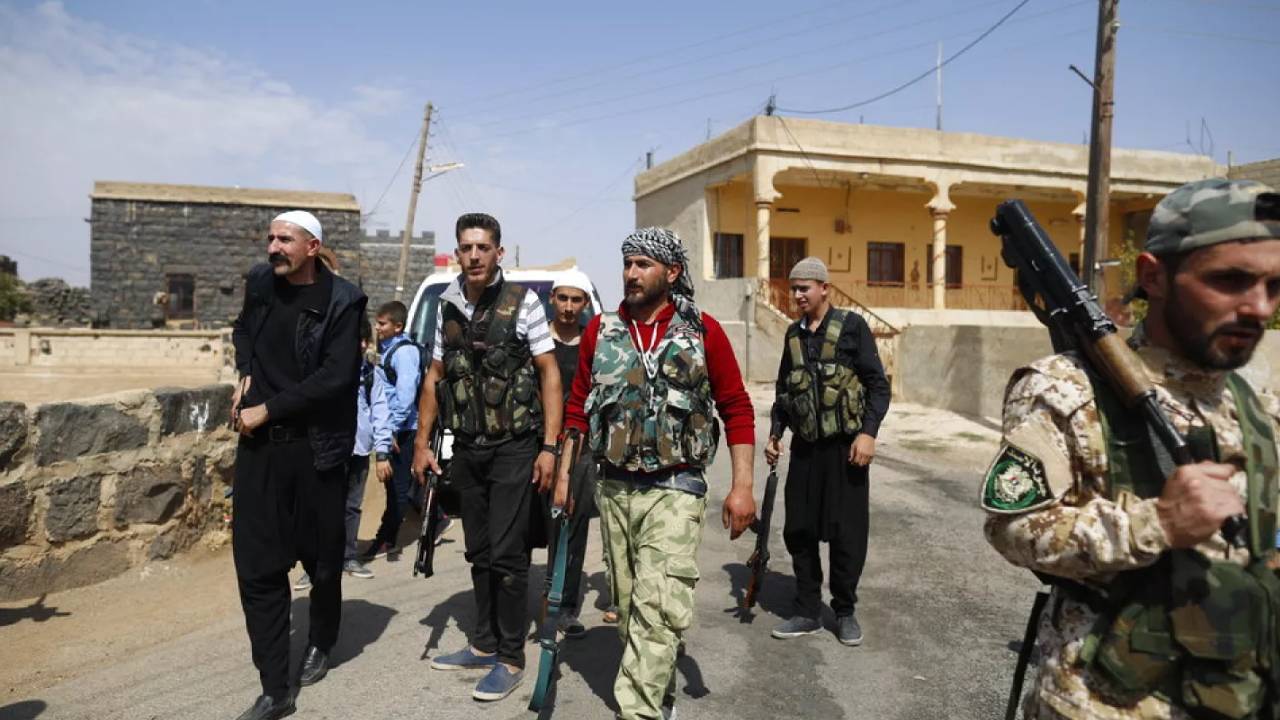
Clashes between Druze and Sunni armed groups are taking place in the countryside of the Syrian capital Damascus.
The clashes began on April 29 when an audio recording allegedly insulting the Prophet Muhammad was shared.
Following the recording, protests were organized across the country.
It was claimed that the voice belonged to a Druze cleric, but he denied the allegations.
The Syrian Interior Ministry said in a written statement that the person in the recording was not the name in question.
As a result of the escalating tensions, Druze and Sunni groups clashed in the Druze-populated town of Jaramana in the Damascus countryside.
On April 30, these clashes spread to the town of Sahnaya, near Ceramana, where security forces also intervened.
Israel, which announced in recent months that it would protect the Druze, carried out an airstrike in Sahnaya on April 30.
The UK-based Syrian Observatory for Human Rights (SOHR) announced that at least 102 people were killed in clashes in the last two days.
It was reported that 71 of the dead were members of the Druze community, while 30 were members of the security forces or pro-Damascus armed groups.
SOHR bases this information on local sources.
Government officials told Syria's official SANA news agency that a ceasefire was declared in Jaramana after clashes.
On April 29, the Enab Baladi news website reported that the ceasefire will include compensation for the relatives of the dead and the prosecution of those responsible.
Reuters news agency reported that Damascus authorities and some religious leaders from Ashrafiyat Sahnaya met on April 30 and agreed to end the fighting.
At a meeting in the predominantly Druze city of Suwayda, leading figures from the community and armed groups agreed that the Druze are an integral part of a united Syria.
A spokesperson for the community emphasized their rejection of “separation, division or severing ties”.
On the other hand, Druze religious leader Sheikh Hekmat-ul-Hijri claimed that a “campaign of genocide” was being waged against the minority group and called on the international community to intervene to restore peace and prevent the continuation of these crimes.
Hundreds of security guards were dispatched to Sahnaya after the agreement.
Speaking to Reuters, Sahnaya resident Elias Hanna said there was “extreme panic and fear” in the city.
“We fear that the massacres on the coast will be repeated here against the Druze,” Hanna said.
In March, hundreds of people were killed in clashes between alleged pro-Assad groups in Latakia and Tartus on the Mediterranean coast.
United Nations and Turkey call for restraint
Syria's Grand Mufti Sheikh Osama al-Rifai, who was appointed in March, said that “every drop of Syrian blood is precious and must not be wasted,” SANA reported.
“Everyone must return to their minds, hearts and consciences, refrain from calls for revenge and retaliation, and allow justice to prevail so that souls can rest in peace,” Al-Rifai added.
The United Nations (UN) said in a statement that UN Special Envoy for Syria Geir O. Pedersen is “deeply concerned” about the “unacceptable violence” in the country.
The statement called on all sides to show restraint and called for a halt to Israeli airstrikes.
Pedersen also called for the prosecution of those responsible for the outrage and the killing of civilians and for “absolute respect” for Syria's sovereignty.
Turkish Foreign Ministry spokesperson Öncü Keçeli posted on her X account about the developments in Syria.
“We are confident that the violence will be brought to an end through dialogue and common sense and that those who played a role in the incidents will be brought to justice,” Keçeli said in his post.
The foreign ministry spokesperson also said that Israel should end its airstrikes, which are “undermining the unity and integrity efforts in Syria.”.
Israel launched an airstrike
Israeli Prime Minister Binyamin Netanyahu's office also released a statement on the events.
The statement announced an airstrike on “an extremist group preparing to attack the Druze population” in Sahnaya.
“A serious message was sent to the Syrian regime: Israel expects them to prevent harm to the Druze community.”.
Under Bashar al-Assad, who was ousted in December 2024, Israel frequently carried out airstrikes in Syria.
After the fall of the Assad regime, these attacks continued, especially against military bases belonging to the Syrian Army.
Israel does not usually announce that it is carrying out these attacks.
However, both Netanyahu's office and the Israeli Army's social media account issued statements about the airstrike in Sahnaya.
The Israeli Air Force targeted elements “attacking Druze civilians near Damascus,” the Israeli military said in a statement.
The post also stated that Israel's Chief of Staff, General Eyal Zamir, “instructed to prepare to attack Syrian regime targets in the event of continued violence against Druze communities.”.
Israel also announced the evacuation of three Syrian Druze to Israel for treatment.
Binyamin Netanyahu had threatened to respond militarily to the violence against the Druze after the fall of the Bashar al-Assad regime.
Analyst Michael Horowitz told AFP that by positioning itself as the “protector” of the Druze community, Israel aims to limit the authority of Damascus, which it sees as a “mandate of Turkey and a potential enemy”.
The Syrian Foreign Ministry also issued a written statement on the Israeli airstrikes.
The statement, which did not directly mention Israel, said foreign interference in Syria's internal affairs was “categorically rejected”.
SANA quoted the statement as stressing Damascus“ ”unwavering determination to protect all elements of the Syrian people, especially the honorable Druze community, which has always been and remains an integral part of the Syrian national fabric.".