




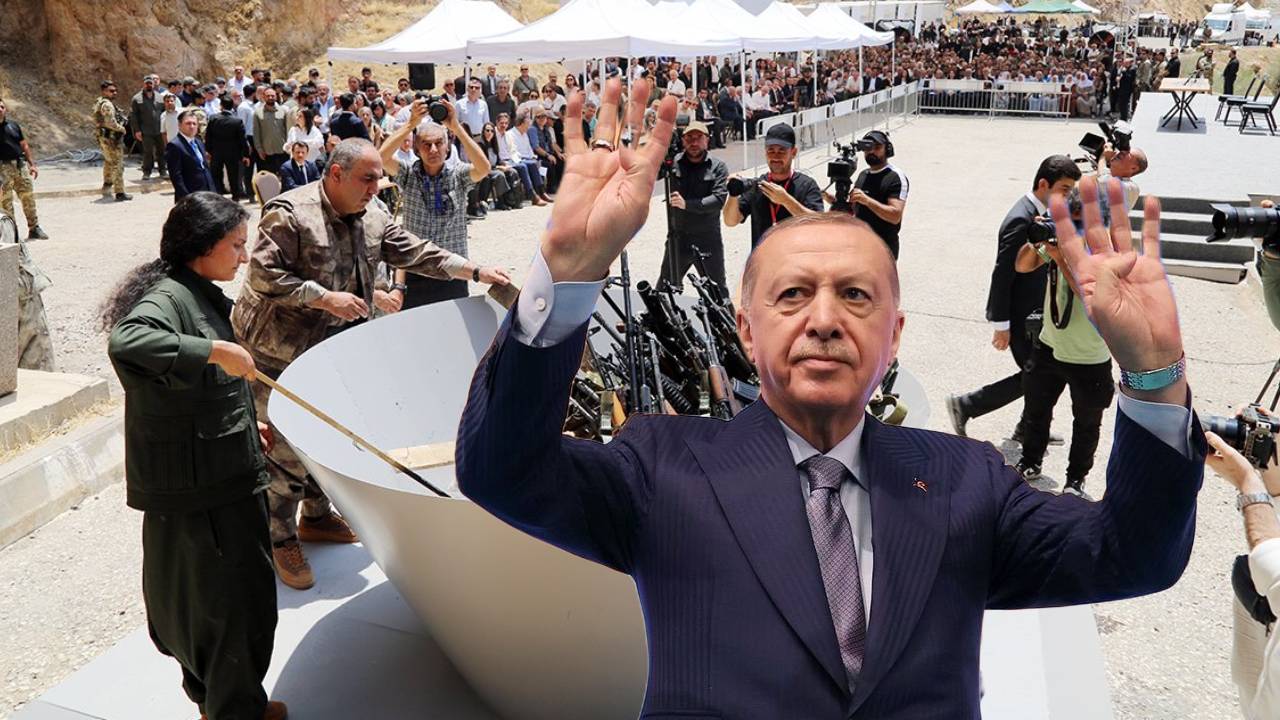
 The process, which started with Devlet Bahçeli's call on October 22, 2024, entered a new phase with the PKK's symbolic laying down of arms on July 11.
First of all, you should know that I am writing these lines as someone who has supported the idea that ‘war has no winners and peace has no losers’ from the very beginning.
For a long time, there was a debate about whether the project initiated by Bahçeli, which the government later renamed ‘Turkey without terrorism’, was ‘domestic and national’ or a project created by the US-Israel-Britain.
It is obvious that a project/policy being ‘local and national’ is no guarantee that it will benefit the people.
‘The most typical example of this is that the economic program implemented under Nurettin Nebati, which is said to be ’domestic and national', and the IMF patented program implemented by Mehmet Şimşek are both anti-people programs.
In many broadcasts I have participated in, I have responded to the frequently asked question ‘why this process has come out of nowhere’ by saying ‘mutual obligation’.
I still think it was.
As a matter of fact, Cengiz Çiçek, an Istanbul MP who was a member of the DEM Party's İmralı delegation and worked as Abdullah Öcalan's lawyer for many years, was asked at a non-governmental organization in Istanbul about the process before the guns were fired, ‘where did this process come from? Do you trust Bahçeli and Erdoğan?’, he answered as ‘mutual obligation’.
There is no doubt that both the Republic of Turkey and the PKK see it as imperative for them to silence the guns, and this is not independent of what has happened in the Middle East over the last 20 years.
The situation in Syria and possible developments in Iran are the main factors creating this state of ‘necessity’.
The situations that create a state of necessity for the state and the organization are a topic for another article. But let's try to find an answer to the question ‘What will happen next?.
The ruling party has been saying from the beginning that ‘this process is not a bargaining or give-and-take process. There are no conditions’, but it is now clear that there is a consensus to recognize the PYD's status in Syria in the medium to long term.
As a matter of fact, I have consistently stated after October 22nd that Rojava is the crux of the process.
It is understood that this will be communicated over time.
Another bargaining issue was rumored to be the ‘constitutional amendment’.
Again, the ruling party has repeatedly stated that the issue is not a matter of constitutional amendment. The parliamentary commission called for by Bahçeli is said to work on “some legal steps” related to the process.
Would the DEM Party side work together with the People's Alliance on a constitutional amendment?
Without a draft constitution, it is not possible to say anything definite about this not only for the DEM Party but also for all other parties.
HDK Co-Spokesperson and former HDP MP Ali Kenanoğlu responded to my colleague Ali Kemal Erdem's question ‘What would your party's attitude be if Öcalan calls you to support a constitutional amendment to be brought by the People's Alliance?’ in a broadcast we attended as follows:
“Such a call will not come. The DEM Party has many components and if such an imposition is made, there will be no party left.”
If the aim is not to remove all limits on Erdoğan's presidential candidacy through a constitutional amendment, then is there another political goal?
Tayyip Erdoğan's discourse of a ‘Turkish-Kurdish-Arab alliance’ at his party's camp in Kızılcahamam sparked a debate: ‘Is there an attempt to build a new Ummah-based method?.
Moreover, his statement that ‘We, AK Party, MHP and DEM Party, have decided to walk this path together’ drew the reaction of many, especially the main opposition party CHP.
As a matter of fact, CHP Chairman Özgür Özel, who supports the ‘Turkey without terrorism’ process
Özel said, “He is Kurdish-Turkish-Arab. DEM is the representative of Kurds, MHP is the representative of Turks and he is the representative of Arabs. He will build a roof. The roof will have an ummah consciousness, not a citizenship consciousness. He will establish a new alliance based on Sunni Islam and will walk with a new alliance based on this. We will do everything to prevent martyrs. As CHP, we will stand where we should stand, but we will not let you calculate Turkey on the basis of ummahism and sectarianism in this geography.”.
Erdoğan said to Özel: “He accuses us of ummahism. For God's sake, since when did it become a crime to defend the cohesion, unity and solidarity of the ummah! Of course, these people do not know what ummah consciousness is.”.
In fact, Erdoğan would love it if the debate shifted to the ummah/nation axis when the parties are AKP and CHP. He knows very well that he will gain political ‘bread’ from this debate.
So what does the DEM Party, which Erdoğan says “we have decided to walk this path together”, think about a companionship based on the ummah?
If the ‘democratic society’ model in Abdullah Öcalan's call turns into ‘ummah brotherhood' in the People's Alliance, will DEM Party continue to walk this path together?
How compatible will the model of “democratic socialism“ in Öcalan's call be with the ummah model of the Republican Alliance?
Where and how will the secular sections of this country, non-Muslims, Armenians, Assyrians, Yazidis take part in this unity of the ummah?
Will Alevi citizens, for example, be included or excluded from this brotherhood of the ummah?
In the event of a problem with Iran tomorrow, will the Shiites be considered as part of the brotherhood of the ummah or is this a sect-based ummahism?
The rightness or wrongness of some of the policies and practices implemented since the foundation of the Republic can be debated, no doubt. However, if you try to impose an understanding of ummahism, which was not even a cure for the Ottoman Empire, as a solution for this country 150 years later, you will not only serve the US and imperialism, but you will also be the first to strike the first axe on the sapling of ‘Peace’, which everyone should protect and grow with great care.
Fantastic quests that try to work history backwards have always brought disasters to humanity. If you try to turn the DEM Party, which assumes responsibility for the construction of peace, into an apparatus for the construction of the ummah, you will first confront a large part of its own base, and then you will have difficulty finding an interlocutor to defend peace.
The “Ottoman nation system” model proposed to Turkey by Tom Barrack, the US ambassador to Ankara and Trump's Special Envoy to Syria, may seem like a brilliant idea to some as a fantasy that has been set up for years in TRT propaganda series, but trying it would end up Lebanonizing Turkey.
If this is not what is really wanted, the model of the ummah nation not only serves imperialism, but also undermines peace.
Building an integrated intellectual struggle that realizes that one cannot be anti-imperialist without being anti-capitalist should be the first task of Turkey's socialists and leftists.