



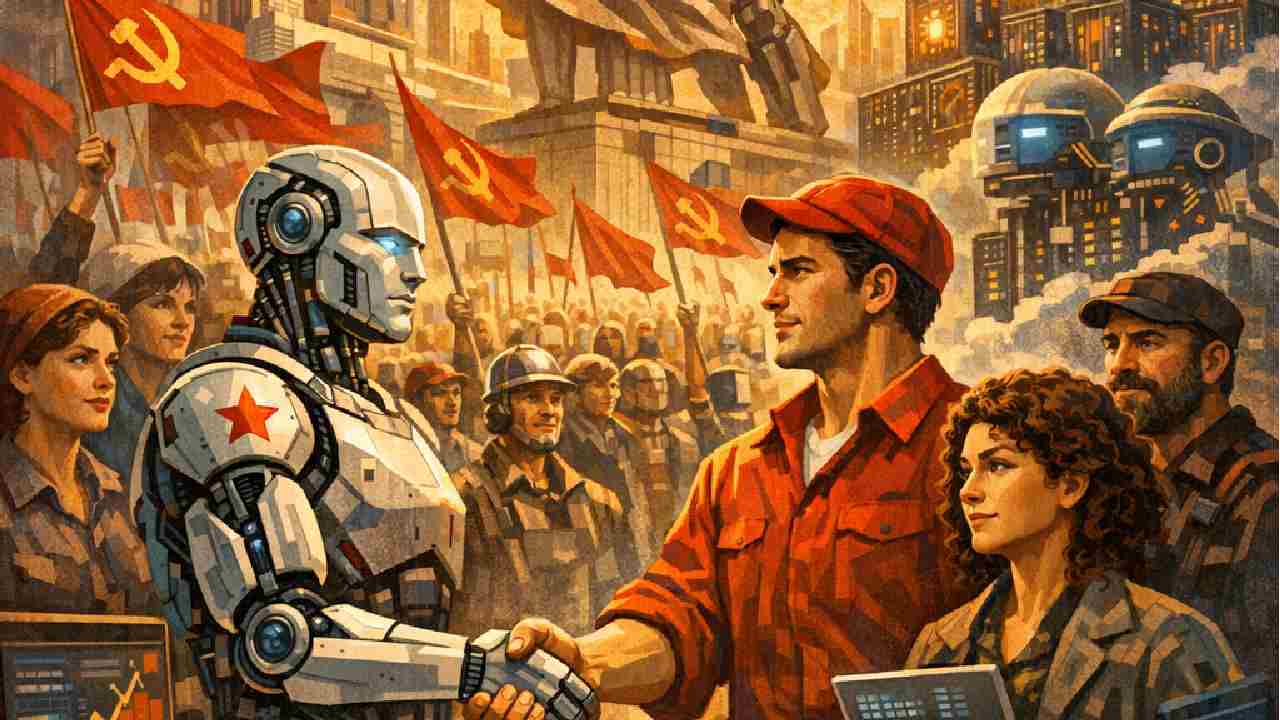
With the deep crises inherent in capitalism, the left in the world and in Turkey has been working intensively in recent years to identify the root causes of this stagnation, which runs parallel to the system. In one of the last links of these discussions, Kemal Okuyan stated on a YouTube channel that they are “basically focusing on an organization model in workplaces, neighborhoods and schools” and added the following: “The Turkish left has to get out of the shadow of the CHP and the DEM.”
This is undoubtedly an accurate observation; however, it is not enough to fully explain the scientific contexts and cause-effect relations of the phenomenon. Because even if we remove this “shadow” issue and the political residue it creates, there is still no concrete, organic answer to how to build that vital bridge between the human of 2026 and its age-specific sophisticated problems and the promises of revolutionary alternatives. In the following section of this article, we will touch upon the Gezi Uprising, which is a case study of the reflections of this question on the ground. I specifically define the model of “politics appropriate to the target audience” that the left, including Okuyan, frequently discusses as a “result”. Because even if such determinations are correct, the tendency to gain power through temporary advantages in the cyclical flow of political periods by failing to recognize the blockage of internal development is a manifestation of looking for the problem in the wrong place; that is, focusing on the phenomenon, not the essence.
Every social advance is not just a mechanical summation of the scientific data that preceded it, but a radical synthesis of that data and a revolutionary challenge to its predecessor. Today, we have a responsibility to discuss the apparent stagnation of the revolutionary neighborhood around the world, not with nostalgic consolations, but on a much bolder, scientific and principled ground. Scientific Socialism has earned its status as the highest and most systematic science of society that modern man has ever achieved, not only because of its “intentions” but also because of the dialectical power of the scientific source from which it draws.
So, what is science? In its simplest form, it is the accumulation of knowledge that is objective, verifiable, critical and open to CONTINUOUS DEVELOPMENT. The ground that gave birth to Marxism was the biology, sociology and psychology of the 19th century into which it was born, as well as the state of the art of that day. To put it from a different angle: if the founders of scientific socialism were alive today, would they still be writing and developing the theory in order to process the scientific data accumulated today? The scientific answer: YES.
But if they are not alive today, who will carry this sacred legacy to the dynamism it deserves?
Undoubtedly, being able to process all the data accumulated today as skillfully as they did is no longer the work of a few individuals, but rather an inter-institutional scientific mobilization. One thing must be clearly established: Every individual, and therefore every society, is a product of the relations of production in which it exists, as well as the scientific data that shape these relations. The individual, society and even the ruling class construct their existence, defense mechanisms and ideological apparatuses according to the level at which the systematic of production and the sum of scientific data have reached.
It is imperative to recognize a critical paradox here: Although there is an emancipatory and progressive route between society and science, the fact remains that the ruling system uses science and technology under its authority as a “fortification tool” for the survival of the status quo. Therefore, even though capitalism seems to be struggling under the shadow of the structural crises of its own making, it is capable of making every new service of science a new “armor” for itself. In this way, it has been able to extend its life through technological reinforcements. Today's global capital has reached the capacity to manage social needs through sophisticated data analytics that the 18th century bourgeoisie could not even dream of.
When socialist ideology was acquiring a scientific form, Marx and Engels used the industrial stage of their time with the rigor of a laboratory to present this legacy to humanity. Likewise, Lenin, using the same dialectical method, integrated the data of his own period into the theory in the most ideal way while diagnosing the 20th century stage of capitalism. In our country, apart from the theoretical contributions of Hikmet Kıvılcımlı, a more practical legacy was left behind. Today, the graph of scientific development has accelerated 40 times faster in the last 20 years than in previous periods. When we categorize the evolution of capitalism, we can clearly see what theoretical tasks have accumulated before the left:
* Industry 1.0 (1780s): The birth of steam power and mechanical production.
* Industry 2.0 (1870s): Mass production based on electricity, which gave rise to Marxism.
* Industry 3.0 (1960s): The arrival of electronics and information technologies on the scene; the first steps of automation and digitalization.
* Industry 4.0 (2010s): Cyber-physical systems and full integration of production with digital networks.
* Industry 5.0: And the Artificial Intelligence-based processes we are breathing in today. A completely different model of relations of production in which the human being is removed from the center of production, robotic technologies come to the fore, and thus capitalism mutates.
The main difference that distinguished scientific socialism from all other ideologies was that it was the only political system of its time that was based on scientific data. At the time scientific socialism was born, biology was still discussing Darwin's discoveries. The discovery of DNA, the science of genetics, psychology in scientific form, sociology or space science either did not yet exist or were in their infancy. The dominance of genetics in human behavior had not yet become conscious. When we read Darwin's then incomprehensible Origin of Species with the data of today's modern biology, we can see how much this line has developed.
But have we fulfilled the same scientific responsibility towards Marxism as we have towards biology and evolutionary theory, which have developed under the domination of capitalism? Today, when we have reached a speed that cannot even be tracked, devoting special time to this data will make it possible for socialists to stop dealing with the results and focus on the causes.
The dialectical law presupposes a law of continuous renewal. If this process is not carried out, the scientific method is replaced by dogmatic conservatism. The cognitive revolution in psychology, neuropsychological data, genetic and epigenetic findings, even the new evidence Göbeklitepe offers for historical materialism... How can one talk about true “scientificity” without including all this vast accumulation of knowledge in the ideological treasury? The socialist milieu cannot ignore these developments; on the contrary, it must evaluate these data from a dialectical perspective and reaffirm the theory.
A concrete example of the gap between social data and the processing power of institutions is the Gezi Park protests in Turkey. During the Gezi protests, while there were millions of people on the streets who were willing to risk death, we were also there as dozens of left parties and factions. Although these two structures were side by side and intertwined, neither those millions who were willing to risk death were included in these alternatives, nor we as institutions were able to organize those millions and capture that frequency. While the masses cried out their demands on the existing order, the left factions failed to develop current policies to address these demands.
In technical terms, this was the result of an attempt to run a “human software” equipped with 21st century data and problems with a first generation “operating system”.
Conclusion Deferred Assignments and False Ports
Unfortunately, the Turkish left has fallen into the mistake of thinking that artificial intelligence is just another ‘digital medium’ like Facebook or Instagram. However, we are not dealing with a new tool, but a profound anthropological and economic mutation.
While global companies are structuring their entire operations according to this new mindset, even the actors of the underworld are evolving into IT-oriented ‘new generation’ networks. While capital and crime are changing their shells with the possibilities of technology, the fact that the left thinks this change is a ‘window dressing’ is the most tangible sign of detachment from the present. Sam Altman, CEO of OpenAI, openly admits that artificial intelligence will first bring down “white collar” strongholds, adding: “In the future, only the physical work that humans enjoy doing will remain. Forced physical labor will be a matter of ‘choice’ as it will be done by robots.”
Elon Musk, also known for his uncontrolled rhetoric: “The main limiter of the economy is labor. If you have unlimited labor supply with humanoid robots, there is no limit to the size of the economy. The concept of GDP loses its meaning,” summarizes the picture. The capitalist class may sometimes speak empty words and sometimes full ones, but emerging data suggests that we should take them seriously.
The next two decades will impose 20 times more impact on the physical world than the internet has had since the 2000s. The result of failing to fortify its own scientific and critical stance with up-to-date data is to drift into marketism or, as Mr. Okuyan says, into the shadow of the CHP and the DEM. Although these false harbors provide security in the short term, in the long term they erode the scientific and ethical basis of the left.
Perhaps the most urgent task of today is not just to build new institutions or make up the results, but to re-read the stage the world has reached, as the heirs of those who read science and data the best. It is to come up with up-to-date and scientific answers to the current problems of the “new human being” revealed by that data. It is to bring the enormous data set used by capitalism for the survival of the system to the side of humanity and to rebuild the future with the heritage of tradition and the science of today. Otherwise, even the “schools” that Mr. Okuyan puts forward as “basic areas of organization” may physically disappear in the near future...
GUEST AUTHOR : Salman TAŞ