



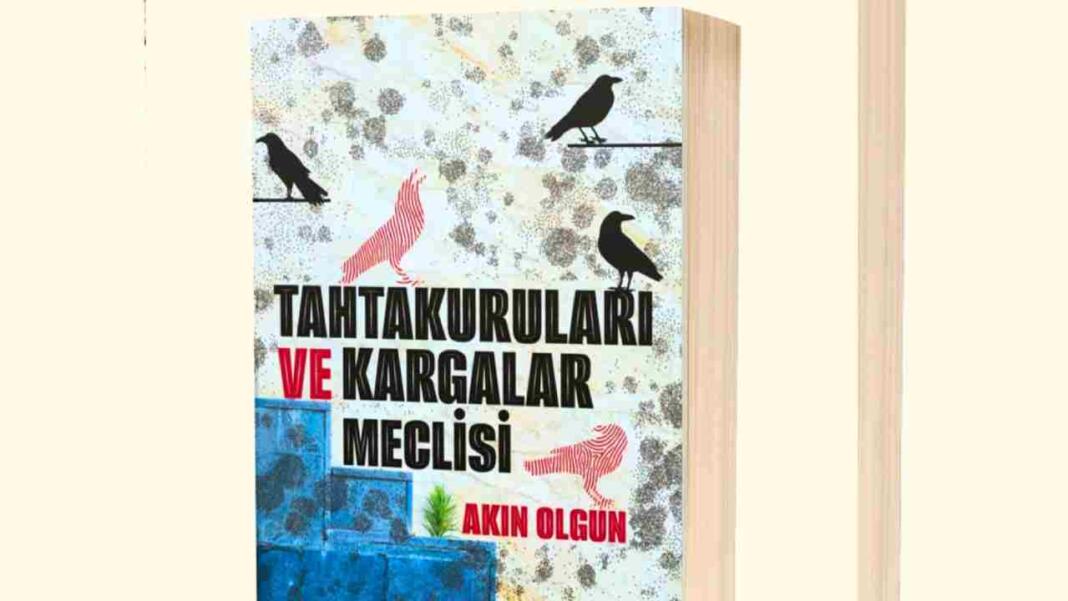
In the speed of the digital age, let us think about the buzzing numbness we feel when refugee news hits our screens. “Boats washed ashore”, “children drowning”, or migrants and refugees who are seen as “statistics”, expressed in millions from one place to another... Once upon a time, it was nothing more than third page news. “Isn't it the same now?” you will ask me, but we don't seem to be interested in this huge movement of people anymore.
Most of us ignore this kind of news now. But maybe someone needed to remind us of some things that are about to be forgotten. With Tahtakuruları ve Kargaalar Meclisi (The Assembly of Bedbugs and Crows), published by Tekin Publishing House, Akın Olgun leaves a huge mirror in the middle of this digital numbness to see ourselves, which we can hardly see through the black screens. The book calls us to confront the human stories behind the numbers, made of flesh, bones and most of all honor. This is not only a memoir, but also a literary testimony raised against a global indifference.
A testimony that turned from a nightmare into a giant story
How can an ordinary vacation in the blue waters of Rhodes turn into a prison diary filled with the ghosts of the past? In her book, the author makes us feel the traumas she experienced in the prisons of Turkey in the 1990s, this time reawakened by a completely different tragedy. It must have been difficult to come to Rhodes on vacation from England, where she had lived for years, and suddenly find herself in the middle of dark waters and within the gray walls of a prison. This is not only the story of a journalist's arrest, but also a testimony that allows us to hear the voices of the ’others“ trapped between the two sides of the Aegean. The book uses words like a scalpel to describe prison conditions. No more, no less, a storytelling focused on its work. Olgun depicts the misery in the prisons of Rhodes and especially Kos with stark nakedness.
In Akın Olgun's storybooks, there are moments that we are afraid of encountering or that we are tired of, there are pains that we cannot explain or talk about because of a heavy experience, and therefore we have a very heavy burden. That's why you feel a part of all the characters inside you. But life is not all about pain. In Akın Olgun's storytelling, the little surprises he reveals when you least expect them always remind us how much we need hope and happiness and how much we need to embrace them. Human moments that shine in the darkness turn into beacons of hope in Olgun's writing. The silent alliance formed by inmates from different languages and crimes breaks the coldness of the prison to some extent in The Assembly of Bedbugs and Crows... Protagoras“ statement ”Man is the measure of the universe" is not a philosophical reference, but rather a proof of the pain felt by the body, the reaction to the smell and the search for honor. By blending his own pain with the screams of others, Olgun reminds us of something we have forgotten: We are all in the same situation in the face of injustice, no matter what nationality or faith we have.
In the later chapters of the book, in the bedbug-infested bunks of Kos Prison, we watch, so to speak, the drama of refugees fleeing Turkey on the one hand, and the regrets of people dragged into the quagmire of crime by poverty and despair on the other. Olgun's cinematographic narrative in the way he describes the space while focusing on the characters transforms us into side characters in a film, not really at the center of the events but witnessing every moment. Admittedly, this is not an easy process. I'm not talking about the depth of the narrative or the language used. The mirror held by Akın Olgun never lies and you confess to yourself on every page. That is why it is not easy. To make a connection with today, while the political winds that set the course of the ship are more ruthless and unpredictable than ever, it is our multilingual, wounded “great humanity” that is tossed back and forth on the deck. No matter how real the events in the narrative of the book are, metaphorically, the author forces us to embark on our own inner journey.
The dust of our conscience
Zafer from Antep, who takes the author under his wing with the spirit of solidarity left over from the Gezi Resistance; Besim, who is a panacea with his Atatürk tattoo on his arm and his closet resembling the “cave of the Forty Thieves”; Ali and Oğuz, who are so oblivious to the world that they think the capital is Adana, but are so nationalistic; and Anılcan, an orphan who is mistaken for a “captain”... On the one hand, the unrequited friendship offered by Greek prisoners Vassilis and Manolis, on the other hand, the hopes exploited by the “BUT pill” sold by lawyers saying “It's hard but we'll manage”... Akın Olgun has described every detail, from the irony of the name “BERAT” engraved on the walls to the crows‘ endless chatter as if mocking him, from the bedbugs sucking blood on the bunks to the suffocating atmosphere that dominates the interior, in a jarring language. The Assembly of Bedbugs and Crows is not just a story of exile or an immigration drama, but an exuberant text of suppressed 'ah's and the fire of friendship that never goes out despite everything. By taking this journey, you will dust off your conscience and look at life in a different light.
Witnessing Akın's incredible care in the process of writing the book, as well as meeting Zafer from Antep in person, reminded me how we are intertwined with completely different lives we thought we were living at completely different times, and broke down many walls of alienation in my relationship with life. I was very impressed by Akın Olgun's power of observation and the care with which he put it on paper. The Victory I read about in the book came to life and was in front of me, no more, no less.
The fact that people I love like Rüstem Avcı, who wrote the foreword, and Selahattin Demirtaş, whose mind and words do not fit in iron bars, are together in this book made me very happy. I hope you will also witness this journey and listen to the voices of those who cannot be heard. (Mehmet Şafak Sarı/T24)