




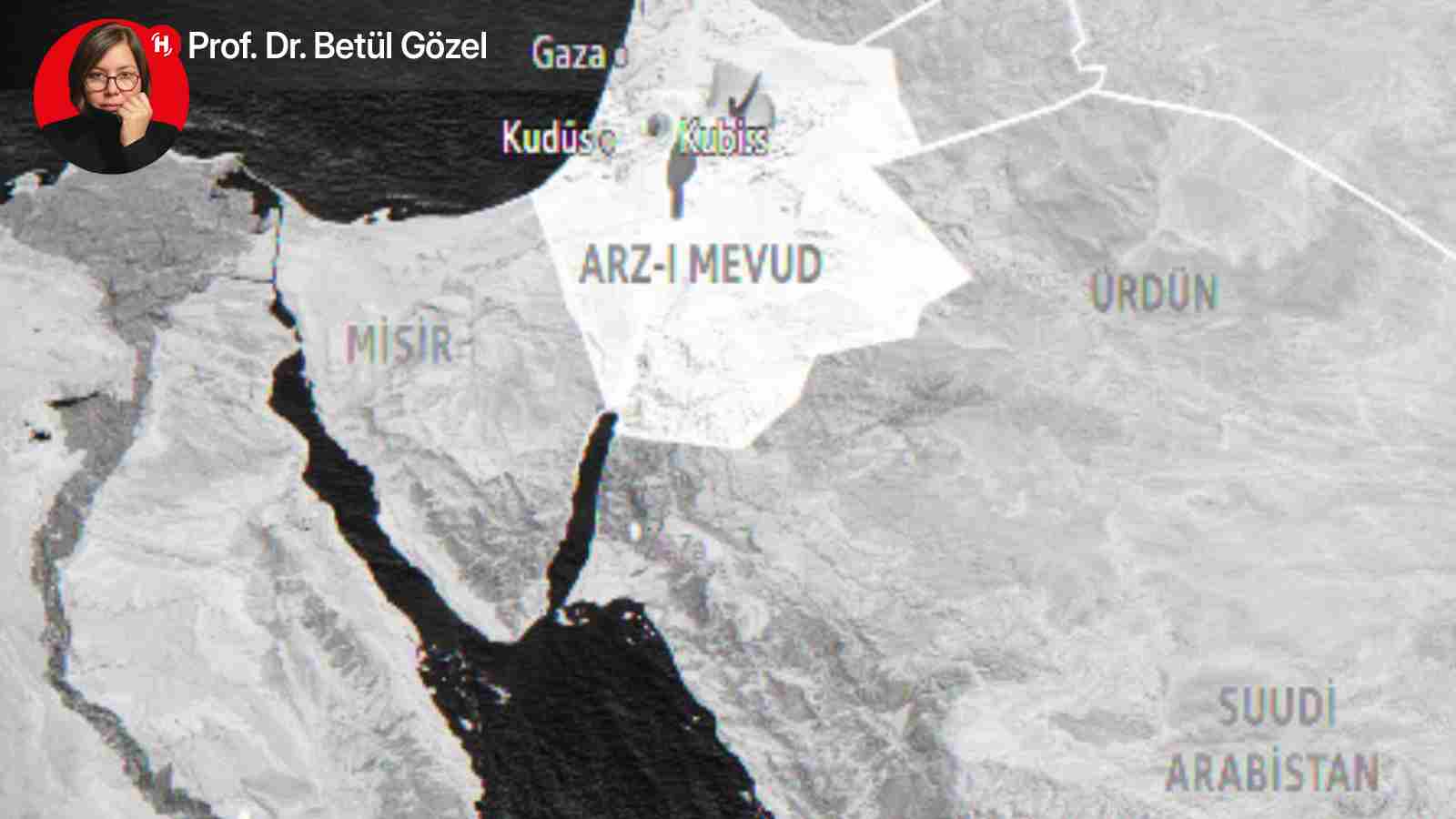
 Arz-e-Mawud (the land promised by God to Abraham and his descendants in Judaism) is a religious narrative. Its geography is the Levant. The Israeli-Palestinian line, Lebanon, Syria and Jordan are within this area. Turkey is not within this framework. The drawings extending to Southeastern Anatolia are neither based on sacred texts nor are they included in Israel's official documents.
But it's not about the map anyway.
The point is that these religious narratives are deliberately inserted into modern geopolitics. In this way, people are engaged in discussions of fear instead of real decisions on the ground, such as military deployments, energy lines, arms deals and immigration policies.
At this point, the issue is no longer religious narratives, but who wants to establish what kind of order in this geography. From here we come to the Greater Middle East Project. On paper, this framework put forward by the US during the Bush era promised multiparty elections, an independent judiciary, freedom of the press, women's rights and a free market. On the ground, it left wreckage. Iraq fell apart. Syria collapsed. Libya was wiped out. Turkey did not even sign the BOP, but the results speak for themselves.
Today, there is no properly functioning state structure beyond our borders.
And we are paying the price.
We may not have lost land. But we have lost a sense of security. We have come to accept constant vigilance as normal. We have become accustomed to the threat of terrorism. This state of habit is the most troubling.
We are experiencing migration. Millions have arrived. The doors that were opened with a humanitarian reflex at the beginning have today become rent, work, school and hospital. Europe has closed the doors. Turkey has become a buffer country. No one says this out loud but everyone feels it on the street.
Every regional crisis returns to us as an energy bill. Investors wait. Trade is disrupted. Who can plan for the future in a country with constant uncertainty?
In foreign policy we are in a narrow corridor. We are in NATO, we have energy ties with Russia, we have troops in the Middle East. We are constantly balancing. We are constantly putting out fires.
But the heaviest burden falls on society and institutions.
In a country living in constant crisis, education falls behind, the law becomes controversial, institutions erode. Society hardens. People become intolerant of each other. This is precisely the ground most vulnerable to foreign intervention.
From Israel's perspective, the picture is clear. Not to enlarge the map, but to leave no strong state in the neighborhood. The state of Iraq is obvious. Syria is in the middle. Lebanon is in the middle. In such a geography, Israel remains the only regular military power in the region. The harshness we see in Gaza is a message not only to Hamas, but to all of us.
Why is the US keeping quiet about this?.
Because chaos suits them.
A strong state means an independent policy. Chaos means arms sales, bases and energy lines.
Did democracy come to Iraq? No.
Has Libya prospered? No.
Has Syria been liberated? No.
But chaos remained.
This is no coincidence.
This is the model.
So what are we going to do?
First, we have to accept this. This cannot be solved with the military alone.
We cannot sweep migration under the carpet. We cannot ignore energy dependency. We cannot postpone education, law and justice. State capacity is not a matter of rhetoric but of institutions.
And we cannot survive by isolating ourselves.
In short, it is not about maps.
It's a question of how worn out we are.
Maps change. If state institutions do not remain strong, external crises will deepen internally.