



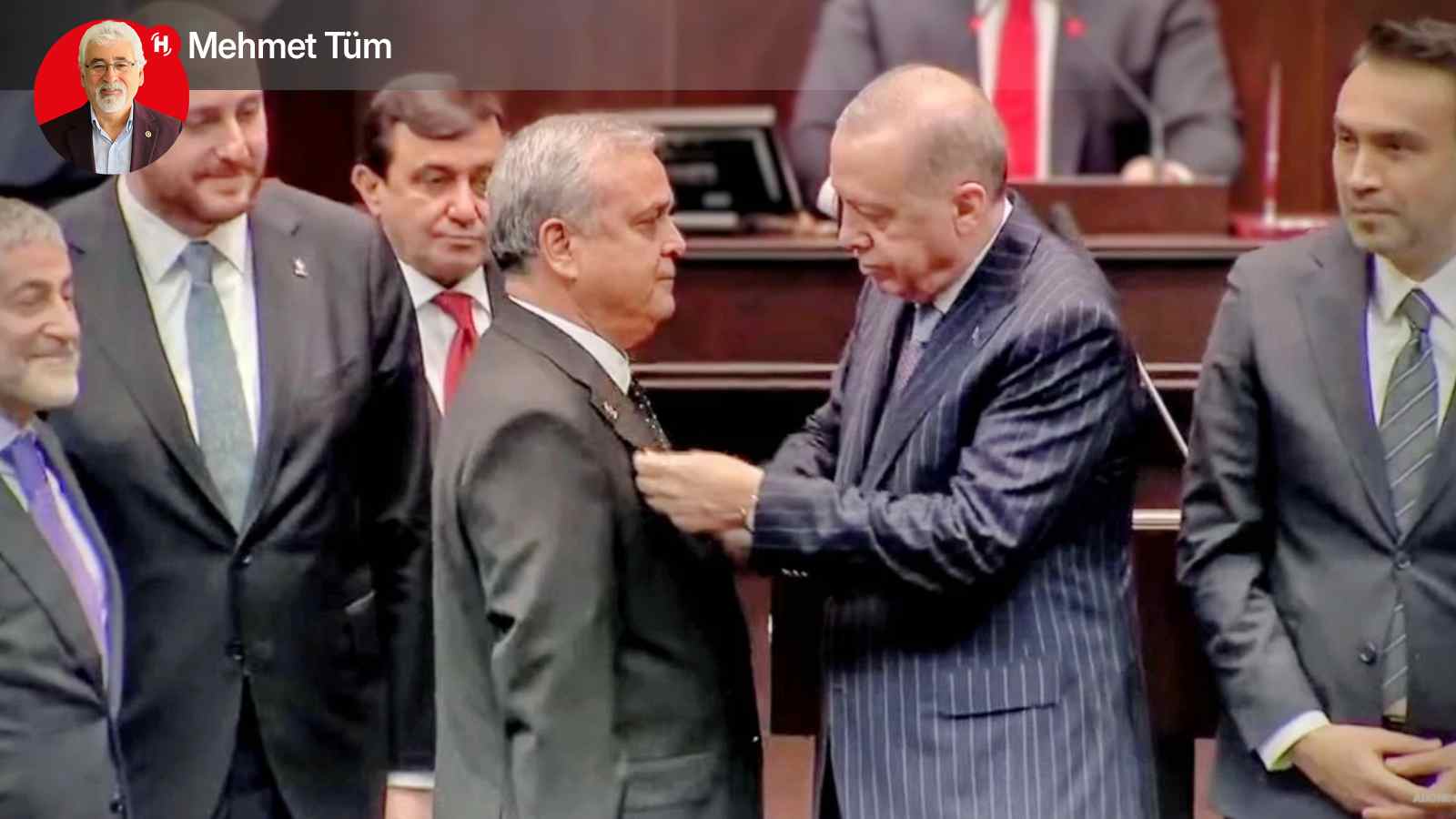
 Politics in Turkey has become a stage not only for ideas and projects, but also for badge changes, political migrations and ascensions without ballot boxes. It is presented as an ordinary political maneuver when people who become MPs or mayors with the votes of the electorate ignore this will and move to other parties in a short period of time. However, this is not just a simple change of preference, but a clear crisis of representation.
Voters do not vote for a person, but for a program, a world view and a political line. Today, however, we see that what is voted for is often just a name. Badges change, positions are preserved, personal careers move forward while the will of the people remains in place. MPs keep their seats in the parliament, mayors keep their seats and move to the ranks of other parties.
This situation not only erodes the moral basis of the political institution but also collapses the institutional structure of democracy.
What is particularly striking is that a significant portion of these transitions have taken place from the right to the left. Actors who have lost their power, whose sphere of power has shrunk or who seek their political future elsewhere, see the left, especially the CHP, as a safe harbor. However, this orientation does not mean the strengthening of the left. On the contrary, it carries the risk of transforming and eviscerating the left.
Because with these transfers, not only names but also a centrist, pragmatic, hierarchical and detached from the people understanding of politics are carried with them. The egalitarian, publicist and labor-centered line of social democracy becomes invisible in the shadow of personal calculations and conjunctural moves.
It is precisely at this point that the nomination process and the primary elections become crucial.
When intra-party democracy does not work, that is, when MPs and mayors are appointed by central appointment rather than by the votes of members, the politician becomes dependent on the party, not the party on the politician. In this system, where the grassroots is sidelined, the elected person's bond with the electorate is weakened and loyalty is directed towards the narrow decision-making mechanisms that put him or her in office.
It is not difficult for a politician who is beholden to the center and not to the voters to change his badge. Because there is no ballot box to stop him. What comes without a ballot box, goes without a ballot box.
This is precisely what lies behind the political transfers we are witnessing today in the Parliament and local governments.
If the CHP were a party that determined its candidates through a real and binding primary election, based on the will of its members, it would not be possible for politicians from the right to find so much space.
Because the organization would ask;
What have you done for this nation?
What price did you pay for this party?
How much do you know this city, this neighborhood, this labor?
If there are no primaries, there is no mechanism to ask these questions.
Political transfers are therefore not just an individual or moral issue. It is directly an ideological issue. Every transfer, every badge change blurs the identity of the party a little more. Will the CHP become the party of labor, secularism and publicism, or a new stop for power-weary politicians?
This is precisely the question voters are asking today.
The CHP's historical strength has come not from accepting every color and every person for the sake of coming to power, but from representing a clear political line. When that line becomes blurred, the party does not grow, it dissolves.
The parliamentary and mayoral transitions send the following message to the electorate
“Your game is less important than my career.”
As this understanding becomes more widespread, politics is devalued, trust in the ballot box diminishes and democracy rots from within.
The solution is clear;
Full primaries, strong organization, politics accountable to the grassroots.
The CHP grows not by the number of seats or municipalities it wins, but by the values it represents. And the way to protect those values is through the grassroots, not the center.
A party that multiplies by changing badges does not grow stronger.
A party that grows through the ballot box cannot be defeated.
The offices of parliamentarian and mayor are not the property of individuals, but a trust from the people.
Those who circulate the trust only grow themselves, not politics.