


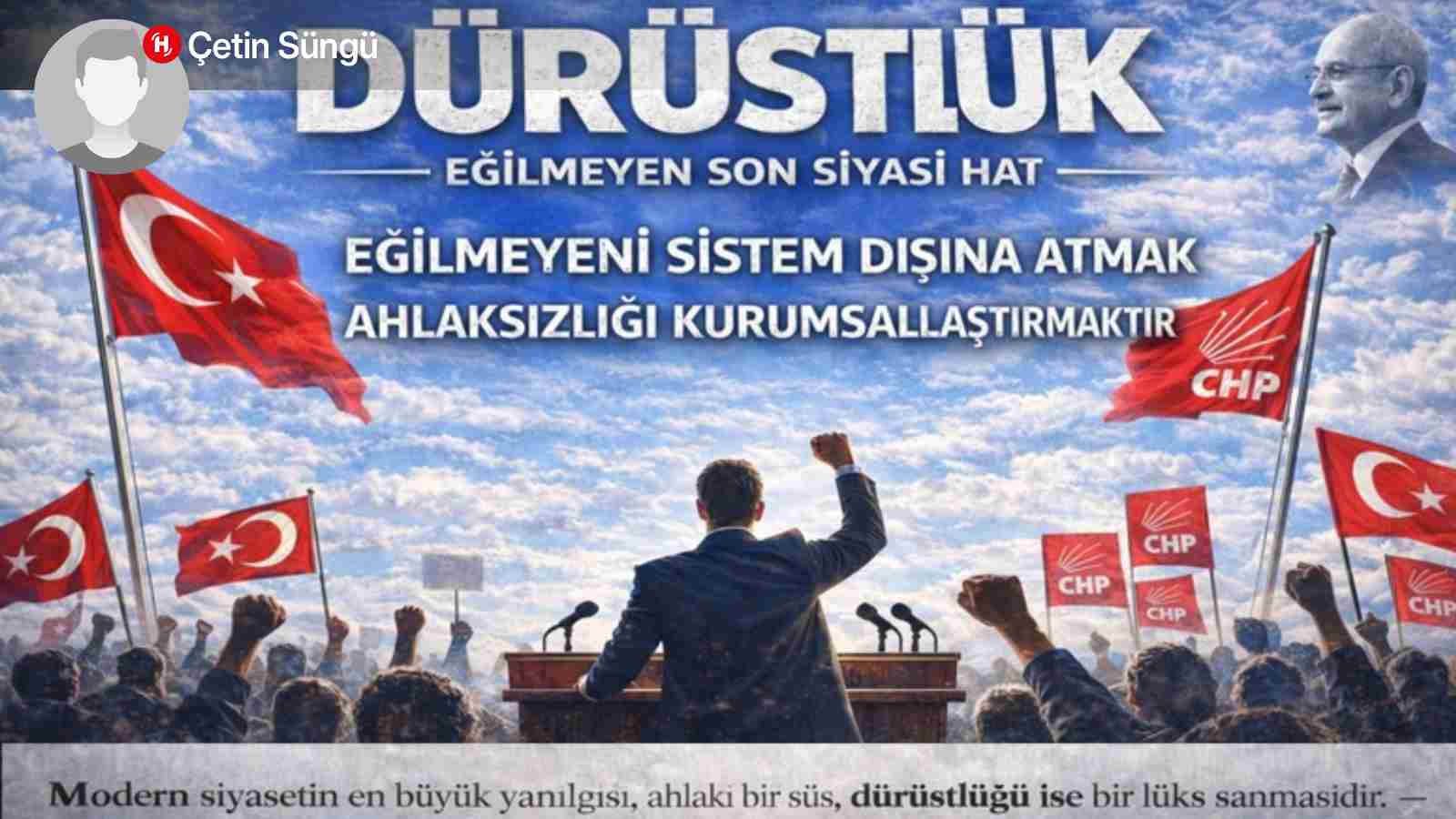
 The biggest mistake of modern politics is that it thinks morality is an ornament and honesty is a luxury. But honesty is neither a showcase of personal virtue nor a tale of individual morality. Honesty is directly a political issue. Because it is the state of not bowing to power, strength and crowds.
(Such as not trimming one's sentences for the sake of applause in a rally square, not bending the truth for ratings on a screen, not saying “now is the time” when a file is placed in front of you).
In this country, honesty is no longer treated as a virtue, but as a vice. Because the current political and social order rewards not those who do not bend, but those who do and market it as “reason”, “balance”, “realism”. Today, the issue is not morality, but the system. Honesty has been removed from being an individual choice and deliberately pushed out of politics.
(Just as what was once called “principled” is now repackaged as “harmonious”, “reasonable”, “center”).
Everyone is talking about “morality”. But morality is acceptable as long as it does not touch anyone's career, position or rent. As soon as it does, it is labeled as “harsh”, “extreme” or “unrealistic”. Because honesty is too noisy, too disturbing a value for this order. It overturns tables. It does not fit backstage. It does not fit into agendas.
(Like the sudden silence when a report is not signed, a tweet is deleted, a sentence is taken off the air).
What should today's political figure look like?
He should be able to deny one day what he says the next day.
They should be able to sell the same sentence with a different tone to different audiences.
He should be able to defend what he criticized yesterday as “state wisdom” today.
This is called “politics”.
(Oppositional in the morning, conciliatory in the evening; tough in front of the screen, flexible behind closed doors.)
This is where honesty clashes with the system. Because honesty requires memory. It reminds. It confronts. It asks, “What did you say yesterday?” That's why it is dangerous. That's why it is ostracized.
(A video from the archive, an old speech that is put in front of you today, etc.)
Today, there is a common reflex in politics, media, academia, even within the opposition:
Targeting not the problem, but the person who says it.
Discussing not the truth, but the tone of the speaker of the truth.
Blaming not the fire, but the one who reported it.
(It's like getting angry at the person pointing at the smoke and getting used to the building burning down).
This is not a coincidence. This is not a collective moral collapse; it is an organized culture of conformism.
(It's like everyone repeating the same sentence with different mouths, but no one takes responsibility).
Politics today is not a clash of ideas; it is a race of bending. It is not a race of who can survive with less loss of principle, but who can bend more skillfully and market it as “reason”, “balance”, “realism”. It is precisely for this reason that honesty is treated as a political threat rather than a moral virtue. Because honesty does not bend. And because it does not bend, it clashes with the order.
(Like a metal bar being declared “brittle” when it cannot be bent.)
Modern politics does not like honesty; it cannot control it. Honesty is not negotiated, postponed or adjusted “according to circumstances”. Therefore, the system either belittles honesty as naivety or criminalizes it as extremism. Thus, the issue ceases to be the difference between right and wrong; it is drowned in technical discussions such as “timing”, “style”, “balance”. Truth is deliberately drowned in procedures.
(The file waits on the shelf, the issue is referred to the commission, the matter is dropped from the agenda).
Today, the type of person produced by the political sphere is clear:
Quick to forget yesterday,
who can deny tomorrow what he says today,
who can present the same sentence to different audiences with different morals.
This is called politics.
(Like an app: update comes, old version is deleted.)
But honesty requires memory. It carries what was said yesterday to today. It calls to account. It confronts. That is why it is dangerous. A person with memory cannot be manipulated. A whole person cannot be managed. A fragmented person is ideal: His word works separately, his conscience separately, his practice separately.
(Those with one face to the camera and one face backstage will not remember).
At this point, morality has been consciously banished from politics. It has been expelled from the public sphere by saying “morality is personal”. However, the expulsion of morality from politics is not the immoralization of politics; it is the institutionalization of immorality. Because authority corrupts when left unchecked; the name of the check is morality.
(such as an uncontrolled tender, an unasked question, a report left unanswered).
That is why the concepts of honor and dignity were deliberately discredited. They were watered down as “heavy words”. Because honor is a reminder of trust, authority, promise and confidence. Honor, on the other hand, is uncomfortable: it demands that you remain true even when no one is looking. This is precisely what today's order does not want. It wants everything to be measured by visibility, applause, approval.
(This is precisely why changed behavior remains invisible when the lights are turned off.)
Character is no longer on the CV. The character that emerges in times of crisis is today considered a “risk”. A person who does not shut up when there is fear, who does not back down when there is pressure, who does not bend when there is interest, is declared a “misfit” in this system. He is cut in front of him. He is left alone. Sometimes he is lynched. And then the following sentence is shamelessly uttered:
“Why is no one talking in this country?”
(Because the speakers disappear after a while).
Because talking has a price.
Because the cost of staying true is high.
Because everyone wants to be right, but they don't want to stay right.
(A system where the one who tells the truth is the first to leave the table).
Look around you:
The authority is bowing down.
The title bows.
Money is bending.
The media is bending.
The crowds are bowing.
(Like shops that turn their signs wherever the wind blows.)
What's left that doesn't bend?
If honesty is bent, it is no longer called honesty.
It's called “strategy”.
“Timing” happens.
“It's ”circumstances".
But not the truth.
(Like a compass whose map has been erased.)
Today it is easy to describe someone as “successful”, “effective” or a “winner”. It is measured by polls, vote rates, social media applause. But the definition of a “beautiful person” is still immeasurable, because it looks not at what is seen, but at what resists. It leans not on the spirit of the times, but on values that resist time.
(Like those who look at the scales of conscience, not the trending lists.)
In politics, honesty is often labeled as naivety. “Be realistic,” they say. In other words, bend a little, shut up a little, ignore a little. At this point, honesty ceases to be moral and becomes a political choice. To choose not to bend is to stand against the natural flow of the system. It produces costs. It produces loneliness. It produces exclusion. But it also keeps social memory alive.
(Like throwing a stone into water and creating waves).
That is why the number of “beautiful people” is decreasing. Because being a beautiful person is not a romantic virtue in this age; it is a political challenge. It requires risking to be alone, to lose, to be ostracized.
But all the breaking moments of history show this:
It is not majorities that move societies forward,
those minorities who refuse to bend.
(The moments when a handful of people changed direction always started like this).
One day everyone will look in the mirror.
Not the seats he won,
the principles he renounced.
Not his speeches,
the moments of silence.
And only one question remains:
After all this bending over,
was honesty still standing,
or had we already sacrificed him to “circumstances”?