




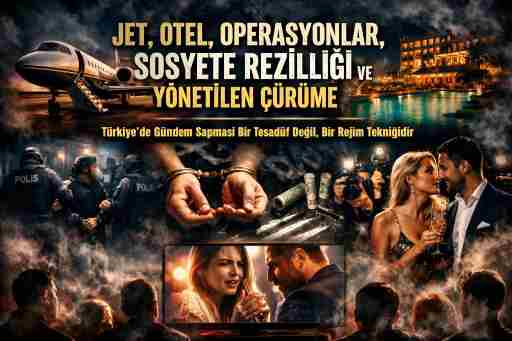
In Turkey, the screen is no longer a mirror; it is a curtain. Behind it is poverty, injustice, insecurity and collapse. In front of him is a wreckage of morality deliberately staged. Socialite scandals, tabloid-polished operations, pornographic exposure of privacy and programs where emotion is disguised as infamy... None of these “coincidentally popular” It is not. This is a managed attention economy.
What we are watching on television and social media today is a “social decay” but an organized agenda distortion. Look at what people are talking about when the minimum wage is announced. Look at which headlines are trending while pensions are being eroded. The cost of living is not presented as a reality, but as a boring detail; instead, disgrace, revelation and scandal are being fomented. Because if hunger is talked about, anger is born. If outrage is talked about, only curiosity.
The media is not an innocent actor here. The media in Turkey has long been no fourth estate; it is an ideological apparatus. It decides what to watch, what to talk about, what to “important” that decides what counts. The most powerful weapon of this apparatus is not immorality, but the normalization of immorality. If you eliminate shame, you eliminate objection. If you destroy privacy, you destroy the sense of boundary.
Those pleas, those revelations, those so-called “sincere” The outrages are not individual deviations; they are a systematic dismantling of social decency. While the honor of manhood is being destroyed “emotional openness” it's called. When women's privacy is marketed “freedom” labeled with a label. Shamelessness is presented as courage, brazenness as honesty. Concepts are turned inside out, because if concepts collapse, thinking collapses.
At this point, let's not tell fairy tales to the audience. “This is how they make us” we can't get out of it. This system works with consent. Everyone who clicks, watches and shares is a cog in this wheel. Every disgrace on the screen is kept alive by the viewer's curiosity. As long as there is demand, the supply continues. No one can put honor on the fairground despite the public; but if the public is curious, everyone can.
The real danger is that the political is drowned out by the immoral. The noise of scandal drowns out the real problems. People don't discuss the money melting in their pockets, they discuss the disgrace on the screen. This is a classic management technique: Magnifying vulgarity to render reality invisible.
As society morally collapses, political objection loses its power. Because without shame, anger cannot be organized.
What is happening in Turkey today is only a “media corruption” It is not. It is the pushing of morality out of politics, the sacrifice of conscience to entertainment and the transformation of the citizen into a spectator. The spectator does not speak, does not question, does not call to account. He just watches. And as he watches, he gets used to it.
This is what is most frightening: getting used to it. A society that gets used to humiliation gets used to injustice. A society that becomes accustomed to the absence of privacy also becomes silent about the exposure of poverty. A society that loses shame cannot defend its dignity.
That's why it's a matter of “moralist” is not a debate; it is purely political. Because morality is about power. The power that decides who speaks, what is shown and what is considered normal also shapes society. What is happening on the screens in Turkey today is not entertainment; it is social engineering.
And yes, we are in this story too. Refreshing our tea, looking at the disgrace, clicking on the scandal, “it's like this everywhere” we are the ones who keep silent. As long as we don't take our eyes off the screen, this order will not change. Because that's exactly what this order is based on: Look but don't think. Watch but do not question. Laugh at the humiliation, forget poverty.
This is not just a story of collapse. This is a managed collapse. And if we continue to be bystanders, we will not only be witnesses to this collapse, we will be complicit.
Conclusion: Collapse is Choice, Not Destiny
And Every Preference Can Be Changed
This picture is not fate. The media did not have to become this way, nor does society have to be so passive. But one thing is clear: This collapse is not the result of coincidence, but of a chain of choices. And results will not change until preferences change.
In Turkey, morality, politics and economy are not disconnected from each other. Where privacy is ignored and shame is ridiculed, justice cannot survive and poverty cannot be questioned. Therefore, the solution, “let's close the channels” but in consciously changing the agenda, language and viewing habits.
1. Stop Being a Bystander: The First and Hardest Step
This system survives on the audience. Without an audience, the disgrace dies.
- Not clicking on tabloidized operation news,
- Not even looking at the display of privacy out of “curiosity”,
- Not sharing the scandal, not quoting it, not spreading it...
These seem like small individual choices, but they are political enough to collapse the attention economy. When consent is withdrawn, the language of the screen changes.
2. Making Morality a Matter of Citizenship, not Religion
This issue cannot be compressed into a “conservative-secularist” fight. Privacy, honor and dignity are not a matter of lifestyle, but of public order.
Both extremes, which declare morality either a purely political tool or a purely individual domain, serve the same end: The normalization of decay.
Social morality is not the enemy of freedom; it is its ground.
3. Media Resistance, Not Media Literacy
“Media literacy” is not enough; we need media resistance.
- When is the agenda being changed?
- Which news is covering up what?
- Which scandal is served on the same day as which economic decision?
A society that does not ask these questions is governed; a society that asks them becomes difficult.
4. Persistently Recalling the Real Agenda
If the minimum wage is not discussed, it becomes unspeakable.
If pensions are not discussed, poverty becomes “normal”.
That is why the same question should be asked in every scandal agenda:
“So, whose life got a little more difficult today?”
5. Being Tough Without Being Moralistic
The solution is not shouting, lynching, demanding a ban.
But neither is silence.
Speaking clearly, calmly, without shame but defending shame.
Not to look like him while displaying disgrace.
Final Word: It is Possible to Stop Being a Spectator
The crisis Turkey is facing today is not only economic or political; we are facing a deeper, more insidious crisis: the crisis of being a spectator. The screen is powerful to the extent that it turns us into spectators. The moment we turn into citizens, that power begins to dissolve.
This transformation does not start with big words. Nor with revolutionary slogans. Sometimes it starts by simply not reaching for the remote. Sometimes by not opening a link. “Everyone is talking” to look away from a disgrace called a "political act". These do not look like political actions, which is why they are effective. The most dangerous forms of disobedience are the most silent.
Because this order fears the citizen who silently gives his consent rather than the loud dissident.
We live in an age where everyone has an opinion about everything but no one takes responsibility for anything. The screen gives us the feeling of constant conversation, but most of this conversation is not political, it is emptying. All day long one comments, gets angry, laughs, gets sad... but in the evening nothing has changed in one's life. This is a kind of relaxation. A very useful relief for the system.
But sometimes the most political thing to do is to admit that you are tired.
“I don't want to watch this” So.
“It's none of my business” So.
“This doesn't teach me anything” So.
These sound like apolitical sentences. But they are not. Because what the government wants is attention. As long as the attention lasts, the control lasts. When the interest is lost, the noise becomes useless.
Another small but effective step is this:
“Why has my life become difficult today?”
This question does not shout but calls for truth.
The solution is not for everyone to become politicized. But it is possible for everyone to stop being a spectator. Citizenship is sometimes built in the kitchen, sometimes at work, sometimes on a screen you choose not to look at.
The apocalypse started on the screen.
But we can still decide whether it will end or not.