




Sport's Relationship with the Regime
“All sports, especially football, should be amateur; resources should be spent on education and health.”
This sentence is not a wish. It is not a legislative proposal at all. This sentence, in itself is a political thesis. Because what is being advocated here is not the banning of sport, but the imprisonment of sport. liberation from the capitalist regime. The objection is not to the ball or the game, but to the organization of body, time and public resources for the market.
Today sport, especially soccer, has severed its historical link to health, a sense of collectivity and public solidarity. It has been replaced by money, spectacle, the myth of the star and spectator pleasure. For this reason, the call for “all sports to be amateur” is not a nostalgic throwback; it is clearly counter-hegemonic is a choice.
This call directly challenges three areas.
First, to the sports industry.
Today, sports, especially soccer:
- It is a global entertainment industry,
- It is a gigantic betting and advertising economy,
- It is an ideological apparatus that reproduces nationalist and class divisions,
- It is a non-stop rating machine for the media.
Therefore, the call for amateurism is not hostility to sport; is a political refusal against the exploitation of the body.
Second, on resource utilization.
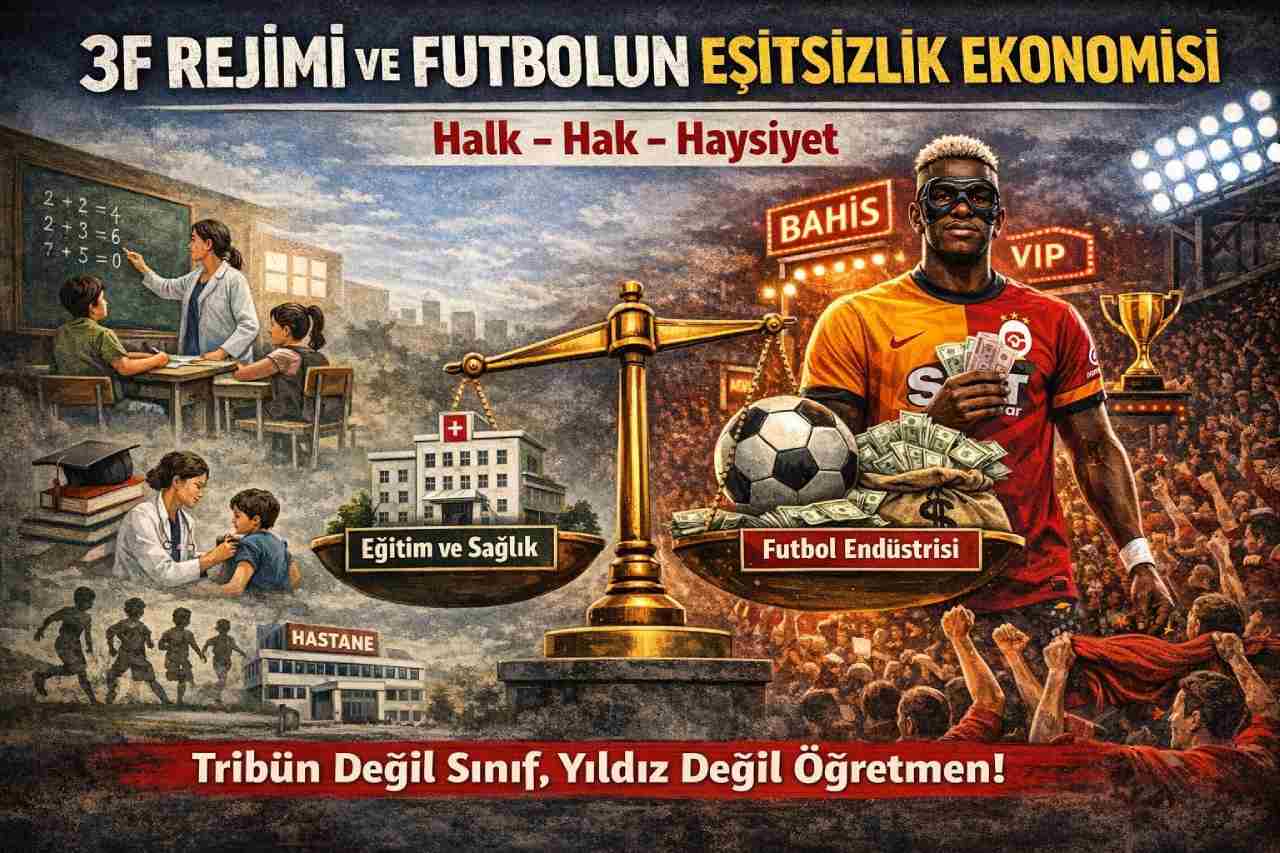
The annual salary of a football player is equivalent to the budget of dozens of schools, the cost of a stadium to a city hospital, a single transfer fee to the scholarships of thousands of students. This table is not an exaggeration; is a declaration of class priority. The common resource of the society is not spent on the common need of the society; it is spent on spectatorial pleasure.
“Resources should be spent on education and health” is therefore not an accounting exercise; a moral and political declarationIt is.
A classroom instead of a grandstand.
A book instead of a jersey.
Teacher instead of transfer.
A hospital instead of a stadium.
Whatever the state allocates money for, it declares what it considers valuable.
Third, the false myth of success.
Professional sport, especially soccer, sells young people this dream:
“Don't work your way out, get elected.”
Instead of education, the talent lottery is celebrated. The millions of losers are rendered invisible, the handful of winners are mythologized. This is not just economic, is a moral question. Because failure is individualized, the system is whitewashed.
3F Formula: Sport as Poverty Management
There is an established concept in Latin American political science literature: 3F - Fútbol, Fiesta, Fe. Football, entertainment and faith. This trio is not to solve the poverty of the people; to accept living in poverty for the next generation.
Hunger is replaced by enthusiasm, injustice by ritual, inequality by hope. Reaction is not suppressed; it is postponed. Objection is not forbidden; it is stalled. Thus, power is not exercised through force, emotion management sustained.
This is precisely the function of football in Turkey and much of the world today. Football is no longer a sport; is a management technique.
The Economics of Inequality, the Stellar Regime and the Tangible Account
A Concrete Account of Inequality: The Osimhen Case
The inequality produced by the sports industry is not about abstract concepts, in bare numbers understandable. It is therefore necessary to take a concrete example directly. As of the 2025-26 season Victor Osimhen’s total annual revenue - including salary, bonuses, image rights and fringe benefits - is approximately 21 million euros level. At today's exchange rate Over 1 billion TL of a source a single athlete each year means transfer.
What does this figure alone mean?
Supported by municipalities and local authorities in Europe amateur football clubs average annual budgets 80-120 thousand euros band. This structure forms the mass backbone of sports with school leagues, neighborhood clubs and infrastructure activities. According to this calculation Osimhen's income for just one year, 170 to 260 European amateur clubs one year budget is equivalent.
In Turkey, the picture is much harsher. The expenses of amateur football clubs in Turkey are often underestimated by the public. However, especially Super Amateur League and Regional Amateur League (BAL) level of a club's seasonal expenses:
- Field and facility rents,
- License, registration and federation fees,
- Away transportation and accommodation costs,
- Technical team fees,
- Athlete expenses and basic health expenditures
taking into account 700 thousand TL to 1.5 million TL ranges between In addition to this at the BAL level hundreds of thousands of pounds of collateral and participation obligations are also available.
Viewed in this reality, one year's income of a single footballer, Hundreds of amateur clubs in Turkey to survive for a season to provide the necessary services.
This picture cannot be explained by a “talent gap”.
This is not the natural functioning of the market at all.
This is a direct for whom social resources are mobilized is the question.
Wages Reality: What Does 75 Million Euros Mean?
Inequality is not only in salaries, in the cost of the even more naked. The price paid for Osimhen an estimated 75 million euros in wages, is a huge one-time transfer of resources.
What could have been done with this money?
- In Europe, with an average annual budget of 100 thousand euros which is 750 amateur clubs all activities for one year could be financed.
- In Turkey, seasonal expense 1 million TL around More than 700 amateur clubs, with this source one full season was sustainable throughout.
It's not just the continuation of sport;
in hundreds of cities, thousands of neighborhoods, tens of thousands of children a public sports ecosystem where people can come into contact with sports is a resource that will make it possible.
Therefore, Osimhen's ability is not the issue.
It is not about the “nature” of the market at all.
The point is this:
Is the social resource being used for social need or for showcasing?
The Star System and Lottery Ethics
The case of Osimhen is no exception; is the norm of the star system. At the center of professional sport is the “star”. The star is not just the athlete who plays well on the field, but a showcase produced by the media, capital and advertising.
This showcase sends a clear message to young people:
“Not with education, by selecting get rid of it.”
This message produces a morality that silently eliminates millions of young people. The story of the losers is not told; the success story of the winners is sanctified. In this way, inequality is naturalized, even glorified. Success becomes a virtue, poverty a personal vice.
This is the neoliberal order in the field of sport. lottery ethics.
Amateur Sports Comparison between Turkey and Abroad: A Conscious Gap
In Europe, amateur sport is not an afterthought that is squashed beneath the professional showcase. School leagues, municipal clubs and local sports arenas are not a part of public sport policy. its main body creates. Support is continuous, infrastructure is secure, sport is not a privilege a public righttruck.
In Turkey, the picture is reversed. Amateur clubs
- It is condemned to unsustainable aid,
- It is made dependent on the personal efforts of local administrators,
- It is sustained by the sacrifices of athletes and families.
Professional soccer, on the other hand, has been boosted by tax exemptions, public land, debt restructurings and stadiums built with public funds. systematically fed. This is not a difference in income in sport; a regime inequality it produces.
It is no coincidence that amateur sport has been left weak. For the professional shop window to shine, the ground must remain in the dark. Inequality in sport is therefore not a consequence; is a conscious design.
The Citizen Turned into a Spectator
The complementary element of this order of inequality is the transformation of the citizen into a spectator. The spectator does not question. A fan does not object. A fan is not a citizen.
Football as it is is not entertainment; is a usurpation of time and attention. People discuss not unemployment but the referee, not injustice but offside. Anger vents but changes direction. Real political demands become invisible.
Betting Regime, Moral Decay and the Discreditation of Sports
Illegal Betting: Structural Consequence, Not Deviation
The current state of professional soccer is not only about economic inequality, with moral decay must also be defined. The illegal betting investigations that have come to the agenda one after another in recent years show that the dark areas surrounding football are not the “exception”, on the contrary structural that it is.
The intertwining of the game played on the field with illegal betting networks off the field is not an aberration. It is an aberration of a sporting system where billions of euros are at stake, oversight is weakened, and the star system is sanctified. is the natural consequence. The betting economy has become not a secondary area around football, but a central revenue and steering mechanism.
Footballers who place illegal bets or are associated with these networks are often discussed in terms of “individual moral weakness”. However, the issue is not individual. The athlete is not just a player in this system; is a high-risk financial asset. Betting, match-fixing and mafia are therefore no exception; is a by-product of the market-centered sports regime.
Astronomical salaries and bonuses on the one hand, and an unregulated betting market on the other... These two areas are not disconnected. On the contrary, they are different faces of the same capitalist logic.
Where Has Morality Disappeared?
Professional sport does not produce morality per se. Morality is not a natural outcome of the market. On the contrary, the logic of the market consumes, erodes it and makes it a secondary element.
In today's football system, success is measured not by honesty, continuity of labor or social responsibility, but by visibility, speed and profit. In this environment, the implicit message to the athlete is clear: “As long as you win, there is no problem.”
Illegal betting is therefore not an “accident of morality”; where morality is systematically excluded is the result of a system. The crime is individualized, the system is whitewashed. A few soccer players are targeted, but it is the system economic and institutional structure is not questioned.
The Gap between the Republic's Understanding of Sports and Today
At this point, the gap between the founding sports mentality of the Republic and today's picture becomes apparent. Mustafa Kemal Atatürk’s understanding of sport was not only about physical development; moral and mental integrity based on.
Atatürk's words are not a wish, but a clear is a statement of public principle:
“I like athletes who are intelligent, agile and moral.”
In this sentence, morality does not follow intelligence and agility; with them is referred to. Because sport is not only about performance; it is also about social exemplar. The athlete is a figure who stands in front of society and therefore gains meaning not only through the matches he wins but also through the values he represents.
Today's professional sports organization has reversed this principle.
Wit, market cunning;
fetishism of agility, speed and power;
morality is reduced to advertising texts.
Footballers who place illegal bets are therefore not “corrupt individuals”; are the products of a corrupt order.
Betting Economy and Attendance Regime
Betting transforms not only the player but also the spectator. The match is no longer a sporting event; an object of financial forecasting becomes a user. The fan is reduced to a user who follows the odds, not a spectator of the game.
This transformation further poisons the social impact of football. Sport is not unifying, disintegrator This process of betting is the reason why it plays such a role. It is not only the individuals who lose money; is the public reputation of sport.
Amateurism A Moral Imperative
The call for amateurism is therefore not only against economic inequality; against moral decadence is also oriented. Amateur sport is not about the athlete as a star; as a citizen and not the betting economy. It makes it part of public responsibility, not part of the betting economy.
Amateurism reunites sport with the body, health and solidarity. Its morality is not a by-product; founding principle into a man.
As long as the professional sports system continues, the “moral athlete” will remain an exception. Because morality is not a by-product of the market; is a public choice.
Liquidation, Nationalization and a New Sports Regime
Radical but Logical Conclusion: Professional Sport Must Be Eliminated
The conclusion of the discussions up to this point is clear. Professional sport - especially football - in its current form is beyond reform. The problem is not a few bad managers, a few corrupt soccer players or a few shady betting networks. The problem is that sport a capital-centered regime is organized as.
The logical conclusion of this text is therefore clear:
Professional sports clubs should be liquidated.
This sentence is not an outburst of anger. It is not a call for a ban at all. It is an indictment of the order of inequality, decay and exploitation in which sport is placed. structurally unsustainable is the determination that it is.
Professional clubs today:
- Turning public resources into private profit,
- Generating privileges through tax exemptions and incentives,
- Turning sports workers into contracted commodities,
- Reducing citizens to fans and sports to spectator pleasure
institutional structures. As long as these structures exist, equality, health, morality and publicity in sports are not possible.
What does it mean to close? Not to Destroy, but to Publicize
“The concept of ”closure" is particularly susceptible to deliberate distortion. What is being proposed here is:
- It is not to erase club histories,
- It is not to ban partisanship,
- It is not to stop exercising.
What is proposed is that clubs company status, profit-oriented structure and market logic is to liquidate it. In other words, privatized sport is expropriation.
In this framework:
- Professional leagues are dissolved,
- Club companies are liquidated,
- Facilities, sites and infrastructure are expropriated,
- Sport through local authorities, schools and public sports associations free, accessible and amateur to make it so.
The aim is not to destroy sport; it is to is to liberate from capital.
The Icelandic Model: Is Success Possible without Professionalism?
Iceland model is one of the most tangible examples of breaking the myth that soccer must necessarily become a fully professional industry. In a country where a large-scale soccer economy is unsustainable due to the small size of the population, the top leagues are largely semi-professional structure. A significant number of soccer players are also teacher, officer or studentsport is not the only and privileged way out of life, but a natural part of public life.
Despite this, Iceland has achieved remarkable success in European and world football in the last decade. This success is not based on star signings, astronomical salaries or transfer markets, school-based infrastructure, continuous and planned support of municipalities and public sport policies based. The Icelandic example clearly shows that football does not have to become a centralized and absorptive professional industry for international success. On the contrary, public and amateur-based organization of sport can provide a stronger basis for both social health and sporting continuity.
Why can't Turkey become Iceland?
The reason why Turkey cannot establish an Icelandic model of public-amateur sports is neither climate, nor population, nor “lack of talent”. The real reason, political and economic choices. From the very beginning, sports policy in Turkey was established as a showcase regime centered on professional football rather than strengthening the amateur base.
Resources were not allocated to school sports, neighborhood clubs and municipal infrastructures, but to stadiums, broadcasting tenders and the debts of professional clubs. Amateur sports have been deprived of continuous public support, while professional football has been protected and expanded by the state. For this reason, professional football in Turkey has gone from a showcase to a structure that has swallowed the entire system.
Sport in Iceland, a social right as a sport, whereas in Turkey, sport is largely seen as a a space for spectator consumptionin Iceland. In Iceland, the soccer player is also a citizen and a laborer; in Turkey, the soccer player has been transformed into the market's lottery of salvation. The difference is not cultural; regime.
“Why Professionalism = Quality” is Wrong?
The most common argument in football debates is this: “Without professionalism, quality will suffer.” However, this assertion does not mean that quality For whom and at what cost is produced. What professional soccer elevates is often not the quality of the game; is the brilliance of the spectacle.
When quality is measured by the number of stars, inequality becomes inevitable. In contrast, quality in public and amateur-based systems; Participation, Access, Continuity and community health through the sporting and social aspects of the sport. The Icelandic example shows that this second definition is more sustainable both from a sporting and social perspective.
Therefore, the issue is not whether professionalism exists or not. It's about whether professionalism a center that swallows or a limited showcase or not. When professionalism takes over the shop window and destroys the public sphere, there is no real quality and no real sport.
The Labor of Athletes: Public Labor, Not Star Labor
The most common objection is: “What about the athletes?”
The answer to this question is clear. Athlete labor is not ignored; on the contrary is secured. But it is not starified, it is not commodified.
Athletes
- Public athlete status,
- They are included in public employment as coaches, trainers and sports laborers,
- While practicing sport, it is also made part of the education system.
This model takes the athlete out of the mercy of the market. It prevents post-injury collapse. It eliminates futility. The athlete is not an investment; a social subject it happens.
From Stadium to Sports Campus
Today, stadiums, built by spending billions of liras, are showgrounds that are used one day a week. The rest of the time they are idle, closed and disconnected from the public.
These areas
- School sports,
- Public health programs,
- Disability sports,
- Free courses for women and children
open multi-purpose sports-culture-education campuses must be transformed.
Thus, the stadium ceases to be a showcase that produces spectatorial pleasure; a living public space it becomes.
A Question of Resources: Morality, Not Money
“Resources should be spent on education and health” is not a technical budget debate. This demand is a direct is a debate on morality and civilization.
Whatever the state allocates money for, it declares what it considers valuable. Today, if money is allocated for stadiums, broadcasting tenders and club debts, this is not for the citizens. that there is investment in the audience shows.
A classroom instead of a grandstand.
A book instead of a jersey.
Teacher instead of transfer.
A hospital instead of a stadium.
This is not a call for a ban; is a call for priority.
Conclusion: 3F versus 3H
Against the Latin American 3F formula-Fútbol, Fiesta, Fe-a new equation is necessary today:
People - Right - Dignity
- Sport must belong to the people.
- Resources must be distributed equitably.
- Human dignity must not be sacrificed to spectacle.
Otherwise, stadiums will be full and schools empty, screens bright and the future dark.
And we still call it “sport”.
Last Word
Professional sport, especially soccer, is no longer an innocent game. It is one of the most effective ideological apparatuses of our time. This is why the issue is not soccer hostility; defending public reason, social priorities and human dignity is a matter of.
Sport either serves public health,
or the spectacle of capital.
He cannot do both at the same time.