



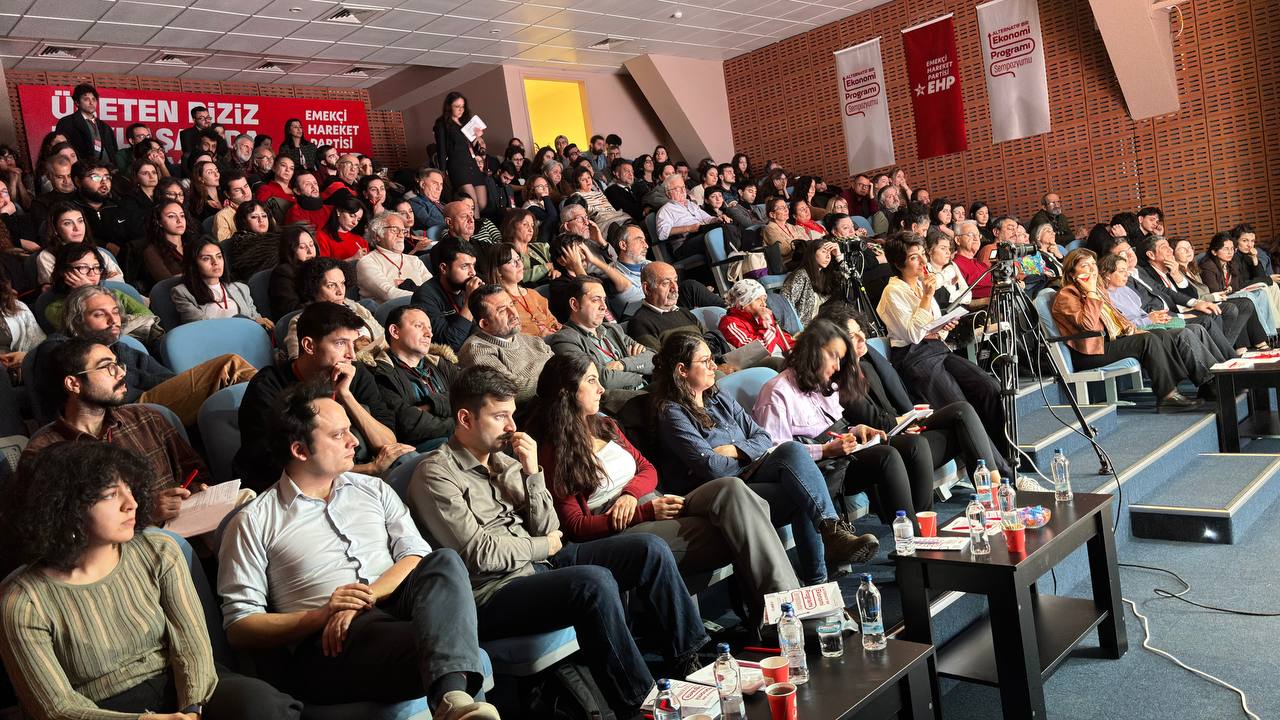
Speakers at the “Symposium on an Alternative Economic Program” organized by the Labor Movement Party on December 20-21 made many important observations.
First Session:
Three sessions were held at the symposium. In the first session titled “Fair Distribution of Income”; Prof. Dr. Gamze Yücesan Özdemir, Prof. Dr. Hasan Tekgüç and Assoc. Prof. Dr. Selin Pelek made their presentations. The session was chaired by Ar. Prof. Dr. Gülşah Suileten took over.
“If capital exceeds public power, there are no human rights in that country”
Delivering the opening speech of the symposium Prof. Dr. İzzettin Önder, Önder evaluated the government's choice not to increase the minimum wage as a “political choice”, not an “economic necessity”. Saying that Turkey cannot find its own way in the capitalist order, Önder said, “In this country, capital has exceeded public power, public power has been crushed; laborers and pensioners have been crushed.”.
Emphasizing that Turkey's understanding of development is based on an incomplete social structure, Önder reminded the role of global institutions established after the Second World War: “Neoliberal policy means going to the most original form of capitalism. What did the IMF do? It downsized the state, imposed privatization, said ‘don't run a budget deficit’, said ‘borrow from the market’ and raised interest rates. The state's infrastructure came under private capital. State-guaranteed infrastructure works were carried out, and now we are paying their bills.”
“Bourgeois economics is asocial, apolitical, ahistorical”
Speaking at the first session of the symposium titled “Fair Distribution of Income” Prof. Dr. Gamze Yücesan Özdemir, emphasized that the current understanding of economics is disconnected from social reality. Özdemir said, “Evaluations made with the figures of bourgeois economics do not reflect reality. Bourgeois economics is asocial, apolitical, ahistorical. Against this, it is necessary not to see the economy as nothing but numbers, and to stick to class analysis and historical analysis.”.
“The environments where workers can come together socially have become very narrow. They are not in places like foundations, associations, organizations, unions. They are distanced from their own publicness,” Özdemir said, adding that this has led to a weakening of class consciousness.
Özdemir said that reformist approaches ignore class conflict and emphasized that concepts such as “basic citizenship income”, “fair transition”, “competition against monopolization”, “transparency” and “reasonable tax policies” are in-system solutions that compromise with capital.
“Answering the question ”What should happen?“, Özdemir said, ”The means of production should be socialized, a planned economy, central planning organizations should be established, public investments should be increased, the labor regime should be transformed and distribution should be rearranged.".
“Income distribution has deteriorated unprecedentedly since 2020’
Prof. Dr. Hasan Tekgüç (Kadir Has University, Department of Economics), stated that inequality in income distribution has deepened in recent years. “Income distribution has deteriorated unprecedentedly since 2020. During the AKP rule, exports increased thanks to the double-decker roads, but inflation also increased due to the negative interest rate policy,’ Tekgüç said.
Emphasizing that the economic deterioration should be read together with the social structure, Tekgüç said that fertility rates continue to decline despite Erdoğan's pro-natalist discourse. “The 8-year education reform, which was implemented in 1997, started to yield its social and societal results during the AKP rule,” Tekgüç said.
“Elderly poverty is a problem of society, not the insurance system”
Assoc. Prof. Dr. Selin Pelek, Emphasizing that Turkey is experiencing a rapid demographic transformation, he said, “The fertility rate per woman has dropped to 1.5. This rate is even lower than Norway. Turkey is now in the category of very old countries,’ he said.
Pelek stated that although the elderly population is increasing, the social security system is unable to respond to this transformation. “The average age is rising even in occupational homicides. The retirement period is no longer a period of rest, but a second period of work,” Pelek said, adding that pensions remain below the minimum standard of living.
“Elderly poverty is different from classical forms of poverty because there is no way out,” said Pelek, emphasizing that this situation should be seen as a social problem, not just an economic one.
Second Session:
Symposium second session “The Crisis and the Downward Trend in Profit Rates”. The session was chaired by Assoc. Prof. Dr. Benan Eres He did it.
Prof. Dr. Ahmet Tonak, Dr. Ozan Mutlu and Dr. Ekin Değirmenci made their presentations. The speakers focused on the internal contradictions of the capitalist system, the limits of capital accumulation and the current crisis dynamics in the Turkish economy.
“Competition makes it inevitable that profit rates will fall”
Prof. Dr. Ahmet Tonak, He emphasized that the downward trend of profit rates in capitalist economies is a systemic problem. Tonak said that low wages reduce demand, and that the reduction in demand leads capitalists to produce less. He said that this situation is at the center of the labor-capital contradiction.
Tonak emphasized that competition is the main mechanism of crises in the capitalist system and said
“Due to the necessity of competition, capitalists turn to labor-saving technologies to reduce costs and increase market share. This increases capital intensity and raises the organic composition of capital. However, when productivity growth is faster than the increase in surplus-value, profitability falls.” Tonak said that this process leads to the problem of “overaccumulation”, meaning that capital becomes idle as profitable investment areas shrink. “Investments slow down, unemployment increases, financial instability and recession set in with the collapse of investment. Demand problems are the result, not the cause, of this process,” he said.
Tonak ended his speech by recalling the historical trend described by Marx in Capital: “The capitalist production process magnifies the revolt of the working class organized by its own mechanism. The monopoly of capital becomes a hindrance to the mode of production that develops under it. Capitalism carries within itself the conditions that prepare its own end.”
“We are experiencing the most severe conditions of exploitation in the Republican era”
Dr. Ozan Mutlu, In his presentation on the course of profit rates and residual-value ratios in the Turkish economy, he noted that there was a significant increase in the residual-value ratio between 2000 and 2011. “The residual-value ratio has reached 380 percent today. We are experiencing the most severe conditions of exploitation in the Republican period,’ he said.
Mutlu emphasized that the increase in the rate of surplus value does not directly raise the rate of profit. “The increase in surplus value does not automatically increase the rate of profit. Because the rate of profit is determined by the structural dynamics of the capitalist economy. Turkey's economy has been facing excessive accumulation of capital since 2015-2016. Investments and growth have stagnated since 2018, because profitability is what drives investments,’ he said.
Mutlu said that the fact that capital accumulation could no longer find profitable investment areas created a systemic blockage and this situation deepened the structural crisis.
“Capital profits were protected by increasing the intensity of exploitation”
Prof. Dr. Ekin Değirmenci, Değirmenci explained that capitalist accumulation is sustained in different forms with the downward trend in profit rates. Stating that there is a direct relationship between profit and surplus-value, Değirmenci defined crises as “moments when accumulation processes are interrupted”.
“With the 2001 crisis, a new period of restructuring began in the Turkish economy,” said Değirmenci, adding, “Regulations were made in the banking system, real wages were reduced, union organization entered its historically weakest period. Capital profits were protected by increasing the intensity of exploitation.”.
Stating that neoliberal policies provided a short-term increase in profitability, Değirmenci said that after 2016, distributional relations changed drastically again: “Salaried workers” wages did not improve under high inflation between 2016-2019. The wage share was rapidly suppressed. Neoliberal regulations temporarily increased profit rates but permanently reduced labor's share."
Third Session
The third session of the symposium was titled “Alternative Economic Program”. The session was chaired by Eylem Babayiğit. In the session Güneş Gümüş, President of the Socialist Laborers Party; Özkan Atar, President of the United Metalworkers Union; Levent Dölek, Vice President of the Revolutionary Workers' Party; Bülent Falakoğlu on behalf of the Labor Party; Doğan Nur on behalf of SODAP; Deniz Tuzcu on behalf of the Social Freedom Party (TÖP); and Ahmet Asena, Co-Spokesperson of the Green Left Party He spoke.
“It is not the radicalism of a demand that will ensure its realization, but the strength of the front that defends it”
Socialist Laborers Party Chairman Gunes Gumus, started his speech with the words of Antonio Gramsci:
“Gramsci has a quote I like: ‘The past is dying and the new cannot be born; we are in the era of monsters.’” Gümüş emphasized the destructive effects of neoliberal policies on society. “When you leave health and education to the hegemony of money, babies and children die,” he said. Drawing attention to the disorganization of the working class in Turkey, he said, “The rate of workers who benefit from collective bargaining agreements is only 5.5 percent.
Stating that the minimum wage has become the basic wage during the AKP rule, Gümüş said, “Workers have been squeezed into this threshold.” Gümüş continued his words as follows: “What will ensure the realization of a demand is not the radicalism of that demand, but the strength of the front defending it. The main issue is whether we can mobilize for the organization of the working class, neighborhood by neighborhood, street by street, with the burning demands of the people.”
“We are facing a big robbery with income tax”
United Metalworkers Union President Özkan Atar, drew attention to the injustice of the tax system. “We are facing a big robbery with income tax. They take it from us and transfer it to capital as an incentive,” he said. Talking about the collective bargaining processes carried out under crisis conditions, Atar said, “There can be losses, there can be gains. We are trying to cope with this.” Reminding the continuity of capitalism's crises, Atar said, “There is no process going badly for capital, those who claim otherwise are conducting a conscious propaganda. We come back to the socialist, socialist economy as the way things should be,” he concluded his speech.
“Capitalism cannot get out of its crises, it is necessary to prepare the working class for power”
Revolutionary Workers' Party Deputy Chairman Levent Dölek, emphasized the systemic nature of capitalism's crises. “The tendency of profit rates to fall is a structural feature of capitalism. Capitalism constantly creates crises,” Dölek said, addressing crises on two levels: “One is the short-term crises and the other is the depression we have been in since 2018. This is not a crisis that capitalism can overcome with its own economic dynamics.’ Stating that it is wrong to think of the economy separately from the class struggle, Dölek said, ”This discussion should not be left to economists on behalf of the working class. The economy is a field of class struggle.“.
“We do not pronounce a figure on the minimum wage. We need to talk about workers who are approaching and exceeding the poverty line. We need to talk about our rights that we have taken by the scruff of the neck, what we have won in strikes.”.
“The cheap production model is based on cheap labor”
Bülent Falakoğlu for the Labor Party, He emphasized that economic analysis should be based on three basic dimensions: “One, the relations of production; two, the way countries are integrated into the world economy; and three, the class power relations shaped through these.”
Regarding the minimum wage, Falakoğlu said, “Instead of announcing figures, this wage should already be above the poverty line.”.
He emphasized the following headlines about the alternative economic program: “Introduce a wealth tax, provide security for the poor, end public-private partnerships. This program must be in harmony with society and nature. We must transform class interests into national interests. We can write a democratic, egalitarian, anti-imperialist program.”
“It is the duty of socialists to oppose the MTP together with the wage struggle”
Doğan Nur on behalf of the Socialist Solidarity Platform (SODAP), said that the Palace regime has increased the exploitation of the broadest layers of the working class and reduced its share of national income. “The Medium Term Program (MTP) is not a disinflation, but a program to lower wages, replenish Central Bank reserves, expand the alliance with international capital and ensure that the Palace regime can withstand crises.” Doğan Nur emphasized the importance of a long-term wage struggle and said, “It is very important to continue the issue of raising the minimum wage in the long term. However, today, it is also normal that there are nuances between what we will do when we come to power and the program we put forward to organize the working class.”.
“It is necessary to fight for the budget and the struggle for free basic needs”
Deniz Tuzcu on behalf of the Social Freedom Party (TÖP), Tuzcu began by emphasizing the declining profit rates and the profit flight of capital. Tuzcu stated that the line of struggle should have two main pillars: “The first pillar of struggle should be the budget struggle. It is necessary to speak in favor of the working class in the distribution of social wealth and intervene in this area. The revenues collected from workers in the budget are transferred as investments in war and industry.” Stating that the second line of struggle should be to define basic needs as free rights, Tuzcu said, “This can be achieved either through citizenship income or direct free access. There are masses who cannot even earn minimum wage and are pushed into the reserve industrial army. Therefore, it is necessary to defend the right to life beyond the struggle for minimum wage.” “Any figure we come up with for the minimum wage can be debunked very quickly by inflation,” Tuzcu said, emphasizing that the ultimate goal is a social order that guarantees workers' right to live humanely.
“A transformative program that takes into account the rights of nature and ecological limits”
Ahmet Asena, Co-Spokesperson of the Green Left Party, In his speech, he said that the alternative economic program must respond to the structural crisis of capitalism, not just to current problems. “It is not necessary to give all the weight of the program to current problems. In this period of depression that capitalism is going through, if the rate of profit is falling, the consequences are obvious in the long run. But the long term corresponds to a short period in today's conditions,” he said.
Emphasizing that the socialist program must be transformative, Asena said, “Our demands must be transformative and transformative. We have to put social needs and benefits at the forefront. Secondly, we must take into account the rights of nature and ecological limits. We must ensure social control, not bureaucratic control. Solidarity and equality must be the basic principle,” she said. “It is not possible to carry out such a struggle only within the borders of Turkey. An international network of struggle must be established; unionist and political. We must be the social failure against social consent. For this, we have to unite forces.” and emphasized the importance of united struggle.
DAY TWO
First Session
On the second day of the symposium “Method and Struggle in Minimum Wage Determination” Elif Akkaya chaired the session. In the session Prof. Dr. Ceyhun Elgin, Prof. Dr. Aziz Çelik and Prof. Dr. Özgür Müftüoğlu made their speeches.
“Minimum wage hike does not increase inflation”
Prof. Dr. Ceyhun Elgin, Elgin evaluated the impact of minimum wage increases on economic indicators. “The minimum wage increase should be at least as much as the inflation rate,” Elgin said and shared the results of the research covering the period 2005-2024. According to the findings, a 10 percent increase in the minimum wage affects inflation by only 1 or 2 percentage points. Stating that this level is controllable, Elgin said, ’Inflation is mainly caused by the increase in profit margins and exchange rate shocks.“ He emphasized that the effect of the minimum wage on unemployment remains in the range of 0.10-0.15 percent.
“Instead of suppressing the minimum wage, the public sector should monitor prices, try to reduce profit margins and formulate an economic program accordingly,” he said.
“There are resources; minimum wage is a matter of distribution”
Prof. Dr. Aziz Celik, He emphasized that the minimum wage is not just a level of income, but a reflection of class division. “Those earning minimum wage and around minimum wage vary between 50-60 percent. Wages are squeezed around the minimum wage; therefore, the minimum wage is a matter of distribution,” he said. Stating that the richest 1 percent in Turkey received 39.5 percent of the total wealth, he said that the ’no resources’ argument has no reality.
Describing the minimum wage policy as a means of intervening not between classes but within classes, Çelik said, “While raising pensions, they lowered the minimum wage, flattening the distribution within the class.” Reminding that in 1974, the per capita wage was close to 81 percent of the GDP, he said, ’Today this rate has dropped to 43 percent. Another minimum wage is possible with a publicist approach.’.
“Stating that the idea that ”minimum wage increases inflation“ has become a superstition, Çelik said, ’In 2016, the minimum wage increased by 33.5 percent while inflation remained at 8.5 percent. There is no direct link between minimum wage and inflation.’.
“Wages are the result of inter-class power relations”
Ozgur Muftioglu, emphasized that the determination of the wage is a direct result of the class struggle. “Wages are the result of inter-class power relations; the tables are for show,” he said. Stating that the nutrition and housing crisis in Turkey has deepened, Müftüoğlu said, “There is a vast majority who cannot eat healthy food. We rank first among OECD countries in terms of rent increases.” In this context, Müftüoğlu stated that the class struggle does not only consist of wage increases and said, “Education, health, housing, ecological struggle, ethnic-sexual inequalities... the class must exist in all areas.”.
Müftüoğlu said that workers need unions and class parties to carry out the struggle, but emphasized that the current union structure has become dysfunctional: “There is no democracy within the unions, there is bureaucracy; the unions are detached from the working class. It is not possible to move forward like this.”
The biggest dream of the bourgeois world was to turn the labor of the worker into a commodity; they succeeded.”.