


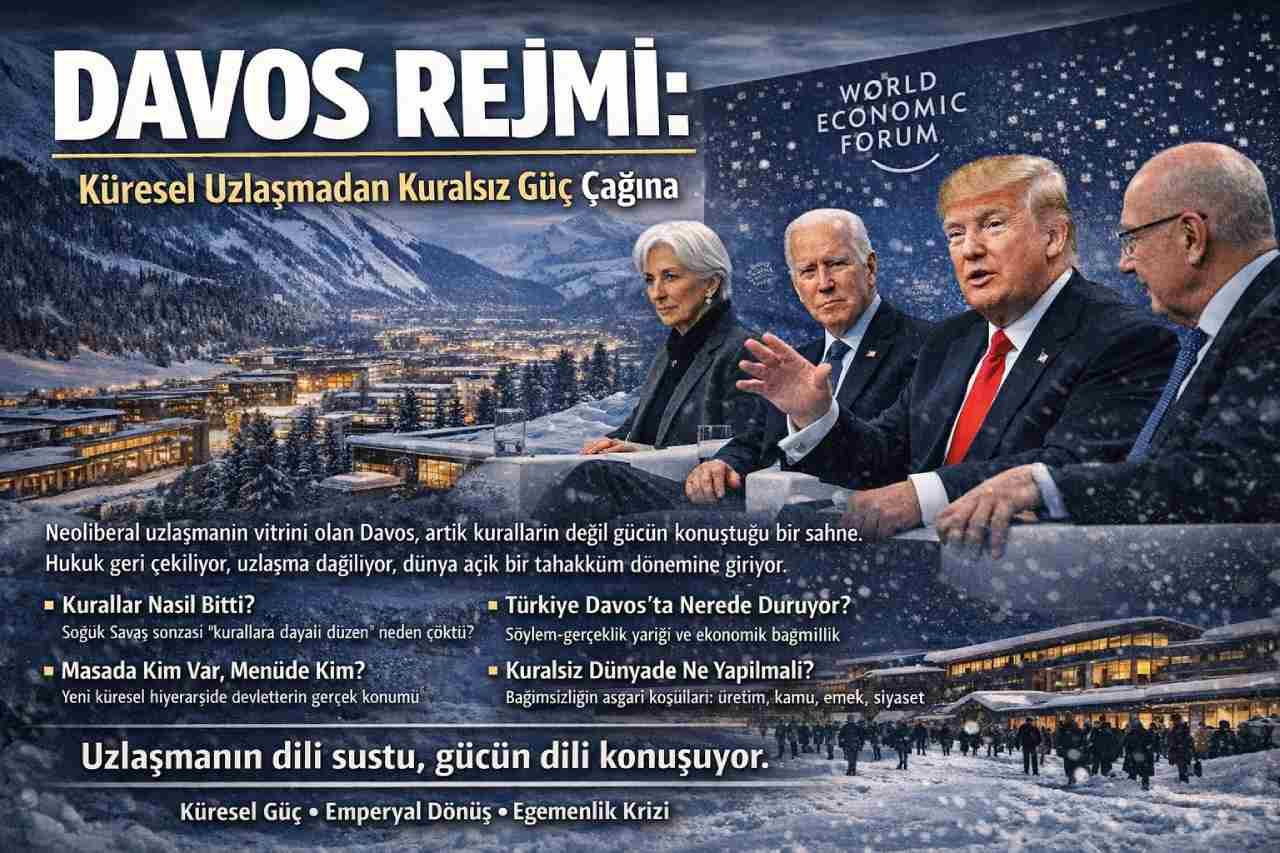
 Davos is not just an economic forum; it is a stage where the global system speaks to itself, sometimes unwittingly making confessions. For years, the World Economic Forum has functioned as the legitimacy production center of neoliberal globalization. While the official declarations were dominated by the language of conciliatory diplomacy, the real power relations were discussed backstage. For this reason, every sentence uttered in Davos is a harbinger not only of the present but also of the political and economic trends to come.
The 2026 summit is a historical turning point in this respect. For the first time, “rules-based international order”The end of the global economic crisis has been openly acknowledged by the representatives of the countries at the center of the system. Canadian Prime Minister Mark Carney's speech was not a temporary diplomatic exit, but a structural diagnosis of the current functioning of the global capitalist order. It is a declaration of an era in which law, multilateralism and universal norms have been withdrawn and replaced by direct power relations.
At this point, we should no longer speak of a moment of crisis, but of a new world order in which deregulation is normalized.
The Collapse of Rules and the Nakedness of Power
The post-Cold War international order was theoretically based on the assumption that the rules would apply equally. But this assumption was largely an ideological framework that legitimized the interests of the hegemonic centers. Today this framework has collapsed. Instead of indirectly enforcing the law, the great powers are seeking direct results through sanctions, debt, energy, finance and security instruments.
It is not only law that has disappeared; it is the claim that law is universal. International relations are not characterized by norms, but by asymmetries of power. Agreements have ceased to be texts of compromise; they have turned into technical documents of imposition. Diplomacy, rather than being the art of mutual gain, has been reduced to the management of compulsory acceptance.
This transformation is evident in the current hot files.
The Hot Files of the Unregulated Order: What Does Davos Say and What Doesn't?
Iran: From Negotiation to Risk Management
The Iranian issue clearly reveals Davos' reflex for the new era. As of 2026, Iran, which in previous years was dealt with within the framework of the nuclear deal and diplomatic solution, is no longer coded as a subject of negotiations, but as a risk factor that needs to be managed in terms of energy markets, Gulf security and regional military balances. Law and diplomacy have retreated; deterrence, sanctions and cost calculations have come to the fore.
This approach is typical of the new era in which the balance of power, not international law, is decisive.
Venezuela From Sovereignty to Resource Space
In Davos, Venezuela is discussed almost exclusively in terms of energy supply security and oil reserves. Political crisis, democracy or social destruction are secondary. The main issue is which bloc will have access to natural resources and under what conditions. This shows that sovereignty is no longer an absolute right, but a functional concept that is recognized as long as it does not hinder global circulation.
Syria: Frozen Conflict, Permanent Fragmentation
Syria is the file on which Davos deliberately abandoned a solution. Neither political integrity, nor reconstruction, nor sovereignty are being seriously discussed. Syria is now “a problem to be solved” but as a state of fragmentation that needs to be managed. This approach emphasizes the comfort of crisis management rather than the crisis-solving capacity of the international system.
Palestine Where the Law is Silenced
The Palestinian issue is the most naked example of a lawless order. The destruction, civilian casualties and flagrant violations in Gaza do not fall under universal law; “regional stability” and “balance” discourse. This is the point at which the law is completely suspended. Palestine is no longer a matter of rights; it has become a file to be adjusted between the balances of power.
Greenland: A New Definition of Sovereignty
The Greenland debate shows how sovereignty is being redefined. New sea routes, rare minerals and energy resources opened up by the climate crisis have transformed sovereignty into a concept that can be eroded without military occupation. The language of economic pressure, sanctions and strategic investment is replacing the classical understanding of sovereignty. Even the climate agenda of Davos is now part of geostrategic competition.
Being at the Table or on the Menu?
In this context, the oft-repeated statement in Davos “If you're not at the table, you're on the menu” is not a metaphor; it is a succinct description of the contemporary power order. Being at the table means having the capacity to produce, not leaving the borrowing regime open to political blackmail and limiting foreign dependency in critical sectors.
Countries that are not at the table are not the subject of negotiations; they are the object of bargaining. Their debts are discussed, their resources are calculated, their labor costs are reduced, their political stability “market confidence” is audited on its behalf.
The question is therefore clear:
A country's representatives may be invited to Davos, but is the country itself really at the table?
Turkey and Davos: The Tension Between Discourse and Structure
For Turkey, Davos is a mirror in which its true position within the global system becomes visible. For years, Turkey has been represented in Davos with tough and defiant rhetoric, while its economic policies, borrowing regime and investment preferences have been within the limits set by global power centers.
This dual structure - being a subject in rhetoric and an accommodating actor in practice - produces a situation in which Turkey appears to be present at the table but is left out of the main parameters of the bargain. This situation cannot be reduced to individuals or periodic preferences; it is the necessary consequence of an economic model that is disconnected from production and dependent on financing.
Real power is not measured by the applause at the podium, but by the dependencies, debt burdens and social costs that are brought to the table.
External domination cannot be established without internal submission
The basic principle of political economy is clear: External pressure will only be permanent if there is a favorable ground at home. If production has collapsed, labor is devalued, and public resources are distributed according to the demands of global capital instead of the social good, no country can sit at the table strong. Even if it does, it will not speak for itself, but for others.
Therefore, the issue is not only foreign policy. It is the economic and class character of the regime.
What to do - The Minimum Conditions for Independence in an Unregulated World
Independence is not an emotion at this stage; it is a question of material and institutional construction. An economy without production capacity, with weakened public power and based on cheapening labor cannot be a subject at any table.
Political independence cannot be sustained until the state becomes a strategic actor again, labor is organized on the basis of social welfare, and foreign policy is no longer a tool to cover the crisis of legitimacy at home.
Conclusion
The 2026 Davos Summit declared a clear truth: The world no longer operates in the language of law, but of power. From Iran to Palestine, from Syria to Greenland, all these files are different faces of this new order.
In this order, countries either build their own material, political and social power or adapt to the plans of others.
There is no third way.
For Turkey, the issue is not what was said in Davos, but why it is in this position. The answer to this question lies not in the global halls, but in the country's production structure, labor system, public preferences and political courage.
Waking up in a world where the rules are over is not a choice, it is a necessity.
Otherwise, every time we are invited to the table, we have to look at the menu once more.