



 I am not an earthquake expert. But I am a person from this region. In recent months, as the ground shook, rumors multiplied, everyone said something, but I could not find a clear and calm explanation, I decided to sit down and investigate.
It's not fear; it's uncertainty that makes you tired.
The tremors we experienced today did not start out of nowhere in Balıkesir and especially around Sındırgı. I checked the official records: seismic activity in the region has been ongoing since the summer of 2025. First there were medium-sized earthquakes, then small-medium tremors continued for months. The magnitude 5 earthquake we experienced at the end of January 2026 was one of the last links in this chain.
So we are not experiencing a single event. We are in a process that moves on a scale of months.
This picture is sometimes referred to in seismology as “earthquake storm” It's called an aftershock. In other words, the clustering of many small and medium-sized earthquakes in the same region for days and weeks, rather than the classical aftershocks following a single large main earthquake. Such clusters are common where the fault consists of segments rather than a single piece. When a segment breaks, stress is transferred to neighboring segments, which respond with small ruptures. The fault system is almost seeking balance within itself.
Why is he here?
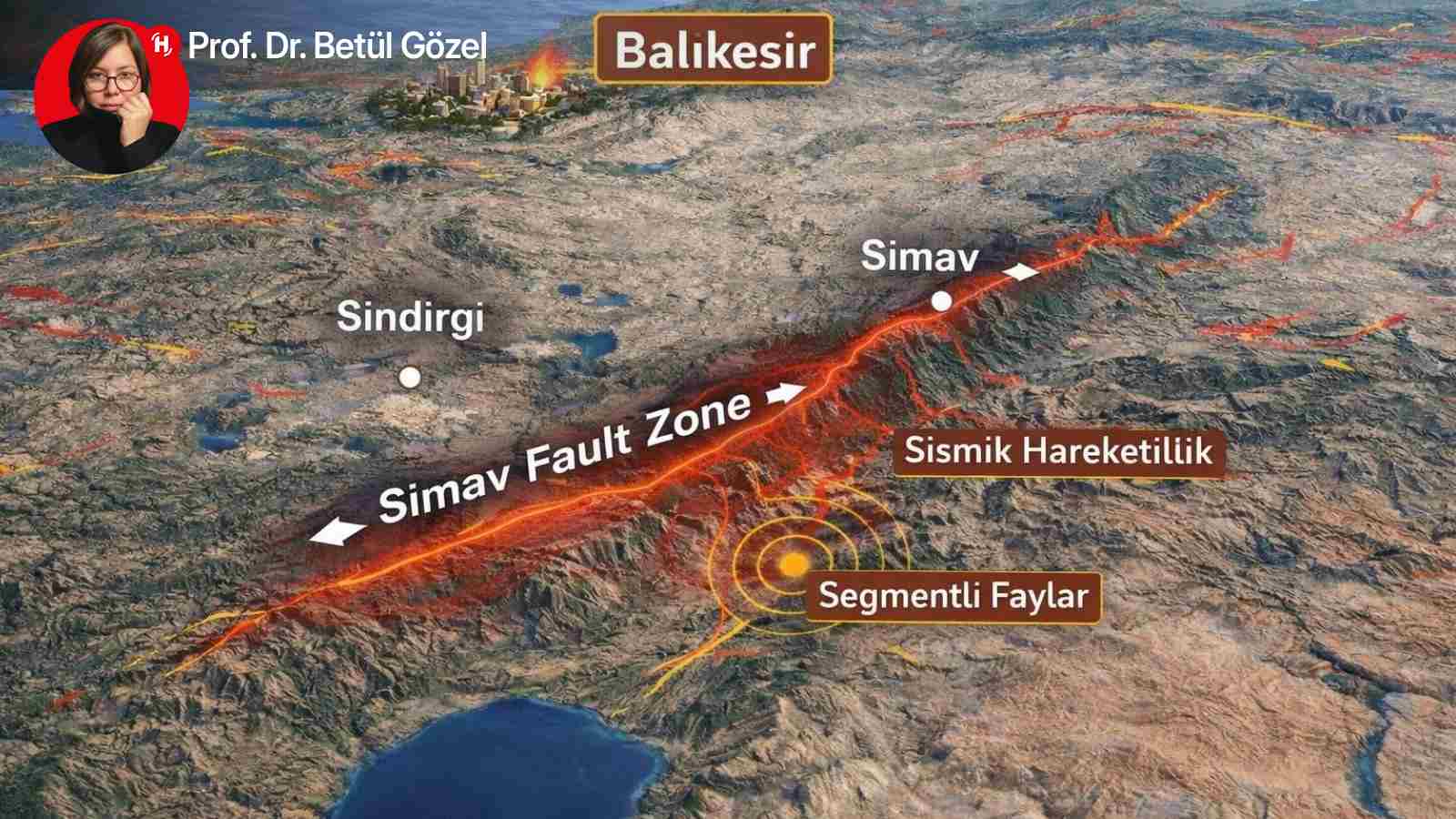
Because Western Anatolia is geologically “stretched” The African plate pushed north, the Anatolian block escaped to the west. With the opening of the crust, normal faulting occurred predominantly in the region. The Balıkesir-Simav line was located right in this system.
Data from official institutions -AFAD and Boğaziçi University's Kandilli Observatory and Earthquake Research Institute- showed that most of the earthquakes occurred at a depth of 10-15 kilometers. This is critical information. These depths indicate completely in-crustal, tectonic ruptures. In other words, we are not talking about surface subsidence or an unusual natural phenomenon. The active faults we know worked.
Another important point is that the faults in this region are not monolithic. They consist of segments. When a segment breaks, stress is transferred to neighboring segments. In seismology, this is called Coulomb stress transfer. What we have seen in recent months “serial” The earthquakes were largely the result of this. Sometimes they were classical aftershocks, sometimes they progressed in clusters whose main earthquake could not be clearly distinguished.
Another frequently asked question at this point is: “There are thermal waters in Sındırgı; could this be related to the earthquake?”
The existence of thermal waters is actually not surprising. Fault zones are fractured-cracked structures and form natural conduits for hot water from the depths. So thermal water is often the result, not the cause, of a fault. Faults carry water upwards.
Groundwater may slightly reduce the friction on the fault, but it does not produce earthquakes. The main cause of earthquakes is the tectonic stress that builds up in the earth's crust. Water only sensitizes a system that is already in place.
(Think of fault surfaces as two big stones rubbing against each other; when groundwater gets in between, it acts like oil, not pushing but facilitating slippage.)
Let's come to the question everyone is asking:
Are these harbingers of a big earthquake?
The more I researched, the clearer it became: Science does not speak with such certainty.
Earthquakes of around magnitude 5 discharged only a small fraction of the energy that had accumulated in the faults over the years. Most of the time such processes created local relief.
But there is also the other side of the story; in the immediate neighborhood, there is a long period of inactivity, that is, accumulation of tension. “locked” If there is a piece of fault, these medium-sized earthquakes may upset the balance there a little bit. In other words, there may be a possibility that the section of that fault, which will break one day anyway, may be pushed forward a little bit in terms of the calendar. GPS measurements, satellite deformation data and detailed stress models are needed to see if this happens.
Today, with publicly available data “there will be a big earthquake” it's impossible to say.
This is the picture I see now.
After the ruptures that started in 2025, the system is still trying to balance itself. Small and medium-sized earthquakes redistributed the stress. This process lasted for months. Many previous earthquake sequences in Western Anatolia also proceeded in this way.
What can be said scientifically about the future is limited but clear:
One: Balıkesir and its surroundings are a region with active faults. This will not change.
Two: It will not be surprising to see aftershocks and similar tremors for a while.
Three: It is not possible today to predict earthquakes by giving time and magnitude.
So I think the thing to do is not to make prophecies.
Seriously questioning the building stock. Staying away from damaged buildings. Making simple fixings at home. Discussing a small earthquake plan within the family.
The ground has moved because this geography is mobile.
Science teaches me to act on knowledge rather than fear, to look at data rather than rumors, and to be prepared rather than panicked.
This is my summary of the research.