



 Turkey is running out of water.
But this is not a natural disaster.
This is a blatant set-up.
The government has been telling us the same tale for years: “There is a drought.”
Wrong. Drought is natural; crisis is political. Nature decides when the rain will fall, but the government decides for whom the water will flow. The thirst we are experiencing today is not the result of rain that does not fall from the sky; it is the result of the rent system that is laid on the ground, the rivers that are piped, the life that is opened to the market.
So it is not just about climate.
This issue is a sum of economic, class and political choices.
And it cannot be solved without a name.
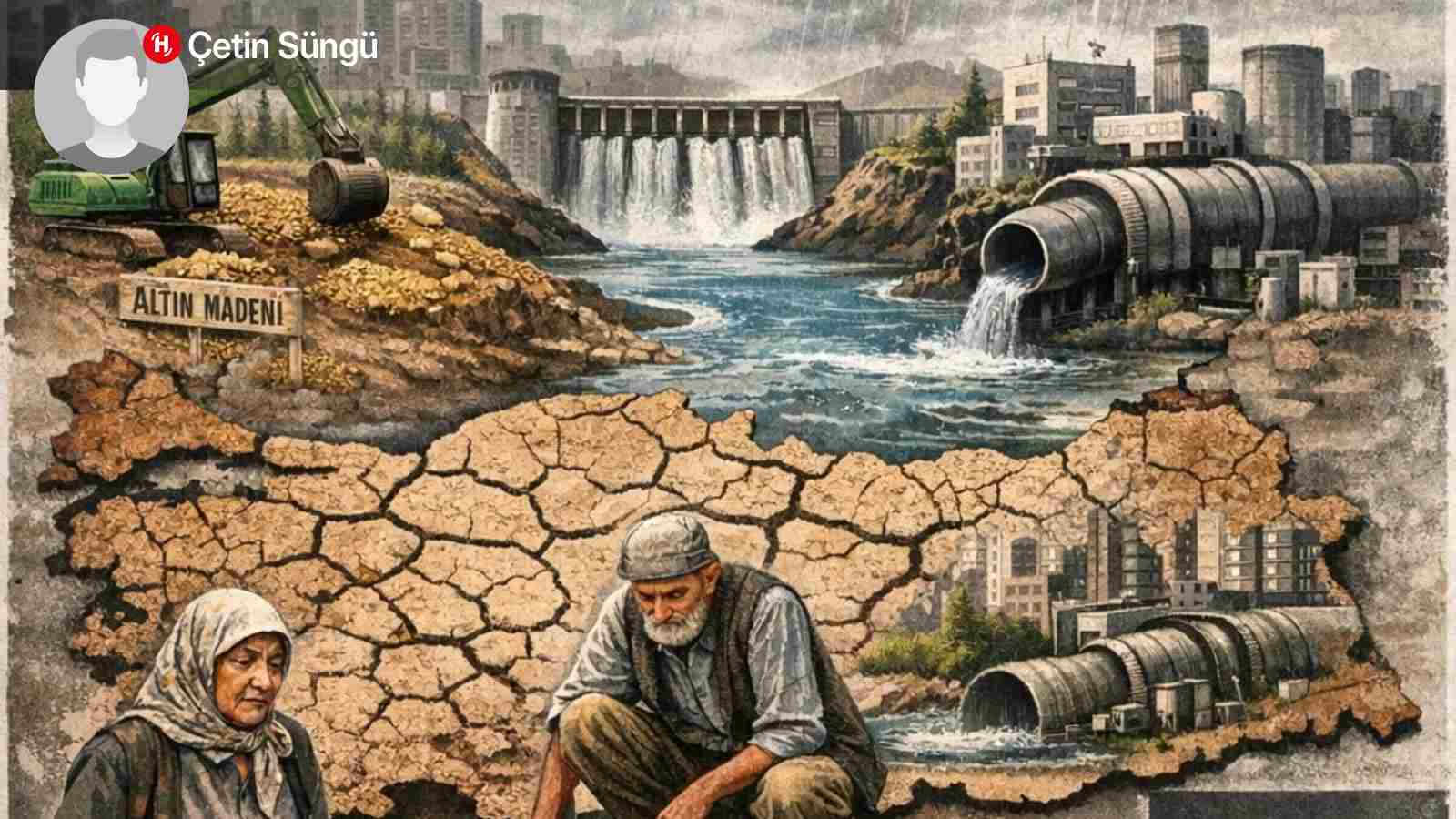
The same scenery is repeated all over Anatolia: Drying streams, receding lakes, collapsing sinkholes, cracking soils... But at the same time, growing mining sites, HEPP projects, agricultural lands consumed by wild irrigation and “natural spring water” plastic bottles filling the market shelves with the label.
This picture is no coincidence.
This picture is not unplanned.
This picture is the product of a conscious, continuous and systematic water regime.
The question should no longer be begged:
Is there really no water, or is it being systematically destroyed?
The Status of Water Changed: From Right to Commodity
Today's water policies are based on a simple but destructive assumption: Nature is limitless, water is inexhaustible. This assumption does not see water as a right to life, but as an input used in the mine, a tool released uncontrollably in the field, a commodity that is monetized in the city.
As the planning capacity of the state shrinks, the capacity of companies to access water grows. Public water decreases and private water increases. This is where the crisis begins.
It is no longer a question of who uses the water.
The question is in whose name it is consumed.
And the answer is clear: On behalf of capital.
Today, water is an asset that is transferred by license, allocated by contract and justified by reports. For the public, it is a necessity that has become increasingly expensive, restricted and in some places even criminalized.
This is not a weakness of governance; it is a class preference.
HEPPs: Clean Energy Discourse, Dirty Appropriation
Hydroelectric power plants for years “renewable”, “domestic”, “national” energy. However, especially small and medium-sized HEPPs have functioned more as river liquidation than energy generation.
A stream is not just flowing water. It is agriculture, fish, microclimate, the memory of the villagers.
With the HEPP, water is taken from above, trapped in a pipe, and sent down “lifeblood” a symbolic amount is left. This is not a right granted to nature; it is a usurpation legitimized by law.
Valleys become silent, villages go thirsty, the ecosystem disintegrates. Despite this, the energy problem is not solved, bills do not decrease, and foreign dependency does not end. Because HEPPs do not exist for energy, but to take water from the public and transfer it to capital.
Mines Gold, No Water
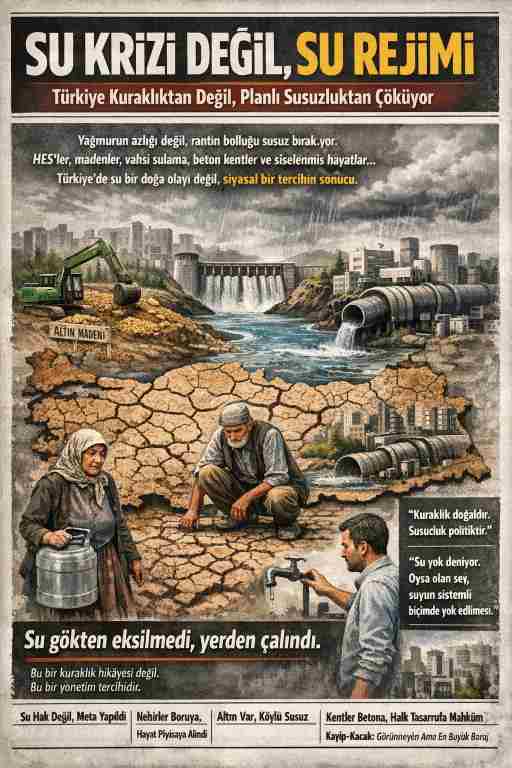
After the HEPPs come the mines. Gold is mined, copper is mined, nickel is mined, coal is mined... But what is actually mined the most is water.
Methods such as cyanide leaching, flotation and ore washing are all water intensive. A mine irreversibly disrupts the groundwater balance in the basin where it is located. Streams change direction, springs dry up, and the memory of the soil is erased.
Then “rehabilitation” It's called.
A few saplings are planted, a few reports are written.
But the water won't come back.
State “employment” He says, “national wealth” He says.
There is no talk of a village without water.
Because in this system, water is a cost item in mines and a fate for peasants.
Wild Irrigation in Agriculture: Wasteful Regime Disguised as Tradition
The biggest consumer of water in Turkey is agriculture. But the problem is not agriculture; it is what kind of agriculture is practiced.
Wild irrigation is still widespread. The water released from the canals drowns the system, not the field. It evaporates, salinizes the soil, draws groundwater and creates sinkholes.
Modern irrigation techniques have been known for years. But they are not applied. Because planning is costly and requires public investment. And rent is fast.
To the farmer “save money” but no infrastructure is provided. Then nature is again to blame. However, the problem is not the lack of rain; it is the liquidation of the public mind.
Bottled Water Life Arranged on Market Shelves
Once water flowed from a fountain. Then “source” it became. Now it has a brand, a logo, an advertising face.
Natural water is taken from mountains and villages, filled in plastic bottles and sold to other cities. Where the water comes from, people carry water in jerry cans, while companies “natural and pure” profit with slogans.
Those who have money have access to water.
Those who have no money listen to austerity sermons.
This is class thirst.
Cities, Concrete and Thirst
As cities grow, water basins shrink. With zoning amnesties, mega projects and concretization, the natural cycle of water is interrupted.
Rain falls, but it cannot reach the soil. There is flooding, followed by thirst. This is not a contradiction; it is two results of the same policy.
Concrete declares water the enemy. Soil cannot breathe, water cannot be retained. This is a conscious urbanization choice.
Where are Municipalities in Thirst?
As much as the central government's water regime, municipal practices are also part of this crisis. In Turkey, a significant portion of treated water is lost before it even reaches the tap. In some cities, loss and leakage rates exceed 40 percent. This is not a technical failure; it is a clear political choice.
Because infrastructure requires investment. It requires patience. It requires long-term planning. Whereas today's municipalism loves asphalt, loves inaugurations, loves visible projects. The underground pipe is invisible; it doesn't bring votes. But it saves water.
A government that drains half of the water into the ground “ethics of saving” to tell the truth. A real water policy first aims to reduce loss and leakage to near zero. Those who do not protect the tap have no legitimacy to demand sacrifices from citizens.
Planned Dehydration Regime
HEPPs, mines, wild irrigation, bottled water, concrete cities, neglected infrastructures... All are products of the same mentality.
For this mentality, water is part of the economy, not nature.
It is not a public resource but a corporate resource.
It is the object of the market, not of the right.
But for society, water is life.
And when life is handed over to the market, crisis is inevitable.
Epilogue: Water, Power and the Liquidation of Public Reason
Turkey's thirst is not a temporary management problem that can be overcome with technical solutions. This crisis is much more than a lack of infrastructure; it is the result of a form of power, an understanding of economy and a liquidation of publicness. This is why the water issue is not only a matter of environmental politics, but also of democracy.
Because the question of who owns the water is the same as the question of in whose name power is exercised.
When water ceases to be a public asset, not only the streams dry up; citizenship also dries up. The commodification of water is not a process limited to the opening of nature to the market. It is also the reduction of the people to customers, rights to privileges, and the public to a corporate logic. Today, if access to water has ceased to be a civic right and has become dependent on purchasing power, this is not just an environmental crisis; it is a clear regime transformation.
While the government manages water, it also manages society. Every decision on whose fields will get water, which stream will dry up, which village will be moved, which company will use the basin is also a decision on who will live and who will be impoverished. This is why thirst “natural” It is not; it is politically produced. Every naturalized crisis is a means for the government to evade responsibility.
Today, water in Turkey is managed by license, not by planning; by contract, not by public interest; by rent, not by science. The public mind of the state that protects, distributes and controls water has been withdrawn and replaced by a fragmented, short-term allocation regime that works in favor of capital. In this regime, water is not the condition of life; it is the raw material for growth. And life can be sacrificed in the name of growth.
Therefore, the solution is not to keep telling citizens to “save”. The preaching of saving is to put public responsibility on the backs of citizens. An order that does not protect water, does not renew infrastructure, opens basins to mines, and imprisons rivers in pipes has no legitimacy to call for morality. Morality starts with the government taking responsibility.
The real solution lies in redefining water as a public good, an equal right and a common ground for life. This requires a political rupture before technical measures: From rent to planning, from the market mind to the public mind, from short-term profit to ecological and social continuity.
Water policy is the litmus test of what kind of society we want to live in. If we leave water at the mercy of corporations, tomorrow we leave land, air and food. If we defend water, we defend the public, equality and the future.
So it's not about the faucet.
It is not about the dam.
It's not the rain.
The question is whether the public is being systematically liquidated.
What Turkey is experiencing is not a climate crisis.
This is a naturalized political choice,
of a marketized understanding of life,
It is the crisis of a regime whose public mind has been dismantled.
And it must now be said clearly:
Water will either be managed together, equitably and publicly,
or thirst will be the most lasting legacy of this regime.
This is not an environmental issue.
This is not a technical issue at all.
It is directly a question of what kind of regime we live in and what kind of country we want to live in.