



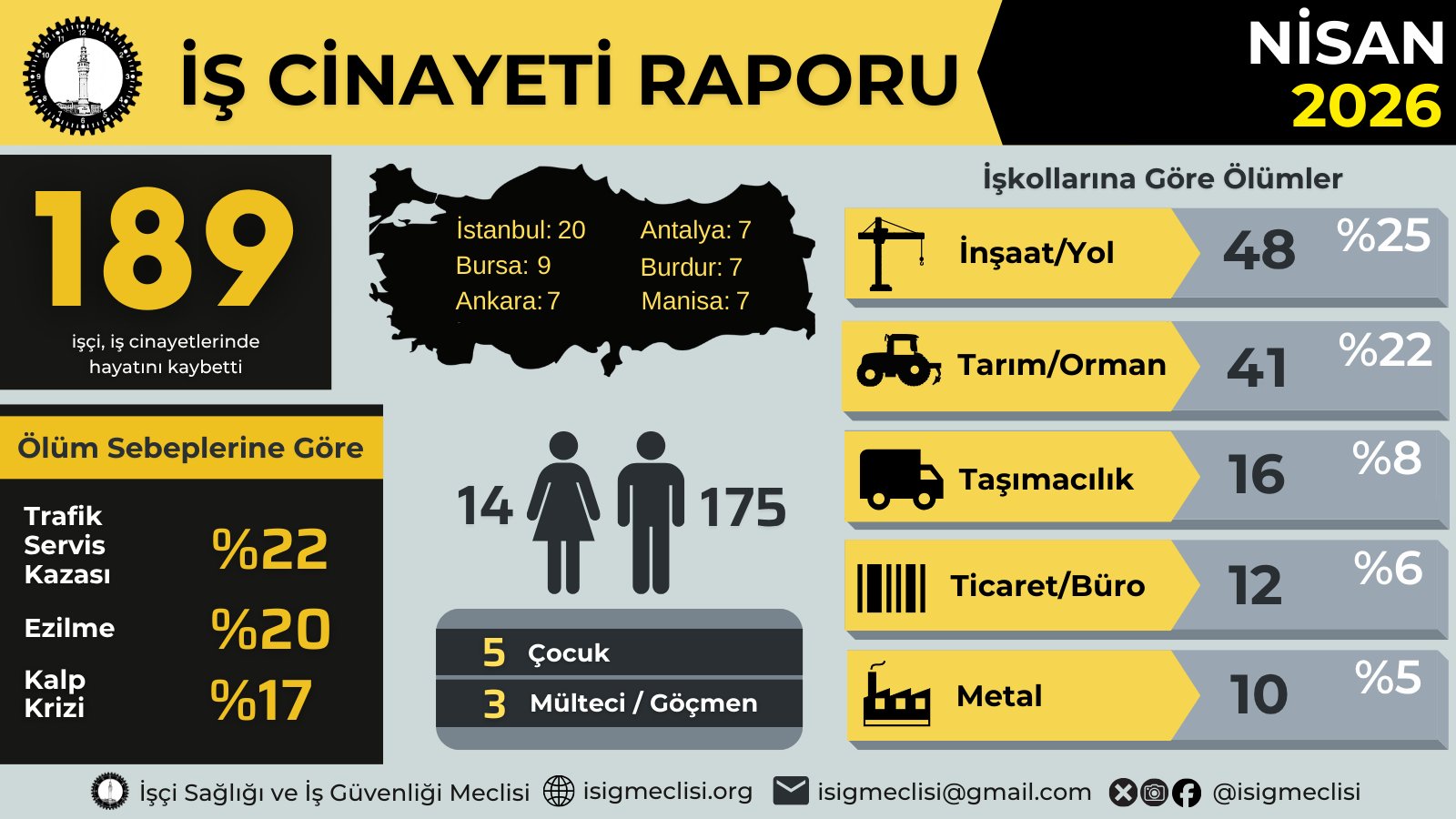
Worker Health and Worker Safety (ISIG) Assembly released its report on work murders in April 2026. According to the report, at least 189 workers lost their lives in April. Thus, the number of workers who lost their lives in work murders in the first four months of 2026 reached 622.
The OSH Assembly stated that 58 percent of the data was gathered from the national press, while 42 percent was gathered from workers’ colleagues, families, occupational safety experts, workplace doctors, trade unions and local press. Accordingly, in the first four months of the year, the number of workplace murders was recorded as 155 in January, 129 in February, 149 in March and 189 in April.
Most deaths in construction
In April, the highest number of workplace homicides occurred in construction with 48 deaths. Construction was followed by agriculture/forestry with 41 deaths and transportation with 16 deaths.
In terms of sectoral distribution, 59 workers died in industry, 51 in construction, 41 in agriculture and 38 in the service sector.
Five engineers lost their lives
One of the striking headlines in the report was the deaths of engineers. 5 engineers lost their lives in April.
The OSH Assembly emphasized that these deaths cannot be seen as individual accidents. In Küçükçekmece, Istanbul, civil engineer Görkem Selvitop, who was waiting for a bus at a bus stop after getting off his bus, was killed when he was hit by a pickup truck stuck in a manhole cover. Murat Bektaş, who was buried under a cave-in while measuring at a school construction site in Şırnak; Levent Acar, who fell from a roof while working as a construction site supervisor in Maltepe; Harun Yıldız, who died in a traffic accident in Van on his way back from an inspection; and Mehet Derda Işık, who reportedly ended his life due to mobbing on the ship where he was doing his internship, were included in the April balance sheet.
Nearly doubled deaths in agriculture
With the warming weather, the number of deaths in the agricultural sector has also increased sharply. The number of deaths in agriculture increased from 21 in March to 41 in April.
The OHS Council drew attention to two main reasons for this increase. The first is the deaths of subsistence farmers who are trapped under overturned tractors. The report emphasized that old and poorly maintained tractors as well as the lack of ROPS (Roll-Over Protective Frame) systems are a critical risk.
The second reason is the precarious employment of agricultural workers. It is stated that this precariousness is not limited to the workplace; it also manifests itself in housing and transportation conditions. The death of 7 workers in a collision between a concrete tanker and a shuttle bus carrying agricultural workers in the Bucak district of Burdur was cited in the report as one of the striking examples of this situation.
Lack of supervision brings death
The report cited the failure of inspection and sanction mechanisms as one of the important causes of occupational homicides.
The death of 3 workers who fell from a height of about 20 meters due to the collapse of a platform during maintenance-repair at the Çolakoğlu Metalurji factory in Dilovası, Kocaeli was recorded as an example of this. The ISIG Assembly reminded that there have been many deaths and injuries in the last 20 years of the factory's history.
The most common cause of death is traffic accidents
In April, traffic and service accidents, mostly in the transportation and agriculture sectors, were the leading causes of workplace homicides.
This was followed by crushes and cave-ins, heart attacks and brain hemorrhages, and then falls from height. According to the report, 69 percent of workers who died from falls from height died in construction sites.
Women workers, migrant workers, non-unionized
In April, 14 of those killed at work were women workers. Most of the women were working in the agricultural sector. The report drew attention to the urgency of occupational health and safety policies specific to women workers.
At least 3 migrant workers lost their lives. It is stated that two of the migrant workers who lost their lives were from Syria and one from Afghanistan.
It was noted that only 13 of the dead workers were union members, while 176 were non-unionized. The OHS Assembly stated that the apparent increase in the deaths of unionized workers, especially this month, is a serious warning for the union movement.
In which provinces were the deaths concentrated?
According to the report, most workplace murders occurred in Istanbul, Bursa, Ankara, Antalya, Burdur, Manisa, İzmir, Kahramanmaraş, Kocaeli, Diyarbakır, Malatya, Sakarya, Bitlis, Düzce, Muğla, Samsun, Aydın, Denizli, Gaziantep, Giresun, Kayseri, Kırklareli, Konya, Mersin, Şanlıurfa, Tekirdağ and Uşak.
We respectfully commemorate the 189 workers who lost their lives in work murders in April 2026...
Güngör Hoşgör, Ömer Keçiören, Furkan Alemdar, Turgay Minaz, Suat Kulakçı, Günay Can, Hamza Günay, Ali Yücel, Mustafa Kabakcı, İbrahim Alkan, Adem Ulucan, Tuncay Kurul, Volkan Akyol, Sercan Aktaş, İsmail Başer, Mehmet Salih A., Mehmet Kurt, Seyfettin Palaz, Varol Yılmaz, Ökkeş Erol, Çelebi Şahin, Anıl Karakuzu, Mustafa Fedaioğulları, Hatice Kocaefe, Ferhat Gül, Onur Öztürk, Vedat Gürbüz, İbrahim Koray Akbıyık, Serkan Yıldırım, Kasım Yıldırım, Osman Savaş Çetiner, Ayla Kara, Halime Aki, Abdulkadir Arzık, Engin Aras, Abdullah Çevik, Mustafa Girgin, Gürkan Kumaş, Muhammed Alimam, Hasan Yüntem, Mehmet Karasakal, Tamer Aydoğdu, Resul Kardaş, Şah İsmail Mayda, Eralp Çoralı, Ahmet Şahin, Adem B., Erol Buyun, Hasan Al, Kemal Tatar, Temel Kurt, Abdullah Avcı, Ahmet Yiğitce, Ahmet Gencer, Mehmet Emin Akcan, Görkem Selvitop, Zafer Gezer, Salih Koca, Tolga Taşçı, Adnan Ünlü, Kemal Doyan, Zekeriya Muhammed Musto, Ahmet Müldür, Muhammed Raşit Okatan, Servet Kurt, Yüksel Şenel, Reis Aslan, Yüksel Arıcan, Hayrettin Taş, Cebrail Çiçek, Engin Tuncay, Bilal Çakır, Ramazan Küren, A.H., Mahmut Bozan, Rıfat Duran, Murat Bektaş, Varol Atmaca, Mikail Yardımcı, Cavit Keskin, Arda Bağırgan, Hüseyin Bezgin, Abdullah Elmas, Fasih Dağ, Seyfi Sökmen, Levent Acar, Bekir Can Kadaş, Ahmet Özdemir, İsmail Koçkat, Sadık Güney, Levent Cumhur Urgan, Recep Işık, Hayri Akdoğan, Harun Yıldız, Bahattin Adiyan, Kara Akça, İlhan Can Yalçın, Uğur Okutan, Cemil Sarıca, Ahmet Pak, Ali Alev, Yılmaz Uzuner, İsmail Çoban, Hakan Özkan, Tayfun Bağcı, Mehmet Küçükaslan, Osman Kaplan, Akın Kızılkan, Mehmet Seçmen, Mahmut Dadaş, Süleyman Akçay, O.Y., Erol Yılmaz, Osman Doğan Baş, Mehmet Çiftlikci, Galip Avcı, Tarık Yasin Şahin, Mehet Derda Işık, Tulay Irkat Ceylan, Volkan Gelmez, Muhammed Emin Dikici, Eren Bakır, Semih Sinan Pelek, Barış Metin, Mehmet Öncül, Mustafa Bebe, İbrahim Özbek, Serkan Hızlı, Mustafa Aksoy, Seçkin Yalçın, Musa Özbay, Akif Tunç, Celil Yazıcı, Durdu Aldemir, Necmettin Doğan, Dilek Turan, Doğukan Yıldızlı, Efe Erdem, Bayram Burak Temel, Sabri Kılınç, F.Ü., M.R.S., Melik Bingöl, Salih Avşar, Kadir Sami Gözüaçık, Hüseyin Türker, Kudret Ahmedi, Süleyman Gülsün, Erdoğan Akbaş, Salih Ayaz, Hüseyin Uysal, Bekir Bolat, Seyfettin Yılmaz, Telat Öztürk, İsmail Arslan, Halim Kutlu, Rasim Başar, Zeki Karabulut, Ferhat Boztepe, Selahattin Aydoğdu, Muharrem Ustaoğlu, Mehmet Şirin İlbaş, Nesrin Kaya, Mehmet Gökcen, Emine Gökcen, Rıfat Gökcen, Mehmet Üstün, Ömer Akkoç, Vakıf Önder, Gülsüm Özkan, Zeynep İnaz, Hayrunisa Karaca, Elmas Yüce, Cemile Çakır, Yeter Gümüş, Adil Özkan, Niyazi Can, Haydar Güler, Haydar Şahbaz, Miran Tutar, Erol Sezer, Deniz Yılmaz, Bedri Ulaş, Mehmet Sıddık Mantam and two unnamed workers...