




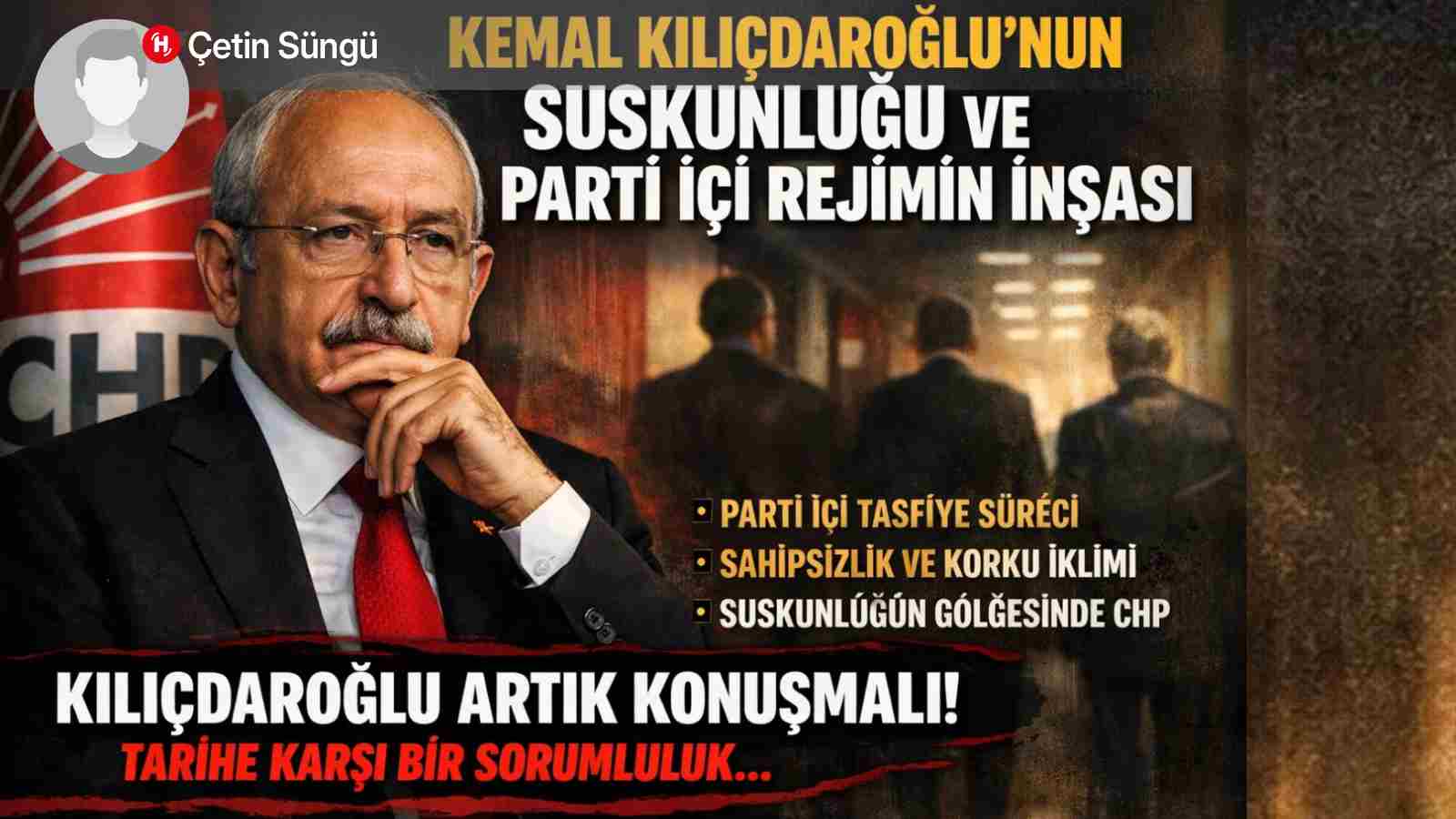
 In politics, silence is often presented as a virtue. However, silence is as much a political act as speaking, and in most cases it is not neutral. To understand the crisis facing the opposition in Turkey today, one should look not at loud polemics, but at a single long-standing silence: Kemal Kılıçdaroğlu's silence.
This silence is not a momentary retreat, a personal resentment, or a search for temporary calm. It has produced institutional consequences over time, even It is a political choice that allowed the establishment of a new intra-party regime in the Republican People's Party.
At this point, silence is no longer an individual attitude; it becomes a collective political practice, even a management technique. Silence is not just a behavior, it produces a signal: It marks who can speak, what can be said, and which boundaries are invisible but impenetrable. Silence here is not a state of “holding back” but an active position that contributes to the reorganization of the political space.
From Moral Justification to Political Conclusion
Kılıçdaroğlu's reticence was initially based on a moral framework: not to escalate the conflict, not to further divide the party, not to turn a personal quarrel into institutional destruction. On a normative level, this position was defensible.
But politics is not limited to the normative sphere. Politics is the realm of power relations and gaps. In a conflict-ridden political arena like Turkey, silence does not mean moral superiority; it means the opening of a hegemonic space. And this space is always filled by the most organized, most aggressive and least hesitant actors.
From this point on, silence ceases to be a virtue; it becomes a ground that makes the action of others possible.
What is critical here is not the intention but the result. Political philosophy teaches us this: Moral justifications lose their meaning as soon as they do not produce results in the political sphere. Morality is effective in politics only to the extent that it comes into contact with power. Morality that does not come into contact with power quickly turns into an abstract narrative of virtue and cannot regulate the political sphere.
The Evolution of Silence into Desolation
This is precisely where the break occurred. While Kılıçdaroğlu's supporters were subjected to an open lynching process and people were expelled from the party every day, no protective political reflex was shown against these processes.
The discussion of intentions is secondary here. What is decisive in politics is perception and results. The emerging picture is clear:
- Kılıçdaroğlu supporters lynched
- Intra-party expulsions normalized
- Not a single protective boundary was drawn at the leadership level
In the language of politics “left unattended” as a betrayal. This is not necessarily a conscious betrayal. But when a powerful actor remains silent, this silence is perceived as either consent or renunciation. For those who support it, the result is the same: isolation.
Here, dispossession is not a psychological feeling, but a political status. An unclaimed cadre is not only unprotected; it is also deemed illegitimate. Because politics works on ownership. Unclaimed positions quickly become marginalized.
How is Unclaimedness Institutionalized?
Apathy is not produced by not speaking all the time; it is produced by not speaking at critical moments. Long speeches are not what is expected from a leader when waves of lynchings are rising, expulsions are coming one after another, and clear injustices are taking place. Sometimes a single sentence is enough:
“Criticism within the party cannot be a justification for lynching.”
“Expulsion is not a means of silencing.”
Failure to make these statements does not produce individual resentment; it produces collective learning:
Silence is safe, speaking is risky.
This learning rewrites the codes of behavior within the party. No one needs written instructions anymore. The regime operates not with explicit prohibitions but with internalized fears.
Building the Intra-Party Regime
It is insufficient to explain the order that operates in the Republican People's Party today only through the bylaws and the mechanisms of the congress. What is decisive is which behaviors are rewarded and which are punished.
The structure that emerges is this:
- Criticism is no longer part of political competition
- Expulsion is a preventive fear mechanism, not discipline
- Silence has become a prerequisite for loyalty
This regime is not a brute authoritarianism; it operates in a more refined, quieter, more sophisticated way. Nobody openly “don't talk” but everyone knows the price of speaking out.
What is being built here is not party discipline in the classical sense, but a behavioral alignment. People learn not what to think but what not to say. This means the gradual dissolution of the political subject.
The Gürsel Tekin Case: Open Confession of Silence
There is no need for theoretical analysis to understand this regime of silence. Gürsel Tekin’s words alone are sufficient:
“When I accepted the duty of the Call Committee and called for a purification, there were MPs who called me and said, ‘Halalal olsun’. Now they are all silent.”
This sentence is not a reproach; it is a confession.
It is not a person who is being defended here;
- Internal party purification
- Confrontation
- A call for accountability
And what is striking is this:
Those who said “well done” that day are unable to repeat the same call in the public sphere today.
Because it is not a question of rightness; it is a question of price.
The Silent Majority and the Exhaustion of Opposition
The most severe consequence of this regime is the silent majority within the party. This majority is neither pro-government nor openly oppositional. It has learned only this:
“To stay in politics, it is more important to bide your time than to tell the truth.”
This is the depletion of the opposition from within. Because the opposition is an opposition to the extent that it can speak out not only against the government but also against the domination within itself.
Instead of Conclusion - Silence Produces a Regime Legacy, Not an Attitude
At this point, the issue is no longer about Kemal Kılıçdaroğlu's personal preferences. The issue is that silence has become institutionalized over time and has produced a political legacy.
In politics, some behaviors are measured not by intention but by impact. And silence is one of the most effective behaviors, especially in times of crisis.
Every order established by silence leaves the following message for the future:
“Don't take risks. Don't talk. Wait.”
An opposition that grows up with this message cannot be transformative against the government.
Hence the question “will he talk?” It is not.
Question:
Will this silence leave a regime of surrender in the memory of the opposition, or will it be broken with a word spoken, albeit late?
Because politics is sometimes done late.
But when it is never done, history will not forgive it.
So What Should Kılıçdaroğlu Do? (Late But Still Possible)
Today Kılıçdaroğlu has two options in front of him:
Either he will remain the historical bearer of this legacy of silence or he will be the figure that breaks it.
There are still things they can do - but they have to be explicit, not implicit:
1. Make a clear political statement to break the silence.
A language that is inclusive but not vague, protective and demarcating.
“Saying ”intra-party lynching is not legitimate" is not taking a side; it is reopening the political space.
2. Set a principled threshold for expulsion and disciplinary processes.
It is not about defending the person; it is about demarcating the method.
Unless this is done, the regime of fear will reproduce itself.
3. Return political legitimacy to cadres who have been left without a voice.
This is not about undoing the past; it is about breaking the silence that poisons the future.
4. He must clearly name his own silence.
The most powerful ruptures in politics happen in moments of public self-criticism.
Because the issue today is not whether Kılıçdaroğlu should become leader again or not.
The question is whether silence will be normalized as a tool for establishing an intra-party regime.
And this marks a threshold that will determine the future of not only the CHP but also the opposition in Turkey.
Silence was a choice.
But disrupting it is still a possibility.
.