




For years in Turkey, we have heard the following from leftist and socialist circles: “The conditions for revolution have never been more favorable.”
In the last days of his life, Celal Bayar, the third President of Turkey, often ‘Communism may come this winter’ but dozens of winters later, there was no communism, no revolution.
But the bogeyman of society ‘communism’ and made great progress in building the country of their dreams. With the September 12 regime and the 2017 constitutional amendment, they reinforced the system they established.
While revolutions were made in many parts of the world after the October Revolution, was it the fault of the revolutionaries that the revolution could not be made in Turkey, or were the conditions really not ‘favorable for revolution’ as it was said?
Revolutionaries have made many self-criticisms about the revolution that could not be carried out. The subject of this article, however, is not to discuss the shortcomings and mistakes of revolutionaries, but whether the conditions for revolution were favorable or not.
And as a footnote, the author of these lines is a person who believes that the definitive solution for humanity is socialist revolutions and bases this on historical determinism.
The inspiration for this article came from two recent articles.
First, the CHP's 7th President Kemal Kilicdaroglu‘published on the T24 website “Is the new world order low-intensity socialism or social democracy?” article.
Kılıçdaroğlu concluded his article as follows:
“It can no longer be denied that the system has impoverished the peoples. Some circles see the solution in “low density socialism”.
In fact, the solution lies in social democracy. Because social democracy is not an imposing, passive ideology. It is an ideology that has the flexibility to produce and develop rational policies for the problems that arise with change. It does not ignore the responsibility that does not hesitate to impose social obligations on big capital under extraordinary conditions.”
The second article is Arab Karaduman‘published on HALKWEB “The Empire of Decay, the Darkness of the Earth and the Birth of Revolution” was titled.
Karaduman said in his article:
“It is neither “Moral Speeches” nor “Reform Promises” that will destroy this order. It is the organized democratic struggle of the working class, the poor people and the oppressed that will destroy this order...”
“What the world needs is precisely the revolutionary will that breaks through the darkness and will be a new sun that will rise over the rotten empires with the breath of a people that will rebuild the earth.”
While both articles drew attention to the rottenness of the system and its inability to produce solutions, they offered different suggestions as solutions.
Kılıçdaroğlu, instead of socialism ‘social democracy’ as a solution, while Karaduman suggested that the solution ‘revolutionary will’ with the world's most powerful people.
I look at it from the perspective of the concrete situation and the class perspective of revolutions. ‘revolution’ and ‘reform’ I will try to look at the feasibility and implications of the options.
Because sometimes ‘revolution’ for the path that has been set out for, because the favorable conditions have not been evaluated correctly. ‘counter-revolution’History has witnessed attempts that resulted in the further strengthening of the state.
A revolution undertaken when conditions are not favorable, “it is either suppressed, or it makes space for another authoritarian power.”
For this very reason “Are conditions in favor of revolution or reform?” to see if there are any other options.
“Reform” and “revision” concepts are considered in the left/socialist literature as adapting to the order and are not welcomed positively. This observation is not very unfair. However, it should not be forgotten that without a concrete analysis of the concrete situation, the consequences of a revolutionary attempt will lead to a historical leap backwards.
The political subject of the revolution is not only the vanguard party/leading cadre, but directly “class” it has to be.
Therefore, it is necessary to make a realistic analysis of the class in terms of Turkey.
When we look at the conditions for a revolution in which the working class and the poor will be the bearers, it is useful to see what kind of a picture emerges before us.
In the bourgeois revolutions in history, while the capitalist class took the lead, the bare-bottomed people played their historical role as the street force of those revolutions.
In socialist revolutions, the working class and the nudists are both the street force and the vanguard cadres of the revolution.
Today, it is being debated again in Turkey. ‘are the conditions right for a revolution’ It is important to take a look at the situation of the class and the barefoot for this purpose.
It would be useful to take a closer look at the economic policies and results of the AK Party government, which has ruled the country without interruption since 2002.
The first one share of GDP allocated to public social spending.
The second is en düşük ve en yüksek gelir grubundaki %20’nin GSYH’den aldıkları pay.
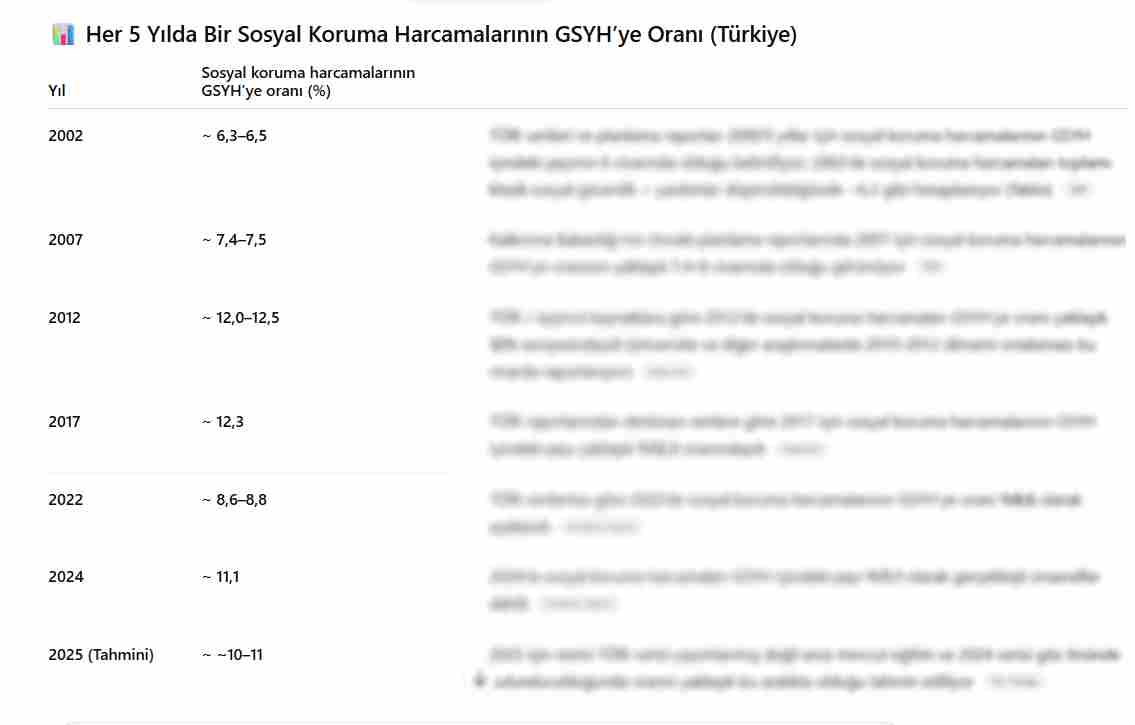
The ratio of social assistance to GDP in 2002, when the AK Party came to power %6,3 while in 2025 it will be about %11 rate. In other words, the share of National Income allocated to the poorest almost doubled.
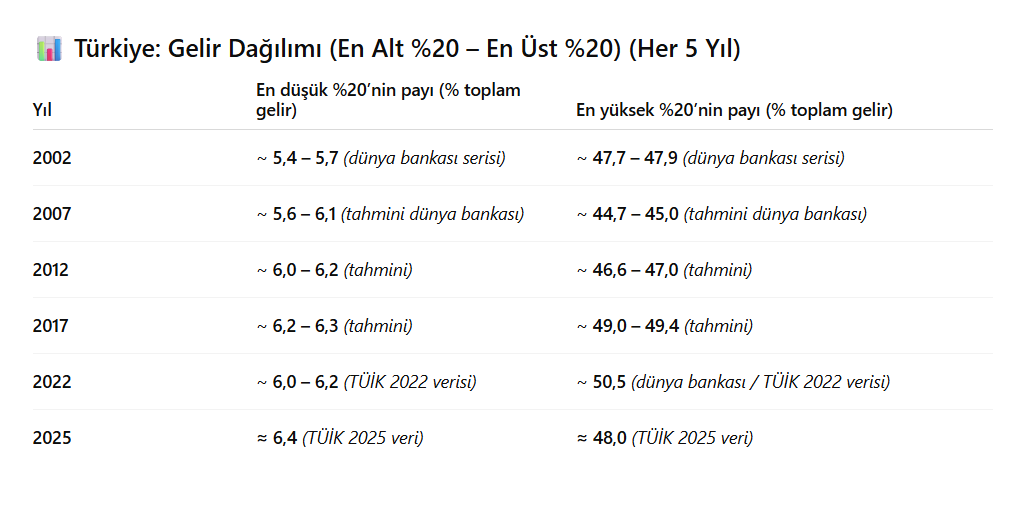
In terms of income distribution, in 2002, according to World Bank income distribution data, the lowest %20’nin payı yaklaşık %5,4, the highest %20’nin payı ise yaklaşık %47,7 was around.
In 2025, the lowest income group %20’nin aldığı pay yaklaşık %6,4 rate, while in the highest income group %20’nin aldığı pay ise %48,0 rate in the last two years.
In other words, both those at the bottom and those at the top have increased their share of national income.
When we look at the 10 percent and 5 percent brackets, we are confronted with the fact that there has been an exorbitant increase in the share of those at the top. This tells us about the deterioration in the distribution of wealth ‘dollar millionaire’ is also increasing in number.
In this case, the biggest loser of the AK Party's economic policy ‘middle class’ as the most prominent.
So let's ask the question: Can the middle class be the driving force of a revolution anywhere in the world?
At this point in the article, let's take a look at the class situation in Turkey.
Lower classes
- Precarious
- Debtor
- Non-unionized and unorganized
- Object of aid, not political subject
Middle class
- Collapsed
- Loss of status and income
- The political reflex is fear and defense
Top class:
- Intertwined with the state
- Rent is protected by tender, finance and exchange rate guarantees
- Most of the time it feeds on the crisis
The lower and upper classes have played their part many times in history in turning the balance in their favor through revolutions. However, the main characteristic of the middle classes is that they are the ones ‘from revolutions’ to stay away, and often with reformist policies ‘correction of deterioration’ to demand the same.
The middle class, the biggest losers from the country's economic policies today, would prefer reformist policies to correct the deterioration and a leader who can be trusted to implement them, rather than a revolution.
For this, a political discourse that stays away from all kinds of extremism and reassures social segments, and support for the cadres who will implement these policies are seen in all public opinion polls.
Ankatlerde %30’ların üzerinde çıkan ‘undecided’ seçmenler de, %40’ların üzerinde çıkan ‘no party can solve the country's problems’ voters who say that the voters who say ‘revolution’ rather than demanding a radical ‘reform’ demand.
Let's talk about whether there are conditions for the ‘revolution’ option.
Most of the structures calling for revolution in Turkey do not have a strong organic connection with the working class. They are predominantly symbolic, urban and cultural left. Their contacts with the broad working class are weak and they are far from leading the masses. In other words, There is the language of revolution, but unfortunately there is no revolutionary subject.
In this case, the revolution will either be suppressed or it will give space to another authoritarian power. This is the biggest risk for the left and the people.
Of course, it goes without saying that while reform can be achieved through the ballot box, revolution cannot come from the ballot box.