
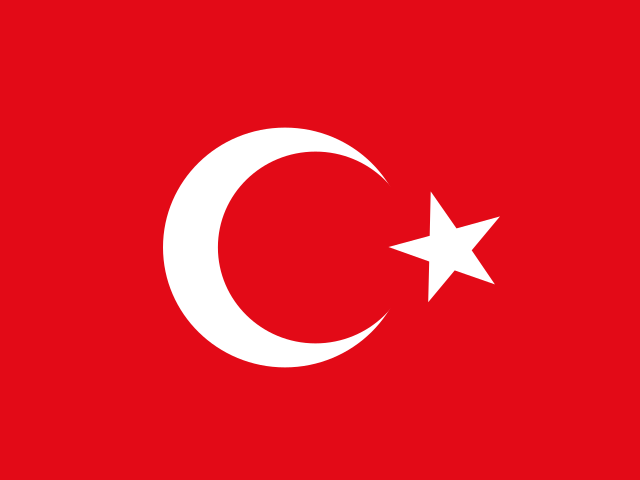



The fall of Ottoman despotism did not mark the beginning of a liberal order in these lands; on the contrary, it paved the way for the establishment of a new architecture of power. Although the Young-Turk movement initially emerged with a demand for constitutionalism and a constitutional order, it gradually shifted towards a centralized and ethno-nationalist design of the State that saw the multinational structure of the empire as a threat. This transformation created an ideological framework that targeted the historical diversity of Mesopotamia and Anatolia. This framework formed the basis of the Pan-Turkist and Turkish-Islamic synthesizing state mentality that would later be decisive in the establishment of the Republic.
The 1908 Revolution and the complete takeover of the state apparatus by the Committee of Union and Progress after the 1913 Sublime Porte Raid institutionalized this ideological transformation. The Young-Turk cadres were able to transform the multilingual, multifaith and multiethnic structure of the empire. “security risk” as a "Turkicized" state. Therefore, Turkification policies, centralized administrative structure and social engineering practices became the main strategy of the State. This process resulted in the suppression of national identities, the criminalization of cultural memory and the exclusion of local communities from the political sphere.
The official end of the Ottoman Empire did not mean the end of this ideological line. On the contrary, the cadres and mentality of the Young Turk movement directly carried over to the founding of the Republic. The new State put into practice more systematically and more rigorously the design of the Nation-State that had taken shape in the last period of the empire. Central to this design was the construction of a nation based on Turkish identity, a modernized interpretation of Pan-Turkist ideology and the transformation of the Turkish-Islamic synthesis into the ideological backbone of the state. Within this framework, the historical peoples, cultures and beliefs of Mesopotamia and Anatolia became the target of the State's homogenizing policies.
The policies of denial and assimilation implemented since the first period of the Republic aimed to render invisible the multicultural structure of these lands. Kurdish identity “Mountain Folk Song” Armenian, Assyrian and Greek presence was systematically erased; the Kızılbaş-Alevi culture was suppressed on both religious and cultural levels. Local languages were banned, cultural practices were criminalized and social memory was encircled by the state's security policies. This process is described in the international literature “Nation Building through Exclusion” was a typical example of the policies described as the ""no-strings-attached" policy.
This regime of denial was not limited to the sphere of identity; class struggle, trade union organization and peasant cooperatives also became targets of the same authoritarian State mind. Since the foundation of the Republic, the trade union organization of the working class, peasants' cooperative initiatives and Revolutionary-Socialist movements were coded as potential threats by the State. Independent Trade Unions were shut down, strikes were banned, the right to collective bargaining was restricted and labor leaders were systematically targeted. Peasant cooperatives, on the other hand, were rendered dysfunctional by State interventions; their leaders were arrested, their activities were blocked and rural solidarity networks were dismantled. Both the economic and political spheres were thus brought under the centralized domination of the State.
The 1960s and 1970s were the years of the rise of the Revolutionary-Socialist movement. Organized in universities, factories and villages, this movement reached the masses with its demand for both class equality and a democratic society. The State, however, was able to “Internal Threat” and put the security apparatus into action. Revolutionary organizations were banned, leaders were executed, murdered and arrested, torture centers were established and social opposition was violently suppressed. The massacres, unsolved murders and paramilitary attacks during this period are historical documents showing that the State used every method to liquidate the Revolutionary-Socialist line.
The 1980 Junta was the peak of both repression in the field of identity and attacks on the class struggle. The junta closed down all trade unions, banned strikes, suspended the right to collective bargaining, and labeled hundreds of thousands of workers. Peasant cooperatives were disbanded, revolutionary-socialist organizations were pushed completely underground and thousands of people were detained, tortured and forced into exile. In the same period, the Turkish-Islamic synthesis became the official doctrine of the state; compulsory religion classes, the strengthening of sects within the state and the criminalization of identity demands reinforced this ideological line.
The 1990s was the period when security State policies were implemented in the harshest manner. The State of Emergency regime, village evacuations, unsolved murders, enforced disappearances and cultural bans have become part of the State's social engineering strategy. Attempts to unionize in factories were prevented, strikes “National Security” and cooperative initiatives in rural areas were suppressed by security policies. The Revolutionary-Socialist movement, on the other hand, faced heavy state violence both in the cities and in the countryside.
Despite all these periods of oppression, the Kizilbash-Alevi culture, the Kurdish freedom movement, the working class, peasants, revolutionary-socialist organizations and the forces of democracy formed a strong line of resistance against the regime of denial. This resistance was not only a struggle for identity; it also became the carrier of the demand for a Democratic Republic, an egalitarian order and a free future. The preservation of cultural memory, the strengthening of social solidarity networks and the continuity of the struggle for rights demonstrated the existence of an alternative historical line in these lands.
Today, this historical continuity, which began with the fall of Ottoman despotism and was carried to the Republic through the ideological legacy of the Young Turk movement, is still in effect. But at the same time, the continuity of resistance, cultural memory and social struggle represents the opposing stream that will determine the future of these lands. The real transformation will take shape in the struggle between these two historical lines.