



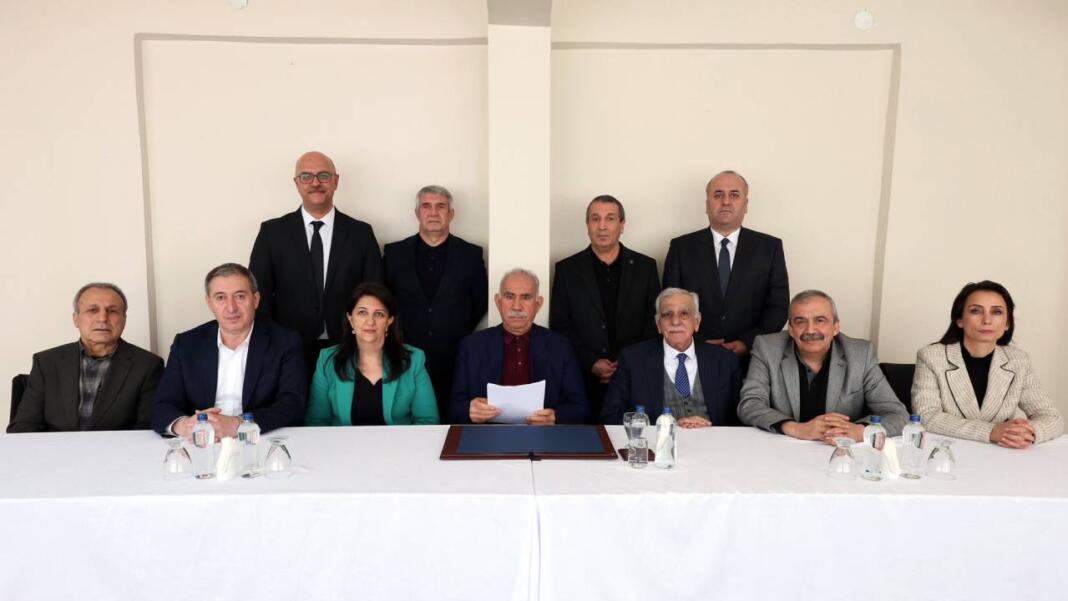
I think we should start by saying that the search for peace, in whatever form it takes, is a better option than conflict. After that, I guess you have to analyze, if you have human values. If you care at least a little bit about human life. After 40 years of conflict, even the MHP is aware that it cannot be resolved with the advantages gained in weapon technologies alone... What comes next will be a bit uncertain and complex, and it will be a bit of a back and forth! Because no peace can satisfy all parties completely. Nor should it, because everyone has to compromise their dreams in some way.
‘It is imperative to get out of the shallowness of ’surrender‘ or ’surrender'
Analyzing these developments with a shallow approach such as ‘surrender’ for one side and ‘surrender’ for the other side would be impossible and poisonous to the process. This is true not only for Turkey and the Middle East, but also from Sudan to Myanmar, from Spain to the People's Republic of China... If you want to use Indonesia and Sri Lanka as examples, let me tell you that everyone there is on pins and needles about what will happen the day after tomorrow. Those who are ‘surrendered’ are always a potential source of rebellion, whether they are Tamils or Papuans...
In other words, no matter how strong your army is, no matter how effective your weapons are, ethnic or religious-based uprisings will continue and continue to be a problem. Unfortunately, nowadays it is difficult to add class to these two! I mean, for example, nobody expects a new ETA to emerge from the Basque country anymore, but I don't think there is anyone who can claim that they won't declare independence through a plebiscite when the opportunity arises. Just like what happened in Catalonia and what happened all of a sudden!.
Can it be done this time?
The reason for such a long introduction is not to pontificate, but because of the complexity of the issue.... I felt the need for such an introduction before commenting on Abdullah Öcalan's ‘Call for Peace and Democratic Society’ statement read out yesterday.
First, it is worth taking a look at the gaps in the text.
Let me start with Öcalan's observations on the historical process. He talks about “...being heavily influenced by the reality of the real socialist system” and “the collapse of real socialism due to internal reasons, the dissolution of identity denial in Turkey, and developments in freedom of expression”. The first of the historical phases he is probably referring to is Turgut Özal's initiatives during the ANAP period... After that, the ‘living’ elements of the state intervened in the developments and the ’White Toros‘ emerged in the 90s during Tansu Çiller's prime ministership. Unsolved murders on the one hand, shady relations on the other...
If you remember, the bones of an unknown number of people were found in acid wells. On the one hand, there were barons on both sides making big money. The mothers of those killed were also in the front row at yesterday's meeting. Years later, the well-known Resolution Process and what happened afterwards... The overturning of the table, then the conflict process and the ongoing events in Syria...
And today we are in a period in which there are dozens of detentions every day, attacks on the main opposition party are at an all-time high, threats are flying, and the leader of the Victory Party, a representative of the anti-foreigner new right, has been jailed. There is hardly a worse period in the history of the western part of the country, at least not in the history of the western part of the country, when freedom of expression is under such a threat and the rule of law is being destroyed!
Öcalan has not really analyzed today due to the process. I guess if he were to attempt such an analysis, it would be very difficult to summarize the context of the call. Of course, since we do not know the mutual promises of the parties, it is not possible to say anything clear.
I am not going to react like some schizoid to the statements about socialism in the text of the call by saying “No, socialism is not over”! That would be the last detail to be discussed in the text. However, aren't these statements on freedom of expression and identity denial beyond optimistic?
Call for dissolution also important for solving the ‘Turkish problem'
In any case, the observations on this historical period are not very important for the present, but the next observation is relevant for today: “The PKK's lack of meaning and excessive repetition...” and “...therefore, it has completed its life like its peers and necessitated its dissolution”...
I think that the observation is correct, but I think it is a bit incomplete, because in the sequel it is probably not enough to explain the armed struggle only in terms of the historical period, for example, it is also necessary to mention the geometric increase in the technological superiority of the Turkish Armed Forces and the ability to carry out many cross-border operations thanks to conjunctural developments. And, of course, there are also the constraints imposed on both sides by the conjunctural situation. However, to be fair, if this observation were made, then such a sentence would be perceived by many as ‘surrender’. Maybe it does not exist for that reason. Because just a few meters away, the YPG or SDF is well armed and well equipped! The US is not likely to withdraw its support to the SDF. Or it is taking a tactical approach in its call to Öcalan and leaving the SDF out of the issue.
This was immediately followed by a call to lay down arms. “But weapons and violence no longer have legitimacy” and “There are two ways: Either by force or voluntary dissolution”... Here the issue goes beyond laying down arms and goes beyond the PKK's dissolution. I think this is important because many people argued that ‘laying down arms’ would be insufficient, that as long as the PKK existed, it could take up arms again at any time. I think this will be an important statement especially for Turks who have no trust in either the government or Kurdish politics. I think, accordingly, the termination was added to the call, just as Devlet Bahçeli stated in his first statement...
Is administrative autonomy an issue limited to the Kurdish issue so that it is not deemed necessary?
So let's say disarmament is realized, what are the expectations afterwards?... Let me quote from the text, “Separate nation-state, federation, administrative autonomy and culturalist solutions, which are the necessary result of extreme nationalist drift, are not the answer to the historical sociology of society”. Putting aside a group of ultra-nationalist sections of Kurdish politics, has there ever been a demand for a nation state? We know that the demand for a federation was shelved a long time ago. But why aren't the administrative regions and super-governorships mentioned by the AK Party during the first ‘Solution Process’ period valid in this new ‘historical sociology of society'? Or why the issue of bilingual education and the second official language is not suitable for the new situation? I don't really understand these.
Administrative autonomy is not even an issue related to the Kurdish question, while democratization and improving the functionality of local governments are frequently discussed in Turkey... I guess we will see why in the future.
Is the unwritten message in the call a reference to new developments?
At the end of the meeting, Sırrı Süreyya Önder quoted a sentence that Öcalan said to the İmralı delegation, which was not included in the text of the call; this sentence, “While putting forward this perspective, it undoubtedly requires the practical laying down of arms, democratic politics and the recognition of the legal dimension”, what should we understand here if not administrative autonomy and culturalist solutions? Only freedom of expression? The emphasis on the rule of law? I don't think so, but I honestly don't know what it is.
It would be naïve to claim that this process of a ‘terror-free Turkey’ or whatever you want to call it is solely related to the developments in Syria, as it is projected to the masses. We also know that Bahçeli, who is touted by some as a ‘great statesman’, cannot become a pacifist overnight. He only assumed the role of ‘spokesperson from the opposite corner’. It is said that talks with İmralı were initiated a year ago, which would not be surprising. In fact, this is what should have happened. We do not know whether the same talks with Qandil, Rojava and elements in Europe started at the same time. We also don't know if there is any influence of some international actors in these processes. However, is it possible that there is not?
Axis of what, whose axis?
If there is one thing to be known, it is that the recent developments in Syria alone did not trigger this process, at least logically this is not possible. Therefore, I think it is necessary to look at the issue from a broader perspective and not only in the short term, but at least in the medium term. Let me add here a statement by Süleyman Soylu, former Minister of Interior: The statement that starts with “While there was a kaht-ı rical in terms of statesmen in the world, with the ‘Turkey without terror’ step of our leader Recep Tayyip Erdoğan and our elder Devlet Bahçeli, who re-established the brotherhood of this nation by taking all the risks, the point we have reached today is the new peace paradigm of our region and the world without ifs and buts” and continues with “With Turkey without terror, it is time to leave unity to our future generations, to bring peace to our region, to strengthen our economy in a peaceful environment and to give the world the ‘new axis’ spirit it needs”... What I am stuck on is the second quote, “it is time to give the world the ‘new axis’ spirit it needs”...
Since the October 7 attack, is the paradigm what has happened?
Immediately after Bahçeli's statement, I remembered a column in Yeni Yaşam newspaper. In short, it was an article that talked about ‘Turkey, Kurds and other elements fighting together in the process of redesigning Iran‘. I understand this as if the other elements are NATO, Israel, non-Shiite Arabs. ’It is in our interest to take part in the war against Iran," the columnist argued. For the US and its allies, there are dozens of strategists both in the US and Europe who have concluded that Iran is the last bastion to blockade China and isolate Russia...
In the time that has passed since the Hamas operation in Gaza, after first Hezbollah, then Lebanon and finally Bashar al-Assad, the last representative of the Baathist regime in Syria, was ousted, a stateless country has emerged in which the remnants of al-Qaeda are trying to dominate, while the Arab Alawites, the last element that can support Iran, will be suppressed in the best case and subjected to mass killings in the worst case, and this emphasis on the ‘axis’ is remarkable. Before that, they will not neglect to take care of a small hitch, the Hashd al-Shaabi in Iraq. In 2026, when the Israel-US and EU alliance is expected to launch an operation to end Iran, it seems as if this is the way things will take shape. Could there be a so-called ‘Turkish-Kurdish’ ‘axis’ in the east, where the Baluchis are revolting, and in the west, joining the alliance formed by the UK, if not by Israel, the US and the EU?
Now a group of collaborative political Islamists, remnants of the Ikhwan will attack those who express this by labeling them as ‘Iransever’ or ‘political Alevism’, don't give a damn about them, their historical mission is to be the servant of the West.
What I can see is that the possibility of such a danger is not at all unlikely and that the forces of evil are plotting a game plan, unless Turks, Kurds and Arabs come together for their common human interests and not on the basis of religious brotherhood!
Every patriot, let alone every humanitarian, who wants Turkey to live in peace, unity, freedom and a strictly secular system with all its elements, needs to watch the developments carefully and take a stand from this perspective. From yesterday, not from today, no development should be left unattended!