




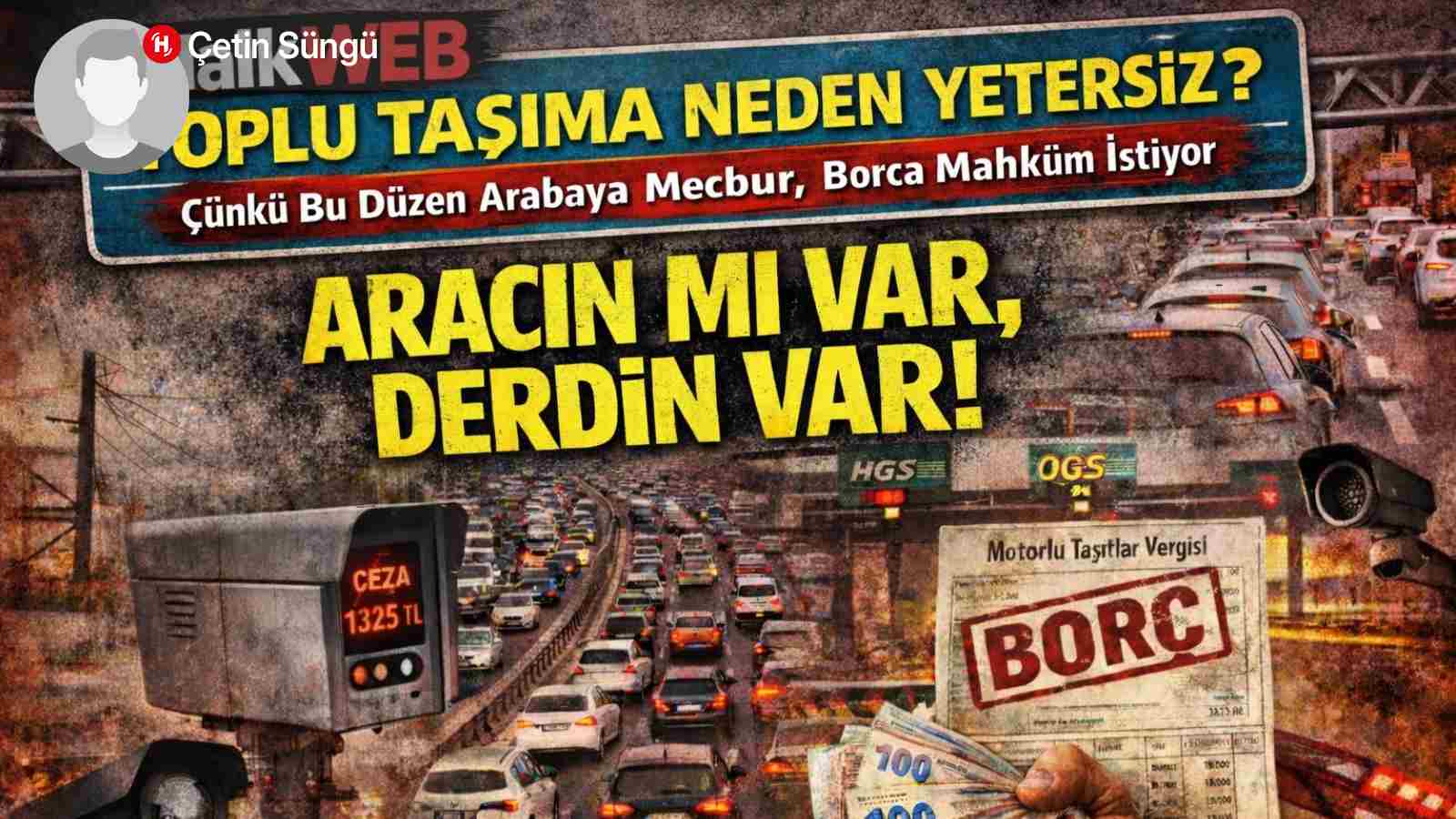
 Owning a car in Turkey is not a choice; it is a part of a regime. Once presented as a symbol of individual freedom of movement, comfort and modernity, the automobile has long had a completely different function in Turkey. Today, the automobile is at the center of the state's constant, disciplinary and costly relationship with the citizen.
Buying a car is no longer a consumption decision; it is the gateway to a long-term cycle of borrowing, collection and obedience. Because in this country, a car is technically a means of transportation, but politically it is an implicit tax contract. It is not written down, but everyone knows it. Its language is harsh, clear and non-negotiable:
Pay up and get in.
Pass and pay.
And pay if you don't.
Shut up and move on.
It is therefore incomplete to treat the issue as a debate on traffic safety, lack of infrastructure or individual preference. The issue is neither accidents nor road quality. The issue is collection. And the systematic organization of collection through the movement of citizens.
Before You Turn the Ignition: Purchase Taxes
In Turkey, you owe money to the government before you even see the car at the dealership. When SCT and VAT are considered together, more than half of the cost of a vehicle goes directly to tax. At this point, one must ask: What does this tax pay for?
It cannot be explained by the environment, because the environmental state taxes the automobile while promoting public transportation.
It cannot be explained by security, because security is a matter of public planning, not taxation.
It cannot be explained by income justice at all, because this tax is not progressive but blunt.
There is only one justification left: the state's need for easy and quick cash.
The same car is a means of transportation in Germany, in Turkey “luxury”kind. Because luxury is not a sociological category here; it is a financial label to close the budget deficit. The state is not based on the standard of living of the citizen, but on its own coffers.
Did you get the car? It's not over. It has started.
You paid the tax, you got the license. Under normal conditions, ownership starts here. In Turkey, however, the state enters the picture at this point and says the following:
It is not enough.
This one “not enough” is not only a financial demand. It is a position that the citizen is constantly reminded of: You have, but not fully. You use, but not for free. You have but you owe.
Motor Vehicle Tax (MTV): Rental Value of Property
MTV is technically a tax; in practice, it is the rental price of property. You pay it every year, even if you don't use your car, even if it rots in the garage, even if you can't sell it.
This tax has nothing to do with the quality of the road.
It has nothing to do with security.
It has nothing to do with income.
Therefore, MTV is not a public service, but a naked collection reflex. The state is here “the user pays” even abandoned its principle, “he who has, pays” of the fiscal state. This is far behind even the modern understanding of the fiscal state.
Compulsory Traffic Insurance: Mandatory in Name, Free in Mind
Compulsory traffic insurance is a typical tool of the regime. Its name is compulsory but its price is free. Its service is not standardized. Citizens cannot bargain. The state has delegated the duty of supervision to private insurance companies.
The picture is clear:
Risk is citizen.
Profit is private.
The state merely enforces, imposes the punishment and takes its share.
This is not a public service, but a market discipline based on necessity.
Compulsory Motor Insurance: Not Compulsory but Obligatory
Comprehensive insurance is not officially compulsory, but de facto it is. Because traffic insurance does not protect, road safety is poor, and the risk of damage is high. The security that the state fails to provide returns to the citizen as a burden on individual purchases.
This is public failure turned into a private bill.
Vehicle Inspection: Public Robbery, Not Inspection
Vehicle inspection is presented as a technical safety service. In practice, however, this is what happens: High prices for a five-minute check, no alternatives, no competition, no objections.
Mandatory.
No alternative.
Non-competitive.
No objection.
If these four characteristics are present, it is not a market but an implicit tax. It is not the condition of the vehicle that is monitored, but the compliance of the citizen. The message is clear:
Pay up and shut up.
Fuel, Parking, Penalty: Continuous Collection Line
When fuel taxes, parking fees and traffic fines are considered together, a continuous line of collection emerges. The state does not see the driver as a citizen, but as an object that generates revenue as it moves.
If you move, you pay.
And if you stop, you pay.
This is not transportation policy; it is the pricing of movement.
Local Governments' Invisible but High-Cost Incompetence
Especially in Ankara and Istanbul traffic, the lack of infrastructure by local governments produces a second layer of collection that makes transportation more expensive.
Bozuk asfalt, çökmüş kapaklar, sürekli kazılan ve aylarca kapatılmayan yollar nedeniyle araçların amortisman süresi fiilen kısalır; süspansiyon, rot-balans, lastik ve alt takım giderleri normal koşullara göre %30–50 daha hızlı artar. Plansız kavşaklar ve kronik trafik sıkışıklığı dur-kalk düzeni yaratarak yakıt tüketimini ortalama %40–60 oranında yükseltir; yoğun saatlerde bu oran fiilen iki katına çıkar.
Lost time is part of this cost: Longer journeys, wasted work hours and increased stress come at a non-refundable cost to the citizen. This picture “service defect” It is called a tax, but the bill does not look like a tax; it is collected silently, every day, from everyone's pockets.
Bridges and Highways: Tolls, Not Roads - Two Separate Collection Regimes
Bridges and highways are not transportation infrastructure, they are financial contracts. If you use them, you pay. You also pay if you don't. Because the issue is not transit, but the guarantee. The state guarantees vehicle passage to a private company. If citizens do not pass, the difference is paid from the budget. If the budget is not enough, taxes increase. So even those who do not use the bridge pay.
Moreover, citizens earning in Turkish Lira pass through the dollar. The exchange rate risk falls directly on society. The so-called “alternative route” is often long, unsafe and economically punitive. Therefore, there is no real choice; there is an obligation.
The problem in Turkey is not the tolling of highways, but the side-by-side operation of two separate collection regimes. On state-built highways, the average cost per kilometer is 50-80 kurus; the fee is in TL, there is no guarantee of passage, and there is no threat of fines or enforcement if payment is forgotten. On Build-Operate-Transfer highways, the cost per kilometer starts at 1.8 liras and rises to 5-6 liras, and on bridges to hundreds of liras. The tolls are indexed in foreign currency, the passage is guaranteed and the exchange rate risk is borne by the public. The real difference does not end there: On BOT roads, if the toll is not paid on time, a quadruple penalty is imposed, followed by enforcement and legal costs; a journey of a few thousand liras can quickly turn into a debt of more than ten thousand liras.
On a state highway you pay; on a BOT highway you borrow. This difference is not related to the asphalt, but to the contract and collection regime.
Why was this Model Specifically Installed in Transportation?
Because transportation is compulsory, continuous and there is no escape. After food, people need to move the most.
There is a license plate.
There is a transition record.
The fine is automatically deducted.
This is more efficient than classical tax administration. This is the digital collection regime.
Why is Public Transport Deliberately Weak?
Strong public transport requires public investment, it requires subsidies and it produces equity. But this model does not want equality. Because if public transportation becomes stronger, the automobile decreases, fuel tax decreases, bridge and highway guarantees collapse.
That's why the subway is late.
The bus stays crowded.
The suburbs are neglected.
Then they say: “The citizen has to have a car.”
No. It is forced.
In which political regimes is this order observed?
This model does not work in welfare states and cannot survive in participatory democracies. It is typical of authoritarian-neoliberal regimes. The public service is transferred to the market, but the obligation is preserved; there is no competition, and mechanisms for objection are weak.
This is not privatization; it is an economy of obedience.
How to Break This Order?
This system survives not because it is strong, but because it is not challenged. Everything that is compulsory is political. Vehicle inspections, MTV, bridge crossings are not “natural”. They lose their legitimacy the moment they come up for discussion.
This order is solved by a crisis of legitimacy before the law is changed.
How Public Transportation Becomes Truly Public
There is only one criterion: Does it generate profit? If it generates profit, it is not public.
True public public transport does not aim for profit, it is planned according to need, not revenue. Public transport is not an alternative to the automobile; it should be a substitute.
Where Can Local Governments Break the Chain?
Local governments are the weakest link in this regime. Because they set the tariff, organize the space, make reality visible.
Making public transportation cheaper,
Limiting vehicle access,
Making parking more expensive,
Making the numbers transparent.
Each of these disrupts the centralized collection line. Transparency is a weapon here, not a virtue.
What Will Replace This Regime?
MTV should be abolished; tax should be levied on use, not ownership.
Vehicle inspection should be nationalized.
Bridge and highway contracts should be renegotiated.
Public transportation should be free or symbolically paid.
Local governments must be given real authority.
Citizen oversight should be mandatory.
These are not technical but regime choices.
Not Transportation, but Citizenship
In Turkey, the automobile is not freedom.
Comfort is not.
It is not a status.
The automobile is an object of collection that constantly generates debt.
The state prices the movement.
The citizen pays as he moves.
And if he stops, he pays.
There is no automobile policy in this country.
There is a regime of taxation, collection and obedience based on transportation.
But no regime is permanent as long as it is taken for granted.
Once transportation is on the table, the collection regime is solved.
The issue is not to build roads, but to stop the citizen from being a passenger.
Because the citizen is not in debt.
It is not obligatory.
It is not an object of collection at all.