




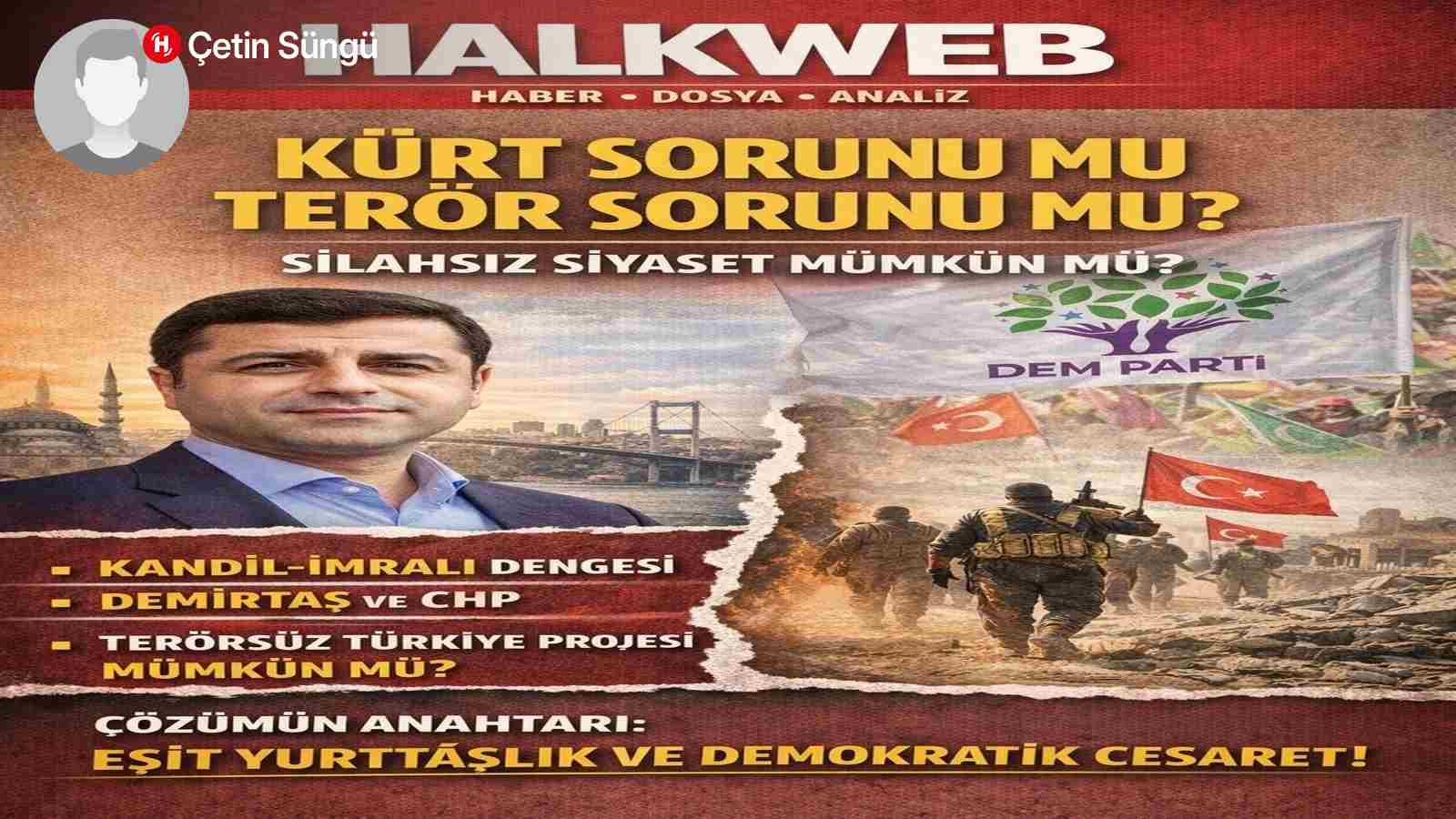
 There are some parties in Turkish politics whose existence gains meaning not with the claim of a solution, but with the continuity of insolvency. These parties can neither be a real alternative to power nor can they be positioned outside the system. Their political legitimacy is constantly kept in suspense; the social segment they represent is recognized, but the demands of this segment are postponed, divided and spread over time on the political plane. The DEM Party is an actor in Turkish politics that is placed precisely in this structural jam.
Today, the DEM Party is not just a political party. It is also the political projection of the Kurdish issue that Turkey has been managing rather than solving for decades, the crisis of democratization, the security-centered state mentality and a knot in which regional feudal-social structures are intertwined. Therefore, understanding the DEM Party requires not only looking at the state, but also the class, patriarchal and religious power relations within the Kurdish society.
The Curse of Representation and Feudal Continuity
The DEM Party is a political actor that represents a significant portion of Kurdish voters, is strong in local governments and has an undeniable social resonance. However, this power of representation has paradoxically turned into a mechanism that does not pave the way for the party, but fixes it on a certain political line. This is because this representation includes not only modern demands for citizenship, but also tribal relations, local landlordism and feudal loyalty networks.
On the one hand, the DEM Party tries to protect its masses without distancing itself from these feudal structures, and on the other hand, it tries to establish a modern-democratic political language. This dual situation produces a constant tension between the party's discourse and its social base. Feudal relations strengthen political loyalty, but at the same time suppress individual freedoms, women's rights and class equality.
The boundary drawn for the DEM Party in Turkish politics becomes clearer at this point:
Represent but do not transform.
Use the tribe as a vote depot but do not target the feudal structure.
Conflict with tradition but also a claim to modernization.
This contradiction is a confrontation that not only the state but also the DEM Party keeps postponing.
Women's Issue: Radical in Discourse, Limited in Society
The DEM Party has the most advanced discourse in Turkish politics in terms of women's representation and the co-chairmanship system. Women's liberation, gender equality and the struggle against patriarchy occupy a central place in the party's ideological texts. However, the social resonance of this discourse does not deepen to the same extent.
Because in a significant part of Kurdish society, feudal structure, patriarchal relations and religious references are still decisive. While women are represented in public politics, they continue to be limited to traditional roles in daily life. Instead of directly confronting this contradiction, the DEM Party often prefers to conduct a politics of balance.
In the short term, this preference prevents the loss of votes, but in the long term it turns the women's liberation struggle into a political showcase. Women's representation becomes institutionalized, but social transformation remains incomplete.
Religion, Mendacity and Silent Reconciliation
One of the least talked about but most decisive areas of the DEM Party is its relationship with religion. In the Kurdish geography, religion is not only a field of individual belief, but also a force that generates political influence through mellelik, sect structures and local religious authorities.
Although the DEM Party has a secular political line, it does not directly challenge these religious structures. This is because these structures are not only ideological; they also produce social solidarity, belonging and local legitimacy. The party prefers a quiet compromise rather than an open confrontation with this field.
This compromise protects the DEM Party from being anti-religious, but it does not prevent feudal and patriarchal interpretations of religion from limiting politics. Thus, religion ceases to be an object of critical transformation and is reduced to an element of balance that must be managed.
“The Discourse of ”Terror Free Turkey" and Multilayered Blindness
“The ”Turkey without terror" discourse completely ignores this multi-layered structure. It defines the problem only in terms of weapons; it ignores the social tension produced by feudal structures, class inequalities, the suppression of women and the political role of religious authorities.
This discourse is not a language of solution; it is an operation of political simplification. Reducing a complex social issue to security only compresses both the DEM Party and the Kurdish community into a one-dimensional space.
As long as the gun speaks, politics cannot speak; but as long as the feudal structure, patriarchal order and religious authority are not questioned, politics cannot be liberated.
The DEM Party's crisis is not only a party crisis, nor is it only the result of state pressure. This crisis is the common product of the Kurdish political tradition that avoids confronting the state mind that manages insolvency and postpones coming to terms with feudal and religious structures.
DEM Party will either produce the political courage to face this multi-layered structure
or it will continue to exist as a permanent field of representation, held within the boundaries of both the state and tradition.
ÖCALAN - KANDIL - DEM PARTY: WEAPONS, AUTHORITY AND THE UNESTABLISHED SUPREMACY OF POLITICS
There are some figures in Turkish politics who become more decisive every time they are not talked about. They are de facto present in every discussion without being mentioned by name. Abdullah Öcalan is the most striking example of these figures. As long as his existence is denied, his influence on the political sphere does not diminish; on the contrary, it intensifies. The relationship with the DEM Party is shaped precisely by this paradox: officially absent, politically ever-present.
To understand this relationship, it is insufficient to resort to a simple “instruction-obedience” scheme. The issue is not about taking direct orders; it is about where authority is established, from whom legitimacy is generated and where politics is limited.
The Unbroken Line: Armed Struggle, Social Authority and Political Consciousness
Today's DEM Party is the continuation of the HDP-BDP-DTP line. This line has never produced a clear, permanent and institutionalized break between armed struggle and political struggle. The reason for this is not only state repression. It is also because the Kurdish political consciousness has historically seen the weapon not only as a tool but as a constitutive authority.
The armed structure is not only a military force in Kurdish society. It has also played a historical role in transforming the feudal order, weakening agrarian relations and reshaping local authorities. Therefore, the weapon did not only produce conflict; it also established a new political hierarchy. Over time, this hierarchy created a sphere of “final say” positioned above politics.
A significant part of the DEM Party cadres acquired their political consciousness within this historical context. This relationship is not a chain of command, but a mental and historical reference field. For this very reason, it is a bond that is difficult to break, and often even unspeakable.
“Ocalan's Party?” The Question and the Wrong Framework
The question “Is DEM Party Öcalan's party?”, which is frequently asked in Turkey, is a criminal question, not an analytical one. The purpose of this question is not to understand but to stigmatize. However, this wrong framework also prevents a proper discussion of the issue.
Clarity is required:
DEM Party is not a party that receives daily political instructions from Öcalan.
But the DEM Party does not have the social ground to make politics by ignoring Öcalan.
Because in a certain segment of the Kurdish society, Öcalan is perceived as an authority who can ensure the silencing of the arms, an interlocutor who can negotiate with the state and a historical figure. This perception constantly puts the DEM Party between two fires. When it distances itself, it loses part of its base; when it does not, it is criminalized by the state.
What emerges is not a principled uncertainty, but a regime of necessary ambiguity.
The Imrali Regime: Not a Solution, but a Management Technique
Öcalan was brought into play when there was a possibility of peace in Turkey, and absolute isolation was imposed when the conflict escalated. This is not an inconsistency, but a conscious state mindset. For the state, Öcalan is positioned as an interlocutor when a solution is desired and as a threat when a solution is postponed.
This situation transforms İmralı from a place of solution into a mechanism of control and adjustment. The DEM Party is not the subject of this mechanism, but its carrier. The DEM Party is made to pay the political price of every message that comes or does not come from İmralı: closure lawsuits, trustees, arrests and political isolation.
For this reason, the Öcalan-DEM Party relationship is not a de facto one; it is a politically imposed and externally meaningful relationship.
The Reality of Qandil: A Veto Area, Not a Command Center
The Qandil Mountains are often deliberately mischaracterized in Kurdish politics. Qandil is not a command center that directs daily politics. But it is a veto area that determines how far politics can go.
Qandil draws borders.
Stops excessive deviations.
It does not allow politics to completely exclude the gun.
This difference is often ignored. Because “they are taking instructions” It is easy to say, what is difficult is to accept why politics cannot get out of the shadow of the gun.
There are three main reasons why this shadow persists. The first is the state's continuous narrowing of political space. The second is that the Kurdish issue is still dealt with under the rubric of security, not democracy. The third is that the Kurdish political tradition cannot fully take the risk of confronting its historical role.
Weapon, Feudalism and Patriarchal Authority
The gun produces authority not only against the state but also within society. The dissolution of feudal structures does not always produce democratization. Often the feudal lordship is replaced by an armed-political hierarchy. This hierarchy produces new limits when it comes to women's freedom and individual rights.
The discourse on women's liberation is always limited on a political ground where the gun is the constituent authority. Because the final decision-making area is not politics, but a center of power that operates with the logic of a state of emergency.
The Gun - Politics Standoff: The Real Knot
Everyone in Turkey “silence the guns” he says. But no one says who will allow politics to speak. When politics speaks, closure comes, when elections are won, trustees come, when contact is made, the label “terror” comes into play.
In this situation, the guns will not fall silent; only politics will suffocate.
Öcalan is not the leader of the DEM Party, but he is a historical shadow over its politics.
Kandil does not govern politics, but it limits it.
The state does not want a solution, but it manages the lack of a solution.
Without resolving this tripartite structure:
DEM Party cannot grow,
The gun cannot go outside politics,
Turkey cannot democratize.
DEMIRTAS, CHP AND THE POSSIBILITY OF A RUNAWAY PARTY OF TURKEY: POLITICS IN THE ABSENCE OF COURAGE
There are some figures in Turkish politics; they symbolize a possibility greater than what they represent. Selahattin Demirtaş is such a figure. For the first time in the history of the Kurdish political movement, Demirtaş has shown that a political line that goes beyond the gun, feudal affiliations and narrow identity politics is possible.
Demirtaş's line was based on a perspective that treated the Kurdish issue as a problem of democratization not only for Kurds but for Turkey as a whole. This approach produced a political language that actually challenged the shadow of the gun, tried to overcome feudal loyalty networks, and spoke to the west of Turkey in real terms.
What did Demirtaş do, what did he threaten?
Demirtaş's politics disturbed the establishment in three ways.
First, it transformed the Kurdish issue from an ethnic identity issue into a citizenship issue.
Secondly, it did not establish a language that sanctifies the armed struggle.
Third, it entered into a direct, not indirect, political confrontation with the government.
This line neither leaned on the state nor hid behind armed authority. It was therefore vulnerable.
Why has the DEM Party failed to institutionalize this line?
The DEM Party did not reject the Demirtaş line, but it could not institutionalize it. Because this line required growth, risk-taking and clarification. The party preferred survival to growth.
This choice is rational but politically costly. The claim of becoming a party of Turkey is constantly postponed; ambiguity becomes a permanent strategy.
CHP: Kurdish Vote Needed, Kurdish Issue Lacks Courage
The Republican People's Party's relationship with the Kurdish issue is reflexive, not ideological. The Kurdish vote is needed, but there is no courage to talk openly about the Kurdish issue.
For this reason, the CHP remembers the DEM Party during election periods and leaves it alone in times of crisis. It cannot establish a clear line against the trustees and cannot act consistently on the issue of political detention. This relationship is not an alliance; it is a forced contact based on mutual distrust.
THE CURDS OF TURKEY: INTEGRATION, DIFFERENTIATION AND THE NEW DIRECTION OF POLITICS
It is not possible to understand the future of Turkish politics without understanding the Kurds of Turkey. However, this understanding cannot be done by assuming a homogeneous mass under the title of “Kurds”, as is still commonly done. The Kurds of Turkey are radically different from the Kurds of Iran, Iraq and Syria not only in terms of the state they live in, but also in terms of their level of social integration, political expectations, urbanization experiences and daily life practices.
This difference is the main axis that determines where Kurdish politics will evolve today.
The fundamental difference between the Kurds of Turkey and the Kurds of the region
Iraqi Kurds operate in a semi-state structure with their own political elites and economic networks. Syrian Kurds are experiencing an autonomy centered on an armed structure under the conditions of civil war. Iranian Kurds, on the other hand, exist in an extremely limited political space under harsh state repression.
The Kurds of Turkey, on the other hand, have progressed on a completely different line. The Kurds of Turkey have been citizens of the Republic of Turkey for over a hundred years; they have produced political consciousness not by clashing with the state, but by living in and against the state at the same time. Most importantly, they are urbanized, mixed and socially intertwined.
Therefore, the main issue for the Kurds of Turkey is no longer a “separate structure” but equal citizenship, political representation and dignified integration.
Istanbul Reality: Turkey's Biggest Kurdish City
Today, Istanbul is de facto the largest Kurdish city in Turkey. This is not just a demographic fact; it is a fact with political implications. The Kurdish population in Istanbul has largely broken away from tribal relations; they are part of the labor market, trade unions, slums and the middle class. Their children think in Turkish and are exposed to Turkish politics.
This is an issue for the Kurds “let's build a state” It isn't, “let us live equally and safely in this country” is a matter of.
While this fact narrows the social response to armed politics, it expands the grounds for a democratic, class-based and urban Kurdish politics.
Syrian Kurds and Turkish Kurds' Perspective
Although the Kurds of Turkey have an emotional and historical interest in the developments in Syria, they are politically distant. This is because the Syrian experience is weapon-centered, based on extraordinary conditions and shaped in a conjuncture that has no one-to-one equivalent in Turkey.
For a significant part of Turkey's Kurds, what is happening in Syria is not a model for the future, but a warning. Perpetual war, militarization and foreign dependency is not a desirable political form for the vast majority of Turkey's Kurds.
This is why the Kurds of Turkey see the search for a solution within Turkey, not across the border.
The Kurdish Movement and the Gun in Turkey: Where Will It Evolve?
The current picture is clear: The social legitimacy of the armed struggle among the Kurds of Turkey is shrinking. This is the result of a vital transformation rather than an ideological rupture. For a mass that has urbanized, acquired property and sent its children to university, a state of constant conflict is not a promise for the future.
This does not completely neutralize the armed structure, but weakens its decisive power over politics. The weapon gradually becomes a veto instrument rather than a determinant of direction.
If this evolution is not completed, the weapon will remain in politics but will not be able to represent society. This will shrink Kurdish politics in the long run.
Local Elections, CHP and Kurdish Voter Behavior
For Kurds in Turkey, local elections are not based on ideology, but on pragmatic choice. Kurdish voters are against the trustee regime, care about local service, and prefer candidates who do not criminalize them.
Therefore, support for the CHP in big cities is not an ideological alliance; it is a rational choice. CHP often misreads this support. However, this support is conditional, fragile and has a low tolerance for non-politics.
Abdullah Öcalan's Fundamental Contradictions Based on the Statements Reflected in the Minutes
Based on the statements reflected in the minutes, Abdullah Öcalan's fundamental contradictions are briefly and clearly revealed.
Öcalan says that “the armed struggle is over”, but he does not define a clear and explicit break with the constitutive and limiting role of the weapon over politics. Even if the weapon is declared historically over, its decisive shadow over politics is not removed.
“The phrase ”I do not give instructions" is often repeated, yet the process, the positioning of the state and political moves are still largely adjusted to Öcalan's position. Instructions are denied, but de facto authority continues to exist.
“It is emphasized that ”the solution must be in parliament"; however, the critical thresholds of the solution continue to remain outside parliament. This situation reveals the fundamental incompatibility between institutional political discourse and practice.
“The Kurds of Turkey do not want separation” is largely in line with social reality, but the contradiction between this demand for integration and the regional politics of the armed structure is not clearly resolved. The social orientation is acknowledged, but the corresponding political rupture is not clarified.
“Syria is not a model”, yet the Syrian theater is still preserved as a strategic foothold. While the model is rejected, the regional armed presence continues to be an element of legitimacy and bargaining.
“The phrase ”the gun must fall silent" is strongly voiced, but the concrete conditions, timetable and authorized actors are deliberately left ambiguous. This ambiguity keeps the gun not outside politics but as a force in waiting.
“I am not the center of the solution”, but the process cannot be initiated without it, which de facto reproduces centrality.
In this context, the picture reflected in the minutes is not a rupture, but a language of controlled transition. Until the contradictions are resolved, the gun cannot leave politics and politics cannot be strengthened permanently.
“Terror Free Turkey” Project, İmralı Process and Possible Outcome
In light of these contradictions, the “Terror Free Turkey” project is shaping up as a process that is not limited to domestic politics in Turkey, but is directly linked to the developments in Syria, regional balances and the armed structures' room for maneuver. The project can evolve into two main outcomes.
In the first scenario, the problem is reduced to security; the political space is kept narrow. Even if the weapon weakens, it continues to exist as an area of control and veto over politics. In this case, “non-terrorism” becomes the name not of democratization, but of the low-intensity continuation of non-solution.
The second scenario is more difficult, but more permanent. In this scenario, the silencing of the guns should not be considered as a goal, but as a result of the expansion of politics. The Kurdish issue should be discussed on the basis of class inequalities, local democracy, women's freedom and equal citizenship, not just identity. Political interlocutors should be established on the basis of institutional and legitimate politics, not through temporary figures. Turkey's opposition must approach this issue with democratic courage, not electoral math.
No project can produce lasting results unless it takes into account the social transformation of Turkey's Kurds, who are urbanized, integrated and moving away from armed politics.
In conclusion, the Kurds of Turkey are no longer part of regional fantasies, but part of the reality of this country. It is not possible to govern Turkey without understanding them. It is not possible to produce security by excluding them. Democracy cannot be established without accepting them as equal citizens.