



Is the difference between contestation and dissociation as simple as the substitution of the letter “y”?
TDK lists 4 different meanings of the word contest as follows:
-Competition.
-The act of competing to show one's superiority in knowledge, talent, beauty, sports, etc.; race, competition, concours.
-Competition.
-Don't try to be superior to others.
So which of the above definitions does the word “decomposition” fit when only the letter ‘y’ is moved?
None of them.
You must have guessed what I was going to talk about from my introduction.
The CHP's ‘race to nominate a presidential candidate’ is our topic.
The CHP resorted to a method it had not used before to determine its presidential candidate.
1 million 600 thousand members will be asked to decide on the candidate, Özgür Özel announced.
According to the Constitution, there are 3 different ways to nominate a presidential candidate:
a) Political party groups may nominate candidates.
b) Political parties which, alone or jointly, have received at least five percent of the total valid votes in the most recent parliamentary general election may nominate candidates.
c) At least one hundred thousand voters may nominate a candidate with a notarized signature.
Does this method used by the CHP meet the above conditions?
No, no, no.
That's why the method itself became controversial as soon as it was announced.
Ultimately, at the end of the day, no matter what the result of the poll is, the CHP parliamentary group will vote on the CHP's presidential candidate.
In such a situation, why did the CHP resort to a different method of candidate selection?
Turkey has been electing its president by popular vote since 2014.
Recep Tayyip Erdoğan was elected as president in the 2014, 2018 and 2023 elections, which were held with this regulation introduced by a constitutional amendment following the crisis in the 2007 presidential election.
In each of these 3 elections, the CHP did not prefer a candidate selection method similar to the current one.
But could the fact that those elections were not won by the CHP and its allies be proof that the current method is the right one?
The only way to answer this is to hold elections and see if the chosen candidate wins.
The process so far shows that the method has evolved into a divergence of competition in the CHP.
Unfortunately, for the last 3 elections, Turkish politics has been reduced to the debate on ‘who is the right candidate’ and we have not been able to move on to ‘which policy’.
If we agree that the candidate who wins the election is the most correct candidate, do we accept that Recep Tayyip Erdoğan, who has won all elections, is the ‘most correct’ candidate?
As a matter of fact, the existence of a political arena consisting of the ‘right candidate’ debate reinforces this perception in the minds of voters.
There are several conditions for the CHP's nomination contest to be completed without turning into a divide.
One is a strong belief that the competition will be ‘fair’.
Unfortunately, Erdoğan's long-standing accusation of a ‘shady congress’ and the lack of a response from the CHP leadership, and the fact that even the congress held under the supervision of the YSK (Supreme Electoral Board of Turkey) was ‘shady’, it is not possible to create a strong conviction on the part of the parties that a vote of confidence without the supervision of a judge would be ‘fair’.
On the other hand, there should also be a consensus among the candidates on the timing of the contest.
The current race is a joint decision between one of the contestants and the ‘contestant'.
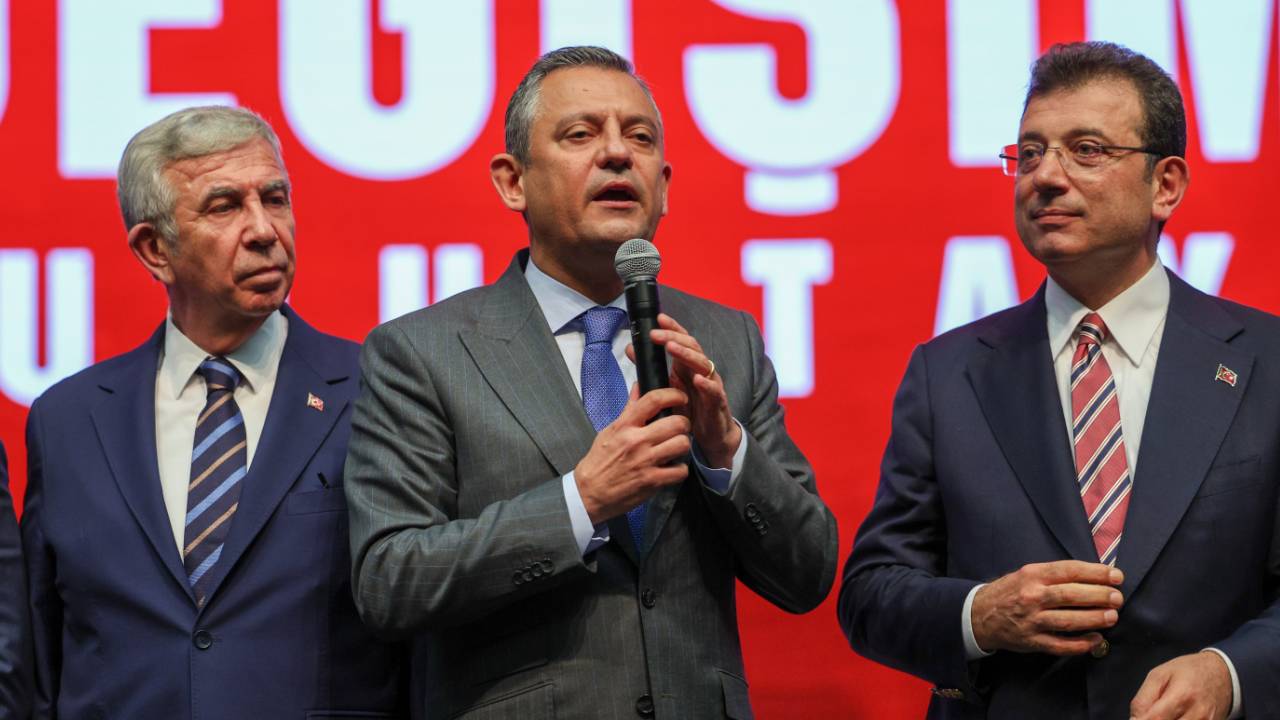
It is no secret that CHP Chairman Özgür Özel and IBB Mayor Ekrem İmamoğlu decided on this method and timing together. After Özel's ‘road map’ statement, İmamoğlu said ‘this is a revolution’ and Mansur Yavaş said ”I think it is too early to nominate a candidate. The election date is not certain. Until then, the conditions in Turkey will change," clearly shows that even if an agreement can be reached on the method of the contest, there is no agreement on the timing.
Imagine that there will be a derby match between two big clubs in Turkey, and the federation and one of the clubs decide together on the field, the date and the referee who will officiate the match, and notify the other club. Is it possible to convince the other club that it will be a fair match?
It is no surprise that Mansur Yavaş has raised objections to the method and timing of the elections.
Before the 2023 elections, the circles advocating the nomination of Ekrem İmamoğlu insistently said, ‘The candidate should be determined according to the results of the surveys’. On March 31, 2024, after the CHP and its candidate lost 500 thousand votes in Istanbul and Mansur Yavaş received twice as many votes as his rival in Ankara, Mansur Yavaş started to come out ahead in all polls. It was at this point that a change in the method of candidate selection was perceived as an attempt to determine the outcome from the beginning.
For this very reason, it seems inevitable that the contest will turn into a grassroots divide.
The only way to ensure that this competition does not become a divisive one is to convince all sides and fans of the existence of a fair and impartial ‘federation’.
Unfortunately, CHP's Özgür Öze has so far failed to draw a profile of an ‘impartial and fair’ chairman in this race.
If the CHP is to nominate its candidate through a contest using this method or any other method, the need for a chairman who will be able to lead the contest without turning it into a divisive one is obvious.
CHP has achieved this 3 times before.
The problem is not that the CHP does not have this capability, the problem is that the CHP does not have a leadership that can demonstrate this capability.