




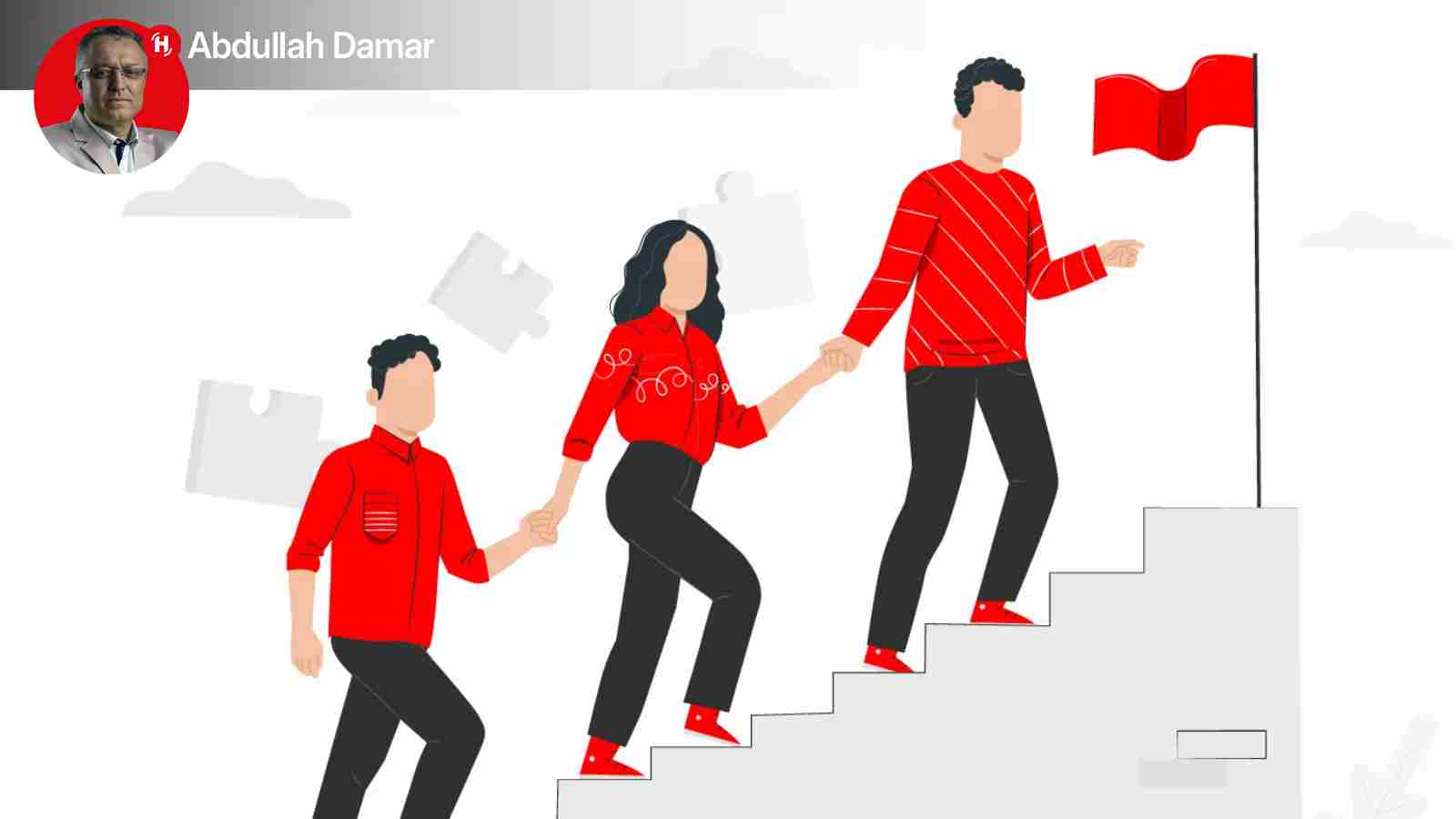
 It is not common for people to live alone. Because without division of labor or cooperation, it is impossible for them to overcome all tasks on their own. People who come together for various reasons form a number of social structures. These social structures also form organizations over time.
In general, an organization is a structure in which two or more people organize their behavior according to formal rules in order to achieve a common goal. In other words, an organization is a group of people organized under the direction of a person in order to perform a specific task continuously, harmoniously and harmoniously. In short, an organization is a union of power and action consciously formed by many people.
Organizations, just like human beings, are born, live, learn, change, develop, become stagnant, become dull and die. The death of organizations is directly linked to whether or not they make efforts to learn, renew, change and develop. In particular, organizations, like people who are closed to learning, suffer from learning deficiencies. The situation worsens when these inadequacies are not recognized. Senge (2013) categorizes learning deficiencies in organizations under the following headings;
-I am what my position is
It is when employees focus only on their own work in the organization they are in, do not make any demands for any work or task other than that work, act like parts of a machine, do not see the whole; when the organization changes tasks or functions, they cannot adapt to the new task and as a result, the organization becomes dysfunctional along with them.
-The enemy is outside
It is the attribution of every failure in organizational activities to an external cause. These reasons vary according to the activity of each organization. If the organization is a business, declining sales may be attributed to the illegal activities of competitors; if it is a school, academic failure may be attributed to the low economic status of the parent profile; if the organization is a political party, failure to increase its votes may be attributed to the power of the ruling party and its control of the media; if the organization is a trade union, loss of members or lack of membership growth may be attributed to government pressure.
-The illusion of assuming responsibility
It is the state of being active in advance, being ready in advance and taking action in advance against events or situations that may occur in the future. In this case, negative situations that may happen later are tried to be prevented in advance, but when they do not happen, it is obvious that all the work done will be wasted and costly. Too often, being proactive in advance is a euphemism for being reactive and can leave organizations in a situation of doing meaningless work.
-Don't get caught up in events
Instead of analyzing the causes of any failure in the organization and proposing solutions according to these causes, it means trying to solve problems by assuming that the usual causes are the cause of all problems. In any organization, when there is a loss of votes, loss of members, loss of influence, attributing it all to the fact that members and managers are not working hard enough or not making enough effort means getting stuck in the events.
-The parable of the boiled frog
If we throw a frog into boiling water, it will immediately jump out, but a frog in slowly heated water will not leave its comfortable place and jump out, and by the time it realizes that it is being slowly heated, it will be too late. In organizations, too, when the usual and always applied solutions to problems are put into effect, it is not realized that the problems have not been solved until the organization is no longer viable.
-The dream of learning by experience
The most powerful learning comes from direct experience, but in the face of problems, it may sometimes be necessary to try untried paths, to turn to areas that have never been traveled. In this sense, expecting to solve problems through experience can lead to more problems.
-Management team myth
Most of the time, executive teams spend their time fighting for their own space to assert themselves, avoiding things that make them personally unpopular, and trying to give the impression that everyone is behind the team's collective strategy. They maintain a consistent team image. Those with serious objections and reservations avoid expressing them openly, and the result is joint decisions and watered-down compromises that everyone can accept and swallow.
It is no coincidence that many organizations fail to learn well, fail to innovate and change, and fail to find solutions to their problems. The way organizations are designed and managed, the way people's jobs are defined and, more importantly, the way we are taught to think and interact create fundamental learning deficiencies. These inefficiencies persist despite the efforts of smart, dedicated people. Often, no matter how much effort is put into solving problems, the result remains the same. Because learning deficits have invaded organizations.
In our time, many organizations, from political parties to trade unions, from political groups to associations, from economic and commercial enterprises to schools, are plagued by learning deficiencies.
Especially left-wing political parties and trade unions are plagued by the above-mentioned maladies in all areas, from their ideological structure to their working principles; from their internal functioning to their decision-making mechanisms; from the demands of their members to their effectiveness in their fields of activity!
To give an example, the Confederation of Public Employees' Trade Unions (KESK), of which we are a member, decided and tried to implement a one-day work stoppage on January 14, 2026.
This decision was problematic in terms of timing, content and method. The January 14, 2026 work stoppage (strike) decision was neither timely enough to prevent the adoption of the Budget, nor content enough to put the demands of public laborers on the agenda, nor a decision taken through a democratic method mediated by KESK and its affiliated unions. This decision is important as it shows that KESK is plagued with the problems listed above.
Not only KESK, but also other trade unions and political parties have similar problems, and the worst thing is that these organizations are not aware of the problem.
Sources
Peter. M.Senge. (2013) The Fifth Discipline. Yapı Kredi Publications.
Salih Güney (2013) Organizational Behavior.