



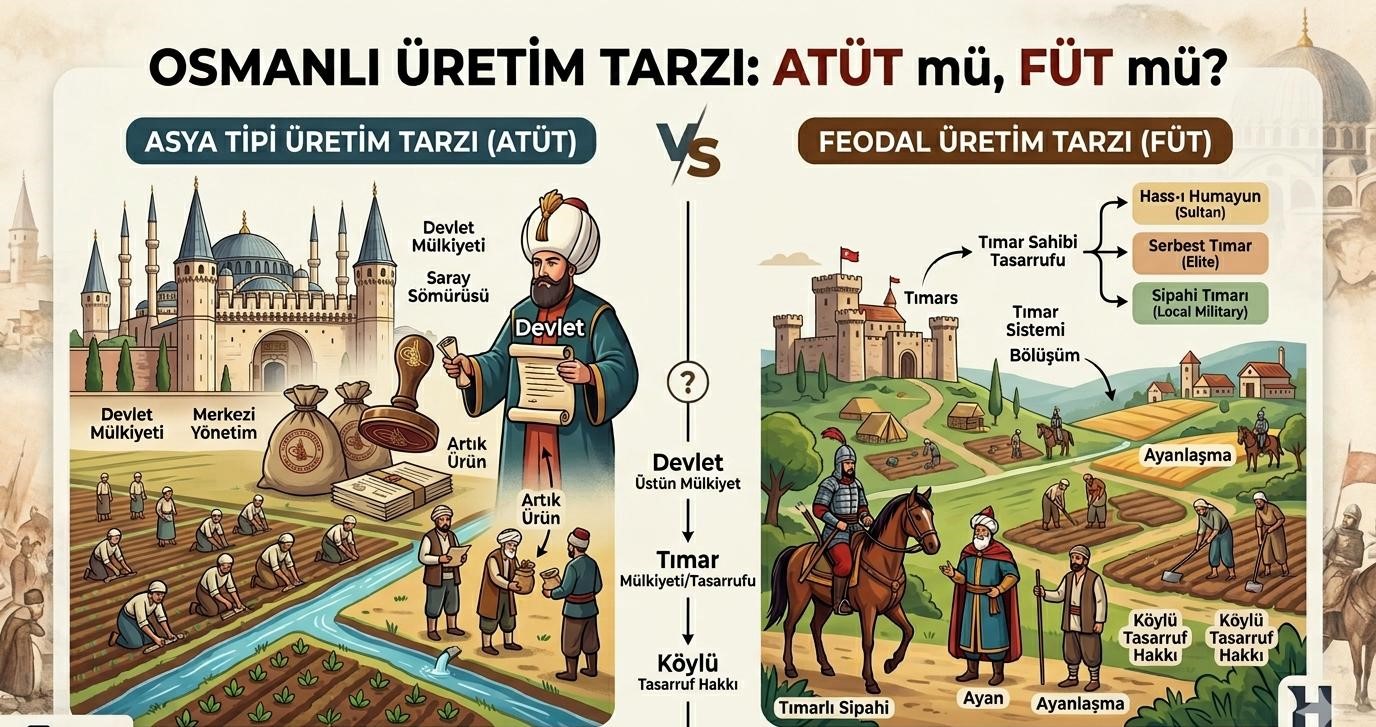
One of the most important issues that social scientists and socialist politicians in Turkey have debated and pondered from past to present is whether the Ottoman mode of production was an ‘Asian mode of production’ (ATÜT) or a ‘Feudal mode of production’ (FÜT).
We can explain these ATÜT-FÜT debates, definitions and historical development, which come to the agenda with debates that flare up from time to time within the world socialist movement, as follows;
Marx and Engels defined the mode of production as a particular form of individual activity, a particular way of living, a particular way of life. Based on this definition, they identified the modes of production that humanity has gone through as primitive communal, slave, feudal, capitalist and socialist modes of production and continued their analysis in this direction. It is noteworthy that ATÜT is not included in this schematization. The ATÜT was introduced by Marx and Engels in the 1850s to analyze Eastern societies, but it was not defined and analyzed in detail; it was constantly debated in the following years; it was completely excluded from Marxist theory by historians in the USSR in the 1930s, but it was brought back to the agenda after 1956; and in Turkey, it was adapted to the economic history of the Ottoman Empire by some thinkers and started to be used to define the mode of production of the Ottoman Empire.
The main feature of ATUT is the existence of a centralized state based on rural labor. In this mode of production, the state retains ownership of the land in the country, there is no private property and the main source of income is the surplus product created by those engaged in agriculture on this land. The state confiscates the surplus through taxation. Since the centralized state is overdeveloped and overgrown, there is no aristocratic class in these countries that directly exploits the peasants as in Western countries. In Asian-type countries such as the Ottoman Empire, China, India and South America, where this mode of production is dominant, public works such as the construction of large irrigation facilities, the supply of arms, materials, supplies and people to the army, and the establishment of transportation networks, which require large-scale organization, are carried out by the state.
Feudal mode of production is a social order based on the domination of noble landowners before capitalism. Feudal society emerges with the end of the slave society that had lasted for centuries. This society is essentially an agrarian society and in agriculture serf labor replaces slave labor. The basis of the relations of production in feudal society lies in the feudal lord's property right over the land and his limited property right over the serf, the direct producer. The serf stands in the middle between the slave and the free man. The serf does not own the land, which is the means of production, but he owns the tools he uses to cultivate the land. While the serfs earn their own livelihood from the land they cultivate, they also work for the feudal lord from this land. In this sense, the serf is the owner of the land in the sense that he owns the small piece of land on which he earns his living. The basis of the feudal mode of production is the land and land ownership of the ruling class of feudal lords and the exploitation of the direct producers, the peasants, who are personally dependent on the feudal lords and tied to the land. Feudal land ownership is defined by the ownership of the land by the feudal lord.
Having listed the basic characteristics of ATÜT and FÜT, we can move on to the discussion of which of these definitions the mode of production of the Ottoman Empire fits into.
At this point, one of the biggest mistakes made in social sciences, as in many other subjects, is the understanding of detaching historical and social formations from the context to which they belong, turning them into frozen, immobile, non-interactive objects and comparing them with each other as if they were templates. This is one of the most important mistakes made in the evaluation of Ottoman history. For example, instead of putting forward a definition of feudalism and examining to what extent the Ottoman State's mode of production conformed to the elements in this definition, the characteristics of European feudalism are put forward and the Ottoman mode of production is examined to see whether it conformed to these characteristics. Moreover, it is investigated whether the feudal elements of Europe, such as feudal lords, serfs, aristocracy and kingdoms, even as adjectives, were present in the Ottoman Empire. This is where the biggest mistake is made. Because in different periods of the world, in different regions and countries, there have been periods when feudalism was the dominant mode of production, but it is out of the question for these feudal modes of production to be identical, provided that they have the basic features of this mode of production.
In assessing what the mode of production of the Ottoman Empire was or was not, we first look at the dominant features of the feudal mode of production, namely the ownership of the basic means of production, the land, and a tripartite view emerges: while the state retained the right of supreme ownership, it transferred this ownership to the fiefs in return for military services; the peasants, the direct producers of the fiefs, had the hereditary right of disposition, regardless of the coercion and restrictions imposed. For the peasants, this right of disposition was not the common property of the village, but personal property and included the right of inheritance. Secondly, when we look at the ways in which different social groups divided the products of production, relations of dominance and subordination determined this division and were based on property relations. The surplus product produced by the peasant was not directly confiscated by the state, but by the fief sipahi through various methods, some of it was transferred to the state, and in this process the peasant received his share not from the state, but from the sipahi. Thirdly, the way in which the peasant appropriated the products of his labor was an essential determining factor. From the surplus product of his own production, the peasant made payments in kind, in cash and in labor that he was responsible to the sipahi, and in this process the sipahi, rather than the state mechanism, was the owner.
In this sense, how feudal mechanisms functioned is also important. Since the economy of the Ottoman Empire was based on agriculture from its foundation, the most important issue for the state was the confiscation of agricultural surplus. For the confiscation of the surplus, fief and iltizam systems were applied. While fiefs were mostly used in the Balkans, Western and Central Anatolia, iltizam was more common in other parts of the empire.
At this point, if we look briefly at the details of how the system of fiefs and iltizam functioned, three types of appropriation can be mentioned;
-Hass-ı Humayun; refers to the property owned directly by the Sultan himself, and the surplus products from these properties were directed directly to the palace. The administrators of the sultan's has were in charge of the refugees in these estates.
-Free fiefs; other than the sultan's has, has and zeamets, i.e. fiefs generating high income, were granted to palace officials with political and bureaucratic positions in the capital, influential people in the provinces and umaras. The holders of these large fiefs had extensive powers based on financial, administrative and even legal privileges.
-Sipahi fiefs; These fiefs, which constituted the most populous group of fiefs, resided in their own lands and transferred some of the revenues and fines from the fiefs to the palace.
As can be seen, while the revenues of the hass-ı hümayun were transferred directly to the palace, some of the revenues from the free fiefs and sipahi fiefs were used to pay subsistence wages to the peasants, some to feed the soldiers belonging to the fief and prepare them for war, and some were left to the disposal of the fief owner. The ATÜT claim that all revenues were transferred to the central state thus became a moot assertion.
Thus, progress seems to have been made on whether the mode of production of the Ottoman Empire was ATÜT or FÜT. It has become clear that the ATÜT claim, that all state property belonged to the sultan, that all property revenues were transferred to the palace, that there were no powerful feudal lords, that the peasants were exploited by the palace, not by the fief holders, that feudal lords did not have the right to dispose of property, that they could not leave inheritance, that peasants could not acquire any land, etc., are debatable. As a matter of fact, despite the difference in period and nomenclature, the Ottoman Empire experienced a similar feudalism to that experienced in Europe a few centuries later with its ayans instead of feudal lords, palace bureaucrats instead of aristocrats, peasants instead of serfs, and experienced the method of confiscation of surplus product and the system of exploitation based on agriculture.