




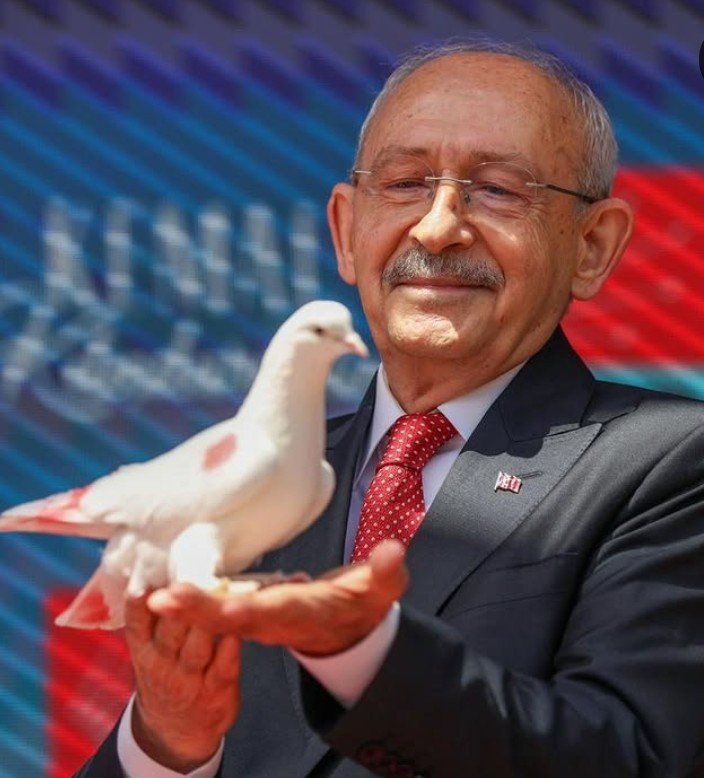
In the ancient narratives of Anatolia, there is a bird. It does not only fly in the sky. It also lands inside people. They call it a dove.
But not every pigeon is a pigeon.
Sometimes it is the walk of an innocent.
Sometimes it is a truth that has come down to earth.
Sometimes it is compassion itself that one forgets.
Throughout human history, the dove has always been considered sacred.
“They call it ”pigeon pants". In Turkish mythology, in Sufism, especially in the Alevi-Bektashi faith... it means that the virtuous, the spirits change their shape and take the form of a dove.
But this is not just an Anatolian story. The bird has always been a symbol of the soul in human narratives.
The soul, called “ba” in ancient Egypt, becomes a bird. It leaves the body but does not disappear.
In Greek mythology, the gods take the form of birds and approach humans.
In Christian narratives, the dove is the descent of the Holy Spirit.
In the Far East, the bird carries news between heaven and earth.
But Anatolia puts this symbol in a different place.
The bird becomes not just the soul, but morality itself.
It is narrated that Gabriel, Michael and Azrael changed their clothes in the face of Muhammad's compassion. They take the form of birds. One becomes a falcon, one a dove.
In that climate of mercy, the falcon gives up its prey. The dove gives up its fear.
Because there is no more hunter and hunted.
There are only beings who stand in the silence of the same truth.
In Alevi-Bektashi myths, “getting into pigeon's pants” is even more profound.
It is not just changing shape.
It is when the being gives up its hardness and takes on delicacy.
It is to descend to the earth with the language of peace, not war.
It is said that Hacı Bektaş Veli came to Sulucakarahöyük dressed as a dove.
In a time when birds of prey roam...
As if to say, “I'm not here to harm, I'm here to shelter.”.
He walks like a dove against the falcons who want to hunt him.
And he says:
“You have come to us as predators, we have come to you as oppressed.”
This sentence is not just a summary of a belief.
A morality itself.
Not the morality of being strong, but the morality of risking being hurt.
Because in the language of Sufism, to change one's pants is to come out of the shell of the “I”.
When a person lets go of his hardness, he changes.
When it learns to exist without harming the world, it takes on a different form.
To be a bird is not to run away.
It is to become lighter.
To land is not to occupy.
Just to exist without hurting.
The dove is therefore a sign in Anatolia.
When it lands on a window, some people don't think it's a coincidence.
He sees it as a reminder.
“Soften.”
“Let go of your hardness.”
“Go beyond the reflex of self-defense.”
The wisdom language of Anatolia knows this:
The pigeon doesn't always come to fly.
Sometimes it lands on your hand.
Sometimes on your head.
Sometimes by a window.
And at that moment it's a matter of not letting it fly away.
Because the pigeon is timid. It doesn't stay easily.
If he stays, it's not a coincidence. It is a trust.
It has found a softening, not a hardness, where it has landed.
That is why the view changes in Anatolia.
Many attribute meaning to his flight.
But those who know the real wisdom look at the moment when it does not fly.
Because flying is its nature.
To land is the will.
If the pigeon does not escape from the hand, that hand is no longer a threat.
It is a refuge.
It is trust. It is love.
And perhaps the most profound sign is this:
Sometimes a bird not leaving says more than a word.
“There is peace here,” he says.
“You can stay here,” he says.
This is the home of mercy, not the home of predatory falcons.
Where landing, not flying, is blessed.
The place where the silent wisdom of Anatolia began.
Perhaps that is why the dove is the quietest bird, even where wars are the loudest.
And perhaps that is why in the oldest stories he is called the “pants-changer”.
Because it's not just change,
that change is possible.
What we call pigeon pants is actually this:
The possibility of remaining good in spite of oneself.
Perhaps the greatest miracle is not to turn into a bird, but to remain human with the timidity and purity of a dove.
And the question to be asked after all this is this.
Does a pigeon that doesn't fly stay because it is really afraid, or because there is nowhere to be afraid anymore?
Image: Ismet Demir