



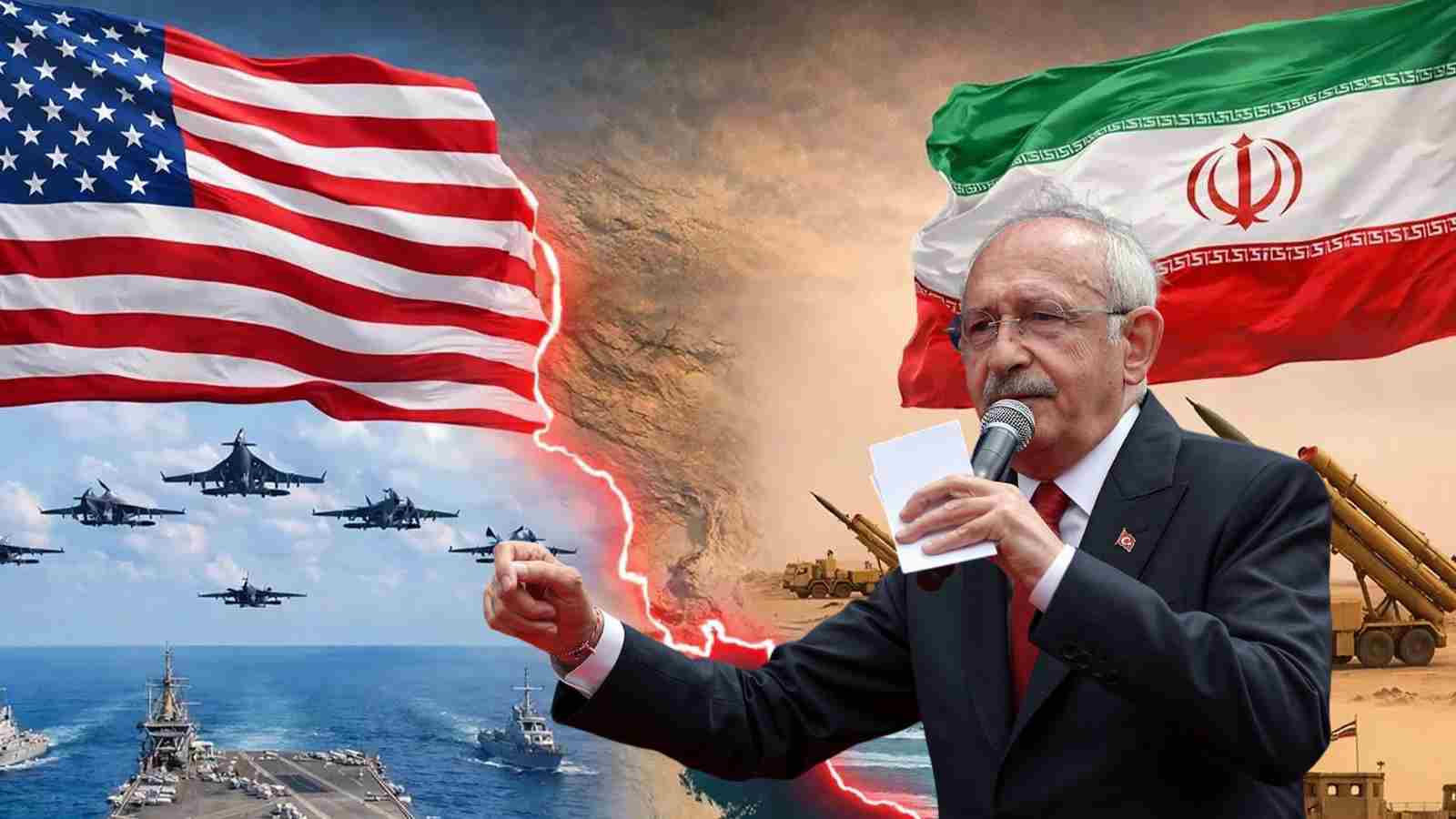
Kemal Kılıçdaroğlu, the 7th President of the Republican People's Party (CHP), wrote an article titled “The new world order: The advantage of geography for Turkey...” published on T24, he analyzed the US/Israel-Iran war and the main and secondary goals of the US.
Kılıçdaroğlu drew attention to the approaches Turkey should develop in the coming period on these issues.
Here is that article:
Those who read the foreign policy of imperial powers only in terms of the first declared goal often miss the real strategic logic of these powers. This is because these powers approach major crises not with a single scenario, but with multiple scenarios. For example, we might think that the United States, together with its proxy Israel, was aiming for regime change in Iran, but failed to achieve it and was therefore strategically defeated. However, this reading is incomplete when we consider the possibility of multiple scenarios. Yes, in the first phase of the war, the aim was clearly to shake Iran's internal political structure and force the regime to dissolve. In this scenario, if the US thought that a regime change could take place when it killed some of Iran's top leaders, as it did in Iraq (2003), then Iran does not know its history. As a matter of fact, it did not find what it expected...
The strategic strait of Hormuz
On the other hand, recent diplomatic and military signals suggest that a second scenario is being put into practice. The focal point of this scenario is the “Strait of Hormuz...” Under the rhetoric of “international security”, the Strait of Hormuz is likely to be transferred to a new order under de facto American control. Indeed, the 15-point proposal that the US sent to Iran asking Tehran to “relinquish its control over Hormuz” clearly shows this. What is critical here is not that the US changes its goal, but that it clearly articulates its real goal. Moreover, the US goal of controlling Hormuz is not new. James Carter, the 39th President of the United States, clearly emphasized the indispensability of control of the Strait of Hormuz for the United States in his speech to the Congress and the House of Representatives on July 23, 1980.
Therefore, the notion of “internationalization” in the context of Hormuz should be viewed with caution. What is at stake here is not a neutral international legal arrangement, but the internationalization of security and the centralization of command. In other words, costs will be shared, legitimacy will be expanded, but strategic command will remain largely in Washington. Thus, oil-energy flows will be controlled in a different way. This approach can be defined as the “flow control strategy” in modern geopolitics. This strategy is based on the capacity to control energy, trade and data flows rather than territorial control.
Unlike classical colonialism, this model produces “network-based hegemony”. It is a system that operates ostensibly multilaterally, but in reality under centralized control. This model represents a “post-sovereignty governance” approach. The state is not completely abolished, but critical functions are transferred to international structures.
Demand for international support...
This key feature of the new system is the emergence of issue-based modular orders rather than a single global order. This structure produces a flexible, fragmented and controllable global architecture. US Secretary of State Marco Rubio's statement that European and Asian countries should also contribute to the security of Hormuz is a clear sign of this.
Here the US is not seeking direct annexation, but de facto control under international cover. This is different from classical colonialism, but logically an updated form of it: multilateral in appearance, but in reality a hierarchical security architecture.
For example, the “Board of Peace” model for Gaza is no coincidence in this respect. The plan, as reported by Reuters, envisages not only a ceasefire or technical peace monitoring, but also a new mechanism for post-war interim governance, disarmament, international security deployment and reconstruction in Gaza. In other words, a new US-backed pattern of international governance that goes beyond the classic UN-centered solution format. However, a multinational “Hormuz Security Force”, a separately discussed trade security mechanism within the UN, and the attempts of the great powers to re-institutionalize this line indicate that a similar structure in terms of function is on the horizon.
The language of a “peace council” in Gaza and a “security council” or “task force” in Hormuz may be used, but the strategic logic is the same: to erode local sovereignty, generate international legitimacy and tie de facto governance to great power coordination...
Dysfunctionalized United Nations...
To put it bluntly, the United States is not doing away with the United Nations altogether; it is making it no longer the sole and central source of legitimacy. The UN is called into action when necessary, but the founding will now comes from Washington in most cases. The new model the world is experiencing is not a universal and singular order, but modular structures designed according to the subject matter. A post-war council for Gaza in one place, a maritime security mechanism for Hormuz in another... In this way, the UN is subordinated rather than eliminated; it is bypassed when necessary, and when necessary, it is used to provide an after-the-fact label of legitimacy to the project designed outside.
Key country Turkey
In this framework, Turkey's role is vital for the region. Turkey should propose a constitutive regional framework, not linger in mediation. It is precisely at this point that the OBIT Project (Middle East Peace and Cooperation Organization), which the CHP has been voicing, gains great importance. Turkey should take an active role in solving regional problems with rational policies and assume the position of ensuring a minimum security consensus among neighboring states. Turkey's historical and geographical position makes this possible. Creating a minimum security consensus among neighboring states, rather than importing foreign intervention, is crucial for the permanence of peace in the Middle East. Turkey should pioneer an updated version of this tradition.
Such an approach has great strategic value for Turkey. Turkey is one of the few states that can simultaneously talk to Iran, Iraq, the Gulf monarchies and the West. This capacity should be used not only to carry messages but also to build a new regional security platform. If Turkey fails to do so, the following arrangement is likely to emerge: The military framework will come from the US, the financial burden will come from the Gulf, the language of legitimacy will come from the “international community”, and Turkey will be positioned as an intermediate actor that does not object loudly but does not fully embrace it either. However, if it assumes a founding role, it can both provide a real alternative to the de facto American control of Hormuz under the guise of “international security” and revitalize the idea of regional sovereignty.
Thomas Barrack's recent statements pointing to Syria as part of alternative energy corridors to Hormuz and the Red Sea should also be read within this larger geopolitical picture.
Barrack said that Syria could be part of the solution to the energy security crisis around Hormuz and the Red Sea and that alternative routes and pipeline connections should be considered. This discourse suggests that Turkey is not just a country on the periphery, but rather wants to be positioned on the land leg of the new energy-corridor architecture. This suggests that the issue is not only a matter of strait security, but also of the holistic reorganization of the region.
Possibilities
When we consider this whole picture together, we come to the following conclusion: For the US, the issue is not defeat or victory; it is which scenario is being executed. Because:
If there is no regime change, the throat regime will change.
If there is no direct control, an international task force is established.
If the UN fails to deliver results, parallel structures to the UN are created.
The cost of these structures is distributed from the center to the periphery, especially the Gulf countries.
Legitimacy is produced through the language of the “international community”.
Command is centralized.
The Iranian war is therefore not only about the future of Tehran; it is about how to restructure Hormuz, the Gulf, the Syrian corridor and finally the regional order. The first scenario may have stumbled. But the second scenario - the transfer of Hormuz to American strategic control under the guise of internationalization - is today more visible than ever.
And the result
For Turkey and the countries in the region, the real question is not, “Did the US succeed or not?” The real question is this: “Will the region build its own security and energy architecture, or will it leave it to external forces under international cover?” If the latter path is chosen, it will not only produce classical geopolitical dependency, but also deepen a wider wave of digital and institutional colonization, ranging from security to logistics, energy to insurance, data to finance. This is why Turkey's task is not to remain a mediator, but to lead the design of regional security and sovereignty with a new strategy (like the OBIT). More importantly, Turkey needs to produce not only security but also economic sovereignty. At this point, the “Trade-Finance-Production Network based on Special Economic Zones” model is a critical tool.
Unlike conventional free zones, this model aims to create a multi-layered system of economic sovereignty that integrates production, finance and logistics. The aim is to transform Turkey from a manufacturing country into a center that manages global flows.
While the US controls the seas, Turkey's strategic advantage is that it can control land corridors and multiple trade routes.
In this context, the development of land and energy corridors centered in Turkey constitutes a strategic alternative to reduce dependence on Hormuz.