




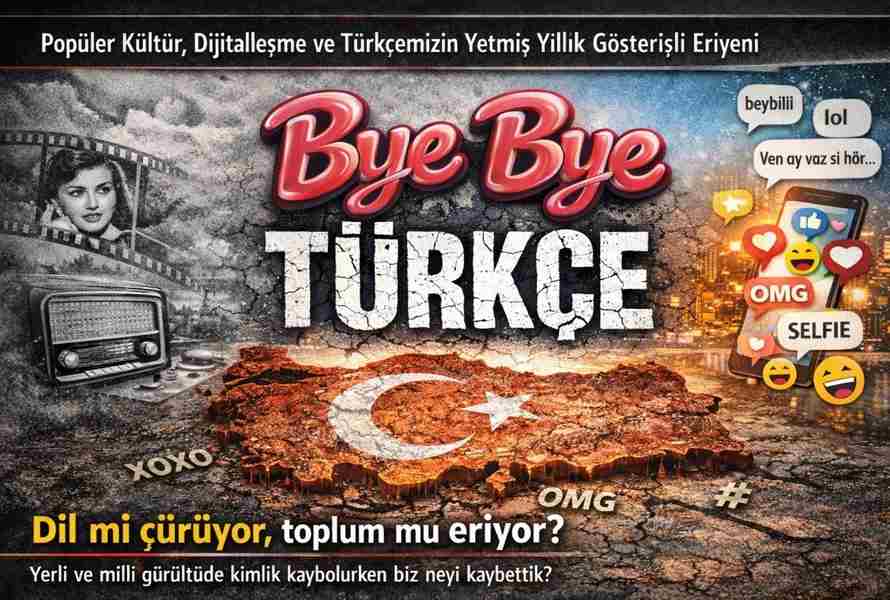
 Seventy years... The adventure of a language cannot be measured only by the change of words. Language is an invisible constitution that carries the aesthetic criteria, ethical values, thinking reflexes and cultural memory of a nation. The period from 1950 to 2025 shows not only the transformation of Turkish, but also how Turkey's mental, cultural and political map was redrawn. Turkish has experienced a dramatic journey from the romantic sentences of Yeşilçam to the measured tone of TRT announcers, from neighborhood conversations to university lecture halls, from social media meme language to political slogan economy. This journey is the story not only of language but also of society's capacity to construct meaning.
Today, everything in Turkey can be domestic and national: domestic automobile, domestic defense industry, domestic energy, domestic energy, domestic TV series, domestic technology, domestic investment... But the language is increasingly being dragged into an imported speed, vanity and superficiality. Once upon a time “May your evenings be auspicious” replaced by delicacy “beybiii offff” aesthetics. While national identity is loudly defended, the language that carries that identity is quietly unraveling. Turkey is at risk of losing its words while protecting its flag.
In the 1950s, greetings were not just a courtesy, but a social ritual. “May your evenings be auspicious” sentence was an indication of the aesthetic bond that the individual establishes with society. TRT announcers did not just convey words, they represented them. Speaking was not a performance but a responsibility. Language was the carrier of modernization. Mustafa Kemal Atatürk's language reform was not just a change of letters, but a project to modernize the way of thinking. This is why Oktay Sinanoğlu's warning years later was meaningful: Language is the house of science and thought. If the house shrinks, the mind shrinks.
Between 1960 and 1980, Yeşilçam was the emotional laboratory of Turkish. The sentences used in the movies were not just dramatic lines; they built the emotional and aesthetic memory of the society. “Please, don't leave me” Sentences such as these engraved the rhythm and melody of Turkish into social memory. Radio announcers were choosing words meticulously and processing Turkish almost like music. At that time, language was the carrier of both modernization and cultural continuity.
After 1980, Turkey liberalized not only economically but also linguistically. Private radios, advertising culture and popular music accelerated Turkishization. “Enjoy the conditions, check it out, son, we'll be in trouble” such hybrid expressions were not just youth jargon; they heralded the structural breakdown of language. Globalization accelerated words, but diluted meaning. Language began to produce individual visibility rather than social belonging.
With the 2000s, social media transformed Turkish into a language of performance. “Ven ay vaz si hör, so I'm very surprised” ironic expressions such as "I'm not a meme" have relegated meaning to the background. Meme culture made language entertaining while at the same time reducing the intensity of thought. Language has become a tool for attracting attention rather than a space for producing concepts. Communication has increased in Turkey, but narrative has weakened.
The post-2015 period has been the most complex phase of Turkish. Greetings still exist: “Peace be upon you, praise be to God.” But a cultural irony immediately follows: “Bye bye Turkish.” This expression symbolizes not only a loss of language, but also the erosion of collective memory, aesthetic sensitivity and depth of thought.
However, the issue is not only a natural consequence of digitalization. In Turkey, the evaporation of language has been systematically condoned. As language withdrew from public life, thought withdrew from the public sphere. If slogans, not words, speak in Turkey today, this is not a coincidence; it is one of the most effective methods of producing a manageable society. Because as language becomes more complex, thought deepens. As thought deepens, those in power become uncomfortable. For this reason, simplification, not simplification, has been encouraged.
Today's political language is used not to explain but to align. “Local and national”, “survival”, “will of the nation”, “foreign powers” Concepts such as these lose their meaning as they are repeated; they produce reflexes. The repeated word does not produce thought; it produces loyalty. Language that produces loyalty eliminates questioning.
The language of the opposition often fails to go beyond this narrow field. The same slogans, the same reactionary reflexes, the same repetition of concepts... Politics in Turkey has turned into a debate economy that does not produce words. Everyone talks, but no one says anything new.
The media is the accelerating stage of this process. Television debates do not generate ideas; they generate tension. Speakers cannot finish their sentences because the program format is based on shouting. Social media accelerates this process to turbo speed. Hashtag culture compresses thought into labels. Lynch culture turns language into a tool of punishment. It is no longer the one who says the most correct sentence, but the one who says the harshest sentence that wins.
Popular culture has transformed Turkish into a field of spectacle. Influencer language, digital jargon and English-Turkish hybrid expressions transform the structure of the language. “Cringe”, “like”, “story”, “random” expressions such as these are not mere word changes; they are semantic interventions that change the way thought is produced. Man thinks as much as the language he thinks in.
The education system accelerates this process instead of stabilizing it. Education in Turkey now teaches test solving, not concept generation. Memorized knowledge does not produce words. A generation that does not produce words does not question; it only reacts. This is why young people in Turkey can communicate, but have difficulty in constructing intellectual narratives.
The language of the state has not been simplified, but narrowed. Bureaucratic texts have moved away from being explanatory and have approached a propaganda tone. When the state language narrows, public reason narrows as well. Because state language determines the limits of public thinking.
There is a direct relationship between language and democracy. Democracy is a regime of debate. Discussion requires words. When the variety of words decreases, the variety of options decreases. When there are fewer options, democracy becomes formal. This is one of the deepest reasons for polarization in Turkey. People lack the conceptual tools to understand different ideas. Therefore, debate does not produce dialog, it produces fronts.
A tragicomic picture emerges here. While defending national identity, politicians in Turkey are watching the language that carries that identity dissolve. Politicians at the rostrum “national values” While he emphasizes nationalism, most of his speeches consist of slogans. It is as if nationalism is practiced through word saving. While the flag grows, the dictionary shrinks.
Today in Turkey, everyone talks. Politicians talk. Commentators talk. Social media talks. Influencers talk. But Turkey's real crisis is not a crisis of talk; it is a crisis of meaning. Because when meaning is lost, discussion is lost. When discussion is lost, society does not shut up; it shouts louder.
Language does not die suddenly one day. First it loses its refinement. Then it loses its aesthetics. Then it loses its concepts. Finally it loses its meaning. And the language that loses its meaning becomes the most widely used language. Turkey stands at this threshold today.
Defending Turkish is not to bless the past. Defending Turkish is defending the future. Because language is not only a means of communication; it is the thinking system of a nation. A society that loses its language loses its culture. A society that loses its culture loses its politics. And a society that loses its politics turns its destiny into a text written by others.
Today, Turkey's greatest need is a new language consciousness as much as a new economic model. Because thought cannot recover without language recovery. Politics cannot recover without the recovery of thought. Society cannot recover without the recovery of politics.
“Bye bye Turkish” is easy to say.
The difficult thing is to have the courage to recall the words.