




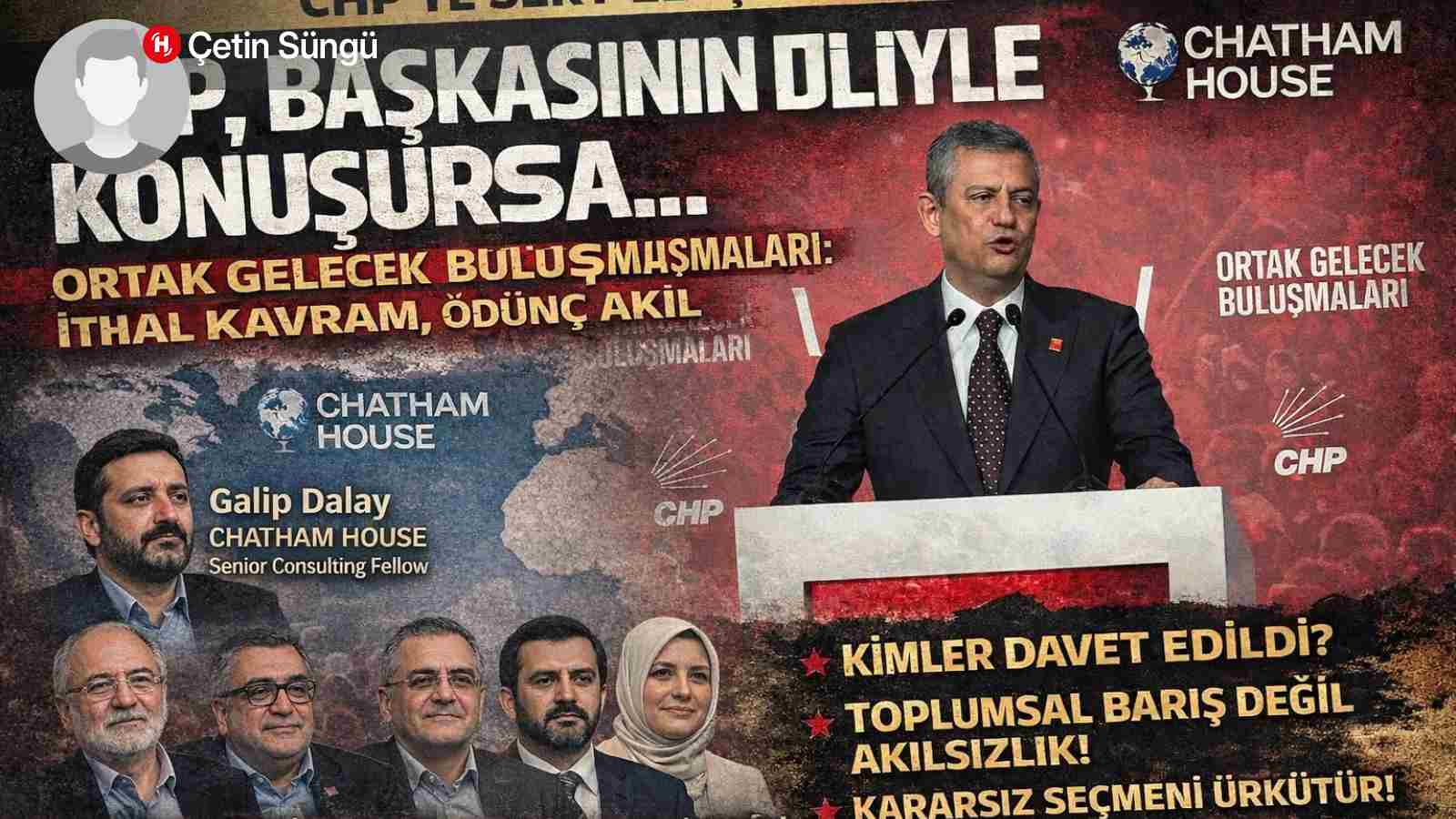
 Republican People's Party, “Common Future Meetings: Democracy and Social Peace Conference” the Kurdish issue, one of Turkey's most sensitive political issues, at a meeting organized under the title "Kurdish Question". CHP Chairman Özgür Özel gave the opening speech of the conference. However, the language used in the first parts of the speech revealed that the conference, regardless of its content, contained serious political problems.
At this point, the content has not yet been discussed, The language itself has produced a political position. This is not a momentary accident of expression, but a natural consequence of the political line adopted by the CHP leadership in the recent period.
These problems are not about intention. This text does not read intentions. The problem is the words used, the concepts preferred and the weight they carry in Turkish politics. In Turkey, sometimes a single word can produce more serious political consequences than a ten-page program.
This is precisely why it is not a matter of personal fault, political intuition and reason is an issue. In a state-building party like the CHP, words are not individual, corporate responsibility overflowing.
The phrase “common homeland of Turks and Kurds” in Özgür Özel's speech, although at first glance presented as inclusive, is in clear tension with the constitutional and founding framework of the Republic of Turkey. The Constitution of the Republic of Turkey is based on the principles of “one and indivisible homeland”, “one state” and “equal citizenship”. The homeland is a legal and political whole; it is not an area that is opened to partnership, shared or negotiated.
The point to underline here is this:
This expression is not borrowed from the CHP's own political heritage, but from another political literature.
“Common homeland” Statement:
- It makes the homeland no longer a legal bond,
- It makes the bond of citizenship vague,
- It makes the principle of a unitary state questionable.
This expression is not new. It is part of a terminology that has been used for years in DEM Party circles and the Abdullah Öcalan line. The CHP's use of this language, regardless of its intentions, takes the party out of its own founding political ground and into someone else's conceptual field. In politics, borrowed concepts do not strengthen the borrower.
The problem here is not only the word used; The CHP leadership does not see this word as a problem. And this is “change” the party's political reflexes have been blunted.
In the same speech “It is necessary to destroy the perception that all Kurds are terrorists” This statement also points to a separate problem. In Turkey “all Kurds are terrorists” There is no widespread, institutionally and socially dominant perception that the marginal discourses are the center of social peace. Putting marginal discourses at the center does not produce social peace. On the contrary, “so there is such a perception” by creating the feeling of a new problem area.
At this point, the language of defense turns into a means of generating problems, not solutions. By centering on an accusation that does not exist, the CHP is creating a new ground for debate.
The defense reflex in politics often produces the problem itself. Constant defense against a non-existent accusation does not strengthen social peace; it generates distrust.
A state-building party has a permanent “we don't say that” speaking in tongues, loss of political self-confidence is a clear indication.
A clear observation must be made at this point: The conference does not mean that the choice made on behalf of the CHP was the right one. What we are facing here is not a conspiracy but a lack of strategic wisdom.
And this lack of strategic wisdom is not individual; is managerial. The “changeist” cadre running the CHP has deliberately and willingly preferred this language.
The mistake made at the very first step of the conference was the following: Turkey's structural political and social problems were addressed through a language centered on identity and perception, rather than on a legal and class basis. This choice rendered the grounds for all subsequent discussions problematic.
Every discussion from this point on will be the natural consequence of this false start.
Concepts and Cadres: Whose Language Did CHP Speak?
The problematic aspect of the conference is not limited to the statements used in the opening speech. The real issue is the conceptual framework that pervades the entire conference and the circles in which this framework is produced. It is not so much what a political meeting says, but what concepts it speaks with and whom it puts at the center that is decisive.
It is precisely at this point that the preferences of the CHP leadership become visible. Because concepts are not chosen at random; concepts, on whose behalf you do politics it's a dead giveaway.
“common future”, “common homeland”, “destruction of perceptions”, “recognition of identities”, “confrontation of the state” Such concepts are not neutral in Turkish politics. These concepts have long been part of the terminology used by a certain political line - primarily the DEM Party circles. When the CHP uses this language not with a critical distance but by appropriating it, it distances itself from its own historical and constitutional ground.
The critical point here is this:
This language is not the language of the CHP base. This language is not the CHP's march to power; the ideological transformation of the party is the language of a minority mind.
Instead of defending the equality of Kurdish citizens, the CHP has constructed a language that normalizes someone else's political narrative. However, equal citizenship is not achieved through the redefinition of identities, but through the equal application of the law to all.
This distinction is particularly important. Because the CHP leadership deliberately blurs the distinction between the defense of equal citizenship and identity politics. This ambiguity is not a mistake; is a strategic choice.
This conceptual choice becomes even more evident when considered together with the profile of the participants of the conference.
Mainly in the living room:
- Academic circles,
- NGO representatives,
- Names working on identity, perception and confrontation
took place.
This preference is not for the wider society; speaking to a narrow intellectual circle is a conscious result of its will.
On the other hand, there were notable shortcomings:
- Constitutional lawyers who openly defend the unitary state perspective,
- Experts working on the security-law balance,
- Actors representing the welfare state, poverty and class inequality,
- Names that have sociological resonance with the CHP's center electorate.
CHP members of the National Solidarity, Fraternity and Democracy Commission of the Grand National Assembly of Turkey deliberately did not take part in this conference.
Because:
The language of the conference was not legal and constitutional, but identity-perception centered.
“Common homeland”, “equal citizenship” They did not want to sign up to such vague and risky concepts.
They avoided giving indirect legitimacy to the debate on unitary structure and citizenship.
They distanced themselves from the change-liberal line within the CHP.
So their absence is not a lack;
It is a conscious political message that shows the divergence within the CHP.
These shortcomings are no coincidence. Because when these topics are discussed, identity politics collapses, imported concepts lose their meaning and the CHP is reborn. on its own ground it's back. It is clear that this is precisely what the administration does not want.
This picture shows that the conference was not a “peace platform” addressed to the entire society; it was an echo chamber in which a narrow intellectual circle spoke to itself. For large segments of society, this meeting gave the appearance of an event that was “about us but not ours”.
At this point, there is no longer an implication, but a concrete fact: Galip Dalay was among the conference participants. Dalay is also a Senior Consulting Fellow at Chatham House. This detail is important. Because the language and framework used throughout the conference almost exactly overlaps with the “conflict resolution” literature of Chatham House and similar Western-based think tanks.
It is not about the existence of a single person. It is about, It is the mentality that the CHP leadership references. Whether the institution is there institutionally or not is secondary; the language is there, the mentality is there. Turkey's historical, constitutional and political reality has been translated into an imported peace dictionary.
This approach does not produce solutions in Turkey. It offers imported prescriptions for domestic problems. It technicalizes and depoliticizes concrete political crises by translating them into the language of identity and perception. The result is not peace but new insecurities.
As a natural continuation of this conceptual line, Ekrem İmamoğlu, who sent a message to the conference, made the following statement:
“Let's pave the way for the teaching of Kurdish language and Kurdish history in our schools.”
This sentence is not an innocent defense of cultural rights. It is a politically highly problematic and dangerous framework. Because the issue here is not freedom to learn a language, but the redefinition of the education system based on ethnic identities.
İmamoğlu's message clearly reveals the political horizon of the “changeist” line within the CHP. This horizon does not aim to produce a common citizenship; segregating public space according to identities normalizes.
The public education system of the Republic exists to bring Turks, Kurds, Alevis and Sunnis together on the same citizenship ground. Transforming schools into carriers of ethnic identities under the name of “social peace” does not produce peace; it institutionalizes segregation.
The question to be asked is this:
- If Kurdish is to be taught, which ethnic group's history will be included in the curriculum tomorrow?
- Will education produce a common citizenship or a catalog of identities?
The real peace is when children grow up in the same classroom, in the same curriculum, as citizens with the same rights.
The CHP's task is not to compete with the identity politics that the AKP has been practicing for years, but to produce a republican, egalitarian alternative to it. However, instead of producing this alternative, the current administration prefers to navigate the fault lines opened by the AKP.
This statement is not a solution; it is the opposition's walking on the fault lines opened by the AKP.
Social peace is not based on ethnic topics, but on justice, equal citizenship and secular public education.
The Language of Defense, Political Consequences and Who Did This Conference Benefit?
The basic tone of the conference as a whole was more about finding solutions self-defense reflex in politics. This is always a weak position in politics. Because the language of defense often makes a non-existent accusation visible and debatable.
This state of defense is in line with the CHP leadership's recent crisis of self-confidence is a clear indication. If a state-building party falls into a defensive position from the start, the problem is not in the arguments used; is capable of building politics.
Statements such as “misperceptions”, “unfair generalizations” and “not all Kurds are terrorists”, which were repeated throughout the conference, brought a widespread and non-institutional perception to the center. This approach does not protect the Kurdish citizen; it does not strengthen social peace. On the contrary, it creates a new area of suspicion by generating the feeling of “so there is such an accusation”.
What is being defended here has itself created the need for defense. The CHP leadership, by constantly pronouncing an accusation that does not exist, by his own hand has produced a new political problem area.
In politics, sometimes what you stand for makes a non-existent problem real. This is exactly what the CHP did at this conference. When a state-building party has to constantly explain and justify itself, there is a loss of political self-confidence.
This defensive language has pushed the CHP into the following position:
- Not setting the agenda, but responding to the agenda,
- Not the one who sets the word, but the one who explains it,
- The image of a party that does not speak from the center but tries to position itself.
This is a grave contradiction for an administration that set out with the claim of “change”. Those who came with the promise of change, It has pushed the CHP further away from the center.
The critical question to ask at this point is this:
What did this conference bring to the CHP?
The answer is clear:
It did not win votes.
On the contrary, it clearly and predictably benefited other actors.
This language and framework is most Justice and Development Party and Nationalist Movement Party for the Turkish government.
The framework that the ruling bloc has had ready for years has been strengthened again:
“The economy may be bad.
Life can be expensive.
But if they come, the state will be discussed.”
With this conference, the CHP leadership is trying to prevent this game that the government has been trying to set up for years. personally staged it. The economy, poverty, justice and the cost of living have fallen off the agenda, replaced by debates on the state, the homeland and the unitary structure.
The fate of elections in Turkey is often decided at this point. Even if undecided voters are overwhelmed by the economic squeeze, they will withdraw at the last moment out of fear that “the state is getting out of hand”. What the CHP is doing with this conference is to reinforce this politics of fear. feed with one's own hand has been.
This outcome is not a misunderstanding. It is a predictable political outcome. For anyone with a political memory of Turkey, this picture is not surprising. Nevertheless, repeating the same lines is not a question of good intentions; lack of political intuition that it is.
Here Özgür Özel's personal responsibility it starts openly. Leadership in Turkey is not about talking long. It is choosing the right word. Sometimes a single word can lose an election. Phrases like “common homeland” are not technical in this country; they are political. And they have political consequences.
This conference did not keep the CHP at the center; on the contrary, speaking in someone else's language to a position where the CHP would not be able to win the elections. This situation both frightened undecided voters and also put the CHP in a position of state founding party identity eroded.
Another important issue that accompanies this picture is the form of political participation in the conference. Commission members from the AKP and MHP were invited to the conference, but did not respond positively. Even if they agreed with the CHP on the PKK, they did not deem it appropriate to participate in an organization they did not organize.
However, the fact that they are together in the National Solidarity, Fraternity and Democracy Commission of the Grand National Assembly of Turkey does not mean that they are against the topics of the conference. This picture shows that different actors at different stages of the same political project that he is standing still.
No peace-themed event or discourse organized by a structure that cannot ensure peace within itself, let alone pursue enemy law, is sincere; nor will it ever be.
The question at this point is a tough but inevitable one:
Why did the CHP leadership so enthusiastically embrace a process that even Erdoğan distanced himself from?
In whose name is this hurry, this appetite, this “smug” excitement?
With so many parties on the right, the CHP thinks that it will win votes by imitation. However, undecided voters do not only consist of those who broke away from AKP and MHP. There is also a section that reacts against the CHP and resents its lack of principles. When those who point out this danger are called “nationalist minority”, history repeats itself.
Solidarity is not what is opposed. It is the CHP leadership politics prone to ethnicism and the party's captors liberal minority.
In this context Tuncer Bakırhan’s targeting of Lausanne with the words “a vicious circle that has been played out for 100 years” has further clarified the direction in which the political line is being carried out.
Furthermore, the fact that the “Equal Citizenship” conference organized by the CHP was closed to the press, and only the opening speech was open to the press, indicates that this process not transparency, but controlled perception generation through the "socialist" movement.
Citizens are already equal according to the Constitution. Get into power, put it into practice. If what is meant here is “equal citizenship”, it is the definition of two separate citizenships and the envisioning of a state with two structures/components and two nations. In other words, it is to divide. The unitary structure seems to be the target. This is in line with the CHP's historical mission and vision. is a clear contradiction.
The problem of political legitimacy is clear
No Turkish flag.
There is no portrait of Atatürk.
There is no national anthem.
The meeting is closed to the press and citizens.
This is not a detail.
Any claim of “social peace” that consciously excludes the founding symbols of the Republic generates suspicion, not peace.
A meeting that is not open, not transparent, stripped of its symbols does not unite society; it alienates it.
Then the question is clear:
What is the CHP up to?
A conference organized on such a critical, historical and constitutional issue Only 15 deputies from the CHP Parliamentary Group attended, this work within the party that it does not have broad ownership shows.
Such a limited attendance among hundreds of deputies, old and new executives and staff makes it difficult for the conference to gain traction with the CHP. weak representative power that the world is a place of peace and prosperity.
More importantly, for this conference No binding decision has been taken by the CHP Central Executive Committee (MYK). An activity without a decision of the FMC:
It does not bind the party program,
It does not generate the authority to speak on behalf of the party,
Every word spoken personal opinion level.
This shows that the conference is not “party policy” but the initiative of a narrow cadre.
Attempts to play politics without taking political responsibility
Such meetings, held without a decision of the FMC, point to a common but problematic method in politics:
“Circulating risky discourses without taking institutional responsibility.”
I mean:
If there is a backlash, they will say “it was not a party decision”,
If there is no reaction, it will be said, “This is the new language of the CHP”.
This approach is not political courage; is political illegal wrestling.
The split within the CHP has become visible
Considering the limited participation of 15 MPs and the absence of a decision by the MYK, the following fact becomes clear:
Within the CHP about the language and orientation of this conference serious discomfort and distance There are.
Not because those who remain silent approve; because they don't want to sign it's quiet.
This picture shows that the CHP does not act from a single center and with a common mind; that more than one political line is being pursued at the same time shows.
It is a vital topic like social peace:
15 MPs,
An organization without an FMC decision,
to the initiative of a narrow circle
cannot be left.
This method produces neither peace nor trust.
On the contrary:
It pulls the party into a controversial area,
It makes responsibility ambiguous,
CHP is not institutionalized, disorganized shows.
The main problem of this conference is not only what was said It isn't; on whose behalf and with what authority.
And this question remains unanswered.
How to get out of this line?
At this point, the issue is no longer criticism. The issue is how to limit the political damage and how to get out of this line. A comeback is still possible for the CHP. But this is neither by apologizing nor by denying what has been done. What is needed is is a change of language and framework.
The fact that needs to be underlined here is this:
The CHP's crisis is not a communication crisis, but a crisis of direction. Wrong words are the natural consequence of wrong direction.
The axis that the CHP needs to return to is clear:
- Constitutional citizenship, not identity politics
- The rule of law, not ethnic accentuations
- Equality and social justice, not perception management
- Not imported peace language, but domestic and genuine political reason
These articles are not a “turnaround”, they are the CHP's reconnect with its founding identity means. This is exactly what the CHP leadership is failing to do today.
Social peace is not achieved by redefining identities, but by the state standing at an equal distance to all citizens. Peace is not achieved with defense phrases; with clarity and confidence is established.
The current CHP leadership, however, deliberately avoids clarity. Because clarity dissolves loose alliances built on identity politics and dissolves the discourse built with imported concepts.
The sentence the CHP should say is not complicated. On the contrary, it is extremely simple:
“The Republic of Turkey has only one homeland.
All citizens of this homeland are equal, regardless of their origin.
The state conducts the fight against terrorism within the law.
Citizenship cannot be discussed on the basis of ethnic identities.”
Every word uttered in the name of “social peace” by a CHP that cannot form these sentences incomplete, vague and problematic will remain.
This language:
- Does not put the unitary state up for discussion
- Kurdish citizens are not excluded
- Will not scare swing voters
- Moves the CHP back to the center party position
The main mistake made so far is the systematic blurring of the distinction between defending the equality of the Kurdish citizen and engaging in identity politics. These two are not the same thing. Equal citizenship, not identity politics; defended by law.
Individual responsibilities are now also clear here.
Problem for Özgür Özel is a lack of political intuition. In a country like Turkey, with its heavy historical burdens and harsh concepts, leadership is not about long speeches; is not to use the wrong word at all. Because in this country sometimes a single word can lose an election.
Likewise, the problem for Ekrem İmamoğlu and the “changeist” cadre around him political orientation. This orientation prioritizes transforming the CHP, not bringing it to power. For this reason, discourse, not the ballot box, concepts, not society, and reports, not voters, are at the center.
This conference is not about how the CHP will build social peace; how to make it harder has shown. Good intentions do not produce political results when combined with the wrong ground. Turkey cannot be governed with think-tank reports, imported concepts and borrowed wisdom.
Social peace:
- Not with abstract peace phrases
- Not with identity assertions
- Not with academic echo chambers
constitutional citizenship.
And the final sentence is this:
As long as the CHP speaks someone else's language, it cannot appeal to its own voters.
- This conference will not win CHP votes
- Spooks swing voters
- It strengthens the ruling bloc's propaganda of “the state is getting out of hand”
- Puts the CHP in a position of speaking someone else's language
But:
- This error is not irreversible
- Damage can be controlled
- With the right language and the right framework, political ground can be re-established
The condition is this:
The CHP must make a decisive break with identity-centered, imported and defensive language.
If the CHP insists on this line, what it will lose is not just an election. What it will lose is its historical legitimacy, its claim to be the center party and its capacity to hold society together.
Social peace is not built with good intentions but with the right political mind.
And only when it speaks its own language, the CHP can once again become an alternative to power.