




 The main point underlined by musicology and folklore studies is this:
A folk song is not the product of an individual moment of inspiration. An emotion or an event is transformed into a melody as it is told and sung in society.
What makes this birth possible is that the emotion generated by the event is felt, owned and repeated by others.
This country has seen much, suffered much.
Cities were destroyed by earthquakes; hundreds of thousands of our people were killed and maimed. We watched the news that people trapped underground in mine collapses could not be pulled out for days. We have seen economic crises, witnessed occupational homicides, been shaken by terrorism, and experienced pandemics.
Life got heavier at different times and in different ways.
But not every experience turned into a pain that left a mark, or the bond we formed was short-lived.
In the past, emotions were experienced together in more closed and small groups of people. People stood side by side, shared time, talked and remembered together. That's why folk songs were not only about pain, but also about laughing together, making fun, daily labor and coping with life.
Here is one of the best examples of this difference “Yemen Song”dür.
Tens of thousands of Anatolian youth sent to the Yemen fronts in the early 1900s did not return. The real pain was that there was no news of those who had left. Months and years of waiting ensued; mothers asked the same question on doorsteps, houses asked the same question at the stove: ’Is there any news?“ This waiting was not confined to a single house, but spread across a whole society, village by village, town by town. This prolonged, shared and embraced pain was articulated in the mouths of a community, not an individual, and turned into a folk song:
“How unfortunate are the hands of Yemen / I wonder why the one who is not coming is not coming.”
Folk songs are not only born from pain; they are also born from shared situations and common experiences.
One of the most well-known examples of this is “Üsküdar'a Gider İken (My Clerk)” is a folk song. In 19th-century Istanbul, everyday life on the roads of Üsküdar - the journeys of chairs, the crowds at the bazaar, young people teasing each other - turned into a folk song as the same scenes were repeatedly experienced and sung by different people.
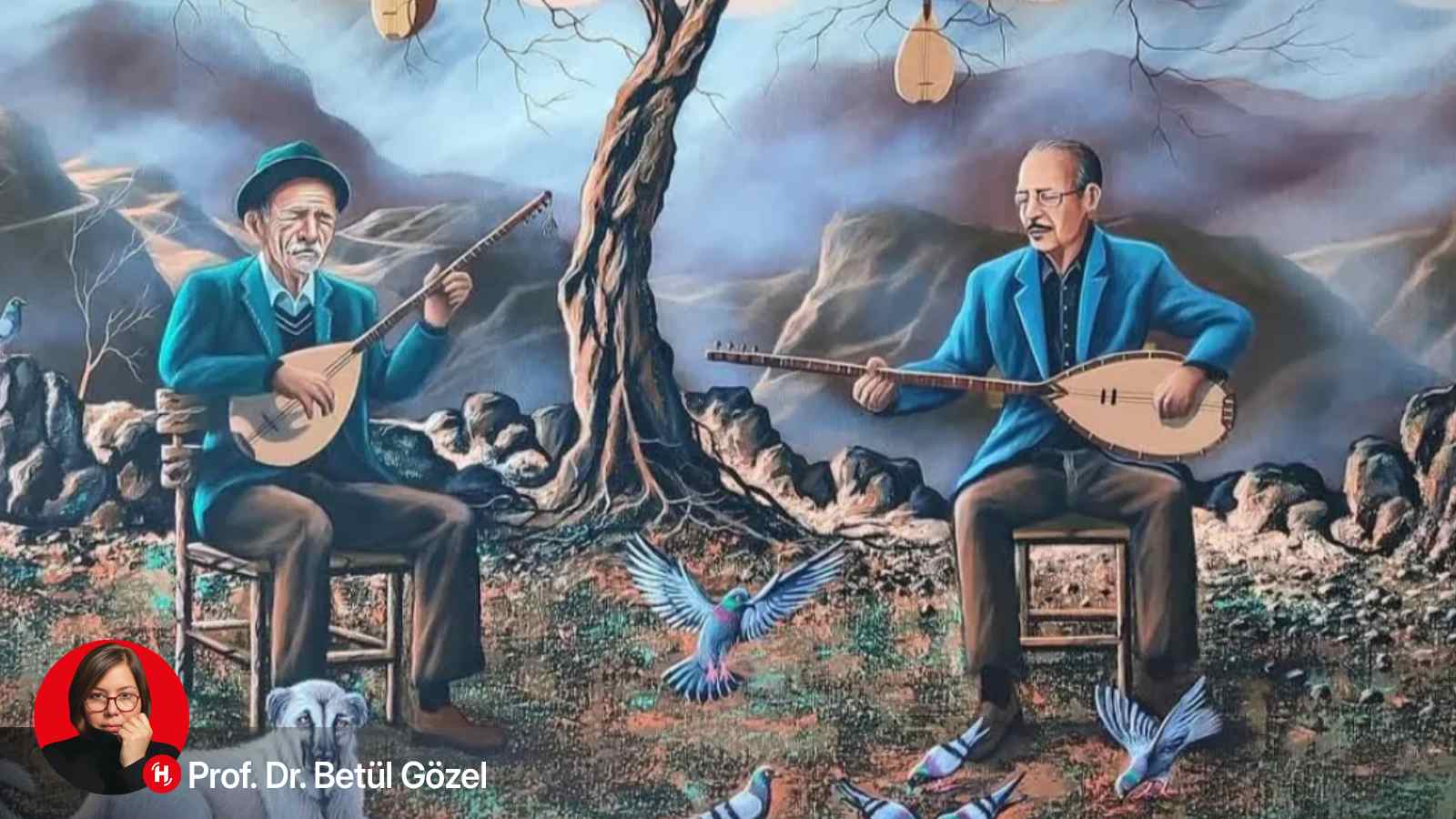
Master Violinist Tahir, considered the memory of Aegean folk songs, is my mother's uncle. He is the oldest known source person of Kerimoğlu Zeybeeg; Forester, Adem Gardeş and In the Midst of the Buying He is also the person who created the lyrics and music of our folk songs. If these folk songs are still alive today, it is because the people can find themselves in these words and melodies.
Today we are side by side, but everyone is in their own inner world. Most of the time this is not a choice; it is a state imposed by the age. As societies have become more crowded, life has accelerated; workload and responsibilities have increased. Living, holding on, surviving has become an effort in itself. As this intensity has increased, the space for common feelings has shrunk.
Another change has occurred in the speed at which emotions circulate. Through social media, we encounter thousands of sufferings and events every day. This makes pain visible, but it also makes it quickly consumable. Before one pain can find its place, a new one arrives; the previous one is pushed back without realizing it. Thus, pain leaves no trace not because it is neglected, but because it does not have the opportunity to accumulate and brew.
Folk song is the sound of experiences that leave a mark and are carried together.
That is why folk songs are not just melodies. They are the memory of a society.
It shows how he remembers his experiences, what he laughs at, what he mourns.
It is a common consciousness, a common history, common feelings.
So protect the folk songs.
Remember Ruhi Su, Neşet Ertaş, Özay Gönlüm, Talip Özkan.
And remember the last representatives, whose names I cannot write here, who were the voice of a generation and carried the tradition of folk songs.
Because they did not sing folk songs; they shouldered the memory of this society. They left a history, not a melody.